Researcher working on conflict prevention, diplomacy, peacekeeping and the United Nations, with a focus on the Horn of Africa. Associate, German Institute for International and Security Affairs (SWP).
Contribution in: Claudia Zilla (ed.), Feminist Foreign and Development Policy in Practice. Requirements and Potentials, SWP Research Paper 2024/RP 09, 21.06.2024, doi:10.18449/2024RP09
Stabilisation in fragile contexts poses a particular challenge for feminist foreign policy (FFP). The declared aim of stabilisation is to make constructive contributions to conflict resolution even in the most difficult situations of violent conflict and terrorist threats. This often means working with and within the existing local power structures in order to achieve short-term and pragmatic improvements in the security situation.1 In contrast, it is the essence of feminist approaches to foreign and development policy to critically examine patriarchal, neo-colonial and other power structures, and to strive for a transformation of social conditions.
The feminist critique of international efforts towards stabilisation problematises various aspects. Against the backdrop of a post-colonial perspective, it addresses the motives of those external actors who strive for stabilisation in other parts of the world. The rhetorical commitment to peace, democracy and human rights obscures unilaterally defined national interests, such as the containment of irregular migration.2 There are also questions concerning whose security should be at the forefront of stabilisation projects if they rely on cooperation with patriarchal, exploitative local elites, whose struggle for dominance is responsible for violent conflicts.3 Gender roles and the safety concerns of women and other marginalised groups may be overlooked, despite goals to the contrary. Furthermore, feminist activists warn of a militarisation of the humanitarian space by linking the political goals of conflict management too closely with humanitarian support.4 The state-centric nature of stabilisation approaches is also worthy of discussion from a feminist perspective, as it is often the state that perpetrates violence, for example by deploying abusive security forces instead of protecting women and the civilian population in general.
The status quo in German stabilisation policy
Since 2017, Germany has been the world’s largest donor country in the field of civil conflict transformation.5 In 2024, the Federal Foreign Office (FFO) had €400 million at its disposal for the three pillars of its integrated peace engagement: crisis prevention, stabilisation and peacebuilding.6 Other departments, in particular the Federal Ministry for Economic Cooperation and Development (BMZ), also support projects that serve stabilisation in fragile contexts in a broader sense. According to the Organisation for Economic Co-operation and Development (OECD), the Federal Government’s somewhat broader global expenditure on “civilian peacebuilding, conflict prevention and resolution” totalled US$960 million (around €875 million) in the last reporting year of 2022.7
Only the FFO uses the term “stabilisation” in the German context. It understands it as a contribution to “support political processes to contain violence, strengthen legitimate governance structures and facilitate initial steps towards reconciliation between conflict parties”.8 Stabilisation includes a range of instruments such as strengthening state institutions; security sector reform (SSR); disarmament, demobilisation and reintegration (DDR) programmes; rule of law; and peace mediation.9 Important partner countries and regions that the FFO repeatedly mentions are Ukraine, the Lake Chad region and north-eastern Syria. The German government often works together with other donors and international organisations, for example within the framework of the stabilisation facilities of the United Nations Development Programme.
Gender issues have long played a role in German peace work.
Gender issues have long played a role in German peace work. The National Action Plan for the implementation of the “Women, Peace and Security” agenda is an expression of this.10 In its guidelines on FFP, the Federal Foreign Office mentions stabilisation in the second guideline: “We systematically include women and marginalised groups in crisis Prevention, stabilisation and peacebuilding measures and take into account gender-specific risks. We want to achieve progress towards more gender-equitable societies and design our international crisis management to be gender transformative.”11
Specifically, the FFO primarily mentions projects to expand the rights, resources and representation of women (e.g. the training and deployment of “gender experts” by the Center for International Peace Operations (ZIF)).12 In its efforts to improve the position of women and marginalised groups, the FFO thus continues to operate within the existing system of conflict resolution without fundamentally questioning its own approaches. However, the impact of experts trained in gender transformation remains limited if there is a lack of political will to embed the resulting viewpoints and perspectives within a more comprehensive strategy.
Although both the FFP guidelines and the stabilisation concept of the FFO contain feminist principles that go beyond the 3Rs (rights, representation and resources), their practical significance is also sometimes limited. One example: The stabilisation concept aims to use “gender-sensitive conflict analyses” to “help identify new approaches, scope for action and actors”. However, “conflicting goals” exist, especially where “male-dominated power players” need to be involved. Here, the FFO intends to present its principled position and “systematically weigh up short-term goals (e.g. a ceasefire) with medium- to long-term goals of societal transformation”.13 This statement could suggest that gender justice is a medium- to long-term task that stands in contrast to other stabilisation goals. However, the quoted paragraph also shows that the FFO explicitly acknowledges tensions between the goals of stabilisation and FFP, and that it at least makes an attempt to systematise its approach in critical situations. This is a step forward compared to earlier government documents, in which normative goals were given equal status and trade-offs were simply mentioned in abstract terms without specifying solutions.
In terms of resources made available for gender equality, German expenditure has fluctuated greatly in recent years. In the last reporting year of 2022, 50 per cent of official development assistance funds14 for civil conflict transformation were used for projects that pursue gender equality as a significant objective (score 1 of the OECD Development Assistance Committee) and 2.8 per cent for those with gender equality as the principal objective (score 2). By 2025, the FFO would like to achieve a funding level of 85 and 8 per cent, respectively, for these categories.15 Contrary to the corresponding equation of these indicators in the FFO guidelines, they are not congruent with the objectives of a gender-sensitive or gender-transformative design. For example, a project can be aimed at women as the main target group (score 2) without questioning gender relations per se.
Some power-critical approaches of feminist research can be particularly beneficial for stabilisation projects.
Possible contributions of feminist foreign policy
A critically defined FFP can contribute to making stabilisation measures more effective, more resilient and more inclusive than before. It offers points of reference, assumptions, concepts and approaches that are already being discussed among stabilisation experts in order to examine previous practices in more detail and, in some cases, to find new answers. Some power-critical approaches of feminist research can be particularly beneficial for stabilisation projects.
FFP can help overcome one-sided liberal peacebuilding
Both in feminist research and in research on stabilisation and peacebuilding, there is widespread criticism of “liberal peace”, that is, the idea that market reforms, a democratic opening and the resolution of armed conflicts are always mutually supportive.16 The focus on such long-term processes marginalises the agency of civil society,17 the political economy of the violence of wars18 and the mechanisms of exclusion that affect women in particular,19 to name just a few points of criticism.
The FFP perspective helps to identify structural aspects that lead to the continuation of violence. The one-sidedness of liberal peacebuilding can also be seen in the 3Rs in the context of peace processes: Involving women (representation), expanding their (nominal) rights by changing legislation or funding institutions with a high proportion of women (resources) is important, but it is not enough. Women’s groups might be involved in peace processes despite their concerns not being taken into account. Oftentimes not even the agreed representation quotas are met. For example, the Juba Peace Agreement of 2020 stipulated a women’s quota of 40 per cent at all political levels in Sudan.20 This was never realised: The implementation of the peace agreement, on the other hand, strengthened the male-dominated security sector in Sudan and exacerbated the political crisis before the coup.21
An intersectional approach that combines feminist and post-colonial perspectives raises the question for whom and what should actually be stabilised. External actors can only successfully pursue stabilisation if they support local efforts by legitimate authorities. The relationship between state institutions and the population is often fractured in fragile situations. State security forces in Nigeria, for example, sealed off villages because they suspected that insurgents were there; this was done instead of protecting the civilian population from looting and forced recruitment by armed groups such as Boko Haram. It is therefore the declared aim of German stabilisation efforts in north-eastern Nigeria to strengthen the legitimacy of state institutions, for example by enabling communities to secure the supply of basic goods and services such as water, food, health and education.22 The feminist perspective helps to recognise that state institutions can only successfully implement stabilisation efforts if the population accepts them as legitimate.
Analysis of power and security
Stabilisation projects require a continuous context and conflict analysis that takes account of the causes, actors and dynamics of armed violence. As experts in power-critical analyses, feminists can make decisive contributions. Gender-sensitive conflict analyses23 can reveal key dynamics that go far beyond the lack of participation of women. Moreover, some gender roles also contribute to violence,24 for example by making it easier for armed groups to recruit, as the FFO also mentions.25
A feminist understanding of security challenges the common assumptions of liberal stabilisation practices. All too often, international actors pursue agreements with (often male-dominated) elites, even if they do not demonstrably curb violence or improve the population’s sense of security.26 “Stability and durability can simply mean that the men with guns continue to run the show and that the ‘trains run on time’”, writes Ní Aoláin.27
Instead of clinging to the next fragile elite deal, a feminist stabilisation policy could measure security using the concrete perceptions of women and other marginalised population groups regarding their daily lives. Surveys of those affected and other methods of regularly recording the perceptions of the local population should become important instruments for stabilisation projects.28 Only when all people feel safe in a place can they develop trust in local institutions and refrain from joining armed groups.
A feminist approach to conflict resolution
FFP offers alternatives to the Realpolitik of elite deals and to excessive liberal interventionism as common approaches to conflict management. Such alternatives are based on a “feminist ethic of care”, which can be helpful in the search for new approaches to conflict resolution. It stems from “care” because it combines moral action with attentive, patient listening and is open to continually balancing conflicting goals and adapting assumptions – instead of propagating a universalistic justice that is defined by its supposed contrast from presumably backward-looking local ideas.29 This ethic is feminist because it questions the (authoritarian) “script of patriarchy”.30
Feminist stabilisation based on such an “ethic of care” does not come from outside to resolve local conflicts, but instead deals with the global, regional and local relationships in which these conflicts arise. It is not just about involving women more in political processes because they would be more peaceful per se, but about questioning the hierarchisation between groups – for example men and women, elites and the population, young and old people – and the modes of action attributed to them in society in general. Feminist stabilisation policy pays particular attention to the local context and accepts that the effectiveness and moral clarity of measures are often fraught with uncertainty.31
Self-reflection and learning processes
Finally, feminist approaches can make an important contribution to monitoring, evaluation and learning processes through empathic self-reflection. These are particularly important in highly volatile stabilisation contexts, which need to be managed closely in order to adapt projects to rapidly changing circumstances. In the absence of a universally applicable stabilisation strategy, the constant testing and adjustment of measures is crucial.32
FFP can help local and international stabilisation actors to reflect on all kinds of power structures as well as on their own roles. International stabilisation actors, for example, bring their own gender norms to fragile contexts and sometimes display an “international fraternity” with local male elites.33 For example, sometimes there are ambassadors who proudly refer to their relationship with the authoritarian president of their host country during a civil war and hug him at every opportunity. However, diplomats and other stabilisation actors should not confuse their required empathy in political processes with sympathy for warlords. In addition, from the view of FFP, the habitual rhetorical commitment of many stabilisation actors to cooperation with local organisations should also be taken seriously in practice – for example, by involving local grassroots organisations as early as possible in the design of projects.
FFP can provide a fresh approach, especially in contexts where it goes beyond the promotion of gender equality.
Conclusion
FFP helps to make stabilisation better, fairer and more context-sensitive by questioning traditional assumptions in the overall approach, analysis, processes, project design and impact assessment. In particular, it can provide a fresh approach, especially in contexts where it goes beyond the promotion of gender equality. With its FFP guidelines, the FFO still falls short in fully embracing the possibilities of a feminist approach. Feminist analyses reveal the unequal, often conflict-driven power structures that arise due to a lack of gender equality, but also the biased gender roles and mechanisms of exclusion along with other differentiating characteristics.
The further development and implementation of feminist efforts towards stabilisation is not just about normative human rights issues. Instead, the inclusion of feminist perspectives can also contribute to the pragmatic claim of stabilisation in fragile contexts34 – when it comes to placing empathy instead of arrogance at the centre of conflict management, for example.
It is in the nature of stabilisation to focus on the status quo because situations are almost impossible to change in the short term and restoring order is the priority. Diplomats also act according to this logic, which is an expression of an intergovernmental system that often finds it difficult to build sustainable partnerships in fragile contexts that extend beyond national governments that are often detached from their populations. Implementing aspects of feminist foreign and development policy that are critical of power is therefore no easy task. However, feminist arguments can encourage ongoing processes of reflection in the direction of stabilisation that is aimed at improving the relationship between the population and the government.
Neuer Einfluss in Afrika? Gerrit Kurtz über russische Marinebasen, die Rolle Moskaus im Bürgerkrieg im Sudan und deutsche Interessen am Roten Meer. (Quelle)
Die Russische Föderation verstärkt durch eine neue Marinebasis ihre Militärpräsenz am Roten Meer. Wie laut schallt die russische Nationalhymne künftig über dem Roten Meer?
Das müssen wir noch sehen. Wir dürfen nicht vergessen, dass die Einrichtung einer russischen Marinebasis am Roten Meer schon seit mehreren Jahren im Grundsatz vereinbart war, allerdings wurde diese Vereinbarung bisher nicht umgesetzt. Kürzlich bestätigte der russische Vize-Außenminister laufende Gespräche, ließ aber durchblicken, dass das Abkommen noch nicht final sei. Neben Sudan verhandelt Russland auch mit Eritrea über eine Präsenz am Roten Meer. Dort scheinen die Gespräche schon sehr viel weiter fortgeschritten als mit Sudan.
Was beinhaltet das Abkommen konkret, und was steht möglicherweise auch nur zwischen den Zeilen?
Diskutiert wurde zunächst nur eine kleinere Basis für logistische Zwecke, die perspektivisch aber auch von der russischen Marine genutzt werden kann. Konkret sollen an dieser Basis bis zu 300 Soldaten stationiert werden und bis zu vier russische Militärschiffe andocken können. Dies war bereits seit längerem bekannt. Jetzt hat die sudanesische Seite als Gegenleistung für diese Basis neue Waffenlieferungen aus Russland ins Spiel gebracht, wenngleich dafür eine Bestätigung aus Moskau noch aussteht.
Die Ursprünge dieses Abkommens gehen ins Jahr 2017 zurück. Das Russland nahestehende sogenannte Afrikakorps hatte im Verlauf der aktuellen Auseinandersetzungen die Rapid Support Forces (RSF) unterstützt. Vollzieht Russland mit der neuen Kooperation jetzt einen Strategiewechsel im Sudan?
Auch vorher war schon deutlich geworden, dass Russland im Sudan ein doppeltes Spiel betreibt. Bereits vor rund einem Jahr waren führende Vertreter der sudanesischen De-facto-Regierung in Moskau und haben das Gespräch mit der russischen Führung gesucht. Der stellvertretende russische Außenminister war kürzlich in Port Sudan und hat sich dort sehr eindeutig auf die Seite der SAF, also der Armee, gestellt und mitgeteilt, dass Russland die aktuelle Regierung als die einzig legitime Regierung des Sudan anerkenne. Gegenstand der Gespräche war auch die Forderung der SAF nach einem Ende der Unterstützung des Afrikakorps für die RSF. Die russischen Vertreter haben dann die Existenz der ukrainischen Soldaten auf Seiten der SAF thematisiert. Bislang ist noch nicht klar, ob es tatsächlich zu einem Ende des Engagements des Afrikakorps im Sudan kommt.
Wenn es zu einer russischen Marinebasis käme, wäre dies dann ein Gamechanger für den innersudanesischen Konflikt? Kann man damit rechnen, dass die SAF mittelfristig die Oberhand gewinnt?
Damit würde ich nicht rechnen. Es wäre sicherlich ein Gamechanger, wenn das russische Militär selbst in den Konflikt eingreifen würde, so wie es das in Syrien seit dem Jahr 2015 getan hat. Danach sieht es momentan im Sudan nicht aus. Hier geht es vorrangig nur um die Lieferung von Waffen, von denen die Streitkräfte natürlich profitieren würden, aber am Ende braucht es nicht einfach nur bestimmte Waffentypen, sondern auch qualifiziertes Personal und taktische Fertigkeiten. An beidem mangelt es den Streitkräften bisher, um gegenüber den RSF wirklich Erfolge erzielen zu können. Von einem Gamechanger kann man daher bisher nicht sprechen.
Früher hieß es, Zentralasien sei das neue Great Game der internationalen Politik. Jetzt kann man den Eindruck gewinnen, am Roten Meer kulminierten die Interessen von sehr viel mehr Akteuren auf sehr engem Raum. Wie gefährlich wird das in Zukunft?
Ja, in der Tat. Auch über Sudan hinaus gibt es sehr viele Akteure, die sich gerade am Roten Meer konzentrieren. Die Angriffe der Houthis auf Handelsschiffe hatten Folgen, auch in militärischer Hinsicht, und führten zu einem stärkeren Engagement der US-Amerikaner und der Europäer. Es könnte noch weitere, anders gelagerte Auseinandersetzungen in der Region geben aufgrund der Bedeutung dieser geografischen Achse für den Handel zwischen Europa und Asien. Die direkten Anrainerstaaten wie Saudi-Arabien und Ägypten haben enorme Interessen, auf die andere Staaten wiederum reagieren müssen.
Sind deutsche außen- und sicherheitspolitische Interessen für die Region ausreichend definiert?
Deutschland hat am Roten Meer definierte Interessen. Dies zeigte sich deutlich an der zeitnahen Entsendung der Fregatte Hessen zum Schutz der maritimen Handelswege, die für Deutschland wichtig sind. Immerhin verfügt die Bundesmarine nur über drei solcher Schiffe. Eines davon für eine solche Mission abzustellen, und sei es nur zeitweise, ist definitiv ein commitment. Die Ergebnisse einer solchen Mission stehen immer auf einem anderen Blatt. Insgesamt bräuchte es sicherlich ein vertiefteres politisches Engagement in der Region mit einer stärkeren Schärfung unseres eigenen Interessenprofils.
Deutschland ist gerade stark mit Innenpolitik beschäftigt. Welche Bedeutung hat das für die Formulierung deutscher außen- und sicherheitspolitischer Interessen im Sudan und am Roten Meer?
Ich würde davon abraten, sich zu stark auf ein mögliches Abkommen für die Marinebasis zwischen Sudan und Russland zu konzentrieren. Der Krieg im Sudan ist an sich schon eine Bedrohung der internationalen Sicherheit und gleichermaßen eine humanitäre Katastrophe, die jeden Tag schlimmer wird. Dies ist die größte Vertreibungskrise der Welt und ich glaube, auch dort sind deutsche Interessen direkt betroffen. Deutschland hat ein Interesse an der Aufrechterhaltung einer regelbasierten Weltordnung. Zu diesen Regeln gehört auch das humanitäre Völkerrecht, gehören grundlegende Menschenrechte sowie der Zugang zu humanitärer Hilfe für Bedürftige. All dies wird im Sudan derzeit mit Füßen getreten.
Seit über einem Jahr tobt im Sudan ein brutaler Konflikt. Es handelt sich dabei um eine der grössten humanitären Krisen der Welt. Trotzdem bleibt der Krieg weitgehend ausserhalb des Blickfelds der internationalen Öffentlichkeit. Wie die militärische Lage derzeit aussieht, schildert der Sudan-Experte Gerrit Kurz.
War has raged in Sudan since April 2023 following fundamental changes in the political balance of power in recent years. The previously dominant security sector is deeply divided and the once weakly organised civil society has mobilised.
Competition within the security sector made it possible to form a civil-military transitional government. Yet the continued rise to power of the Rapid Support Forces increased the risk of armed conflict, especially after the coup in 2021.
Since Bashir’s fall in 2019, the security forces have twice tried in vain to establish sole military rule. The civil-military transitional government also failed because the military still had considerable power resources at its disposal. Sudan’s political elite contributed to this outcome by paying too little attention to the establishment of transitional institutions and too much attention to its own visibility.
International actors who wanted to strengthen Sudan’s transition process could have repelled the security forces more decisively instead of reflexively accepting them. Many international as well as Sudanese efforts suffered from the fact that they viewed the inclusion or exclusion of the security forces as a binary issue.
A new non-inclusive, elitist deal with Sudan’s violent entrepreneurs will not bring peace if there are no civilian forces at the table. Instead, Sudan’s best chance lies in the social capital of its citizens’ voluntary commitment to humanitarian aid, democracy and local reconciliation.
Reporting about the war in Sudan is clouded by three oversimplified narratives – “forgotten conflict”, “war of two generals” and the “proxy war” classification. Gerrit Kurtz (SWP) calls for a more nuanced phrasing by journalists and policymakers.
International reporting and political statements about the war in Sudan often echo three misconceptions about the origin, dynamics, and impact of the conflict. These biased views concern the lack of international attention, the role of the security sector and the interference of external actors – all important aspects of the ongoing conflict that should be highlighted. However, the chosen narratives often oversimplify and twist the discourse in problematic ways. It is understandable, and necessary even, that journalists and international policymakers use shortcuts to make the complex war in Sudan more comprehensible to non-experts. And, of course, there have been excellent reports and carefully considered statements. But biased narratives risk twisting the agency of national and international actors as well as their respective options to silence the guns in Sudan.
‘Forgotten conflict’
That the fighting in Sudan has received relatively scant international attention is incontestable. However, this has less to do with forgetfulness than, arguably, ignorance.
Judging from the number of high-level political statements, the amount of reporting by international outlets and how much of the target funds have been raised by the UN humanitarian appeal, the Sudan war seems marginal compared with today’s two main conflicts: Ukraine and Gaza. Over the past 12 months, for example, the German Chancellery mentioned Ukraine in 190 press releases and Sudan just three times. During the same period, The New York Times has run almost 10 times as many articles mentioning Gaza as those featuring Sudan and more than 13 times as many as articles mentioning Ukraine. And while the UN Flash Appeal for the Occupied Palestinian Territories is funded at 104 per cent, the 2024 appeal for Sudan had been funded at less than 6 per cent, according to the UN Office for the Coordination of Humanitarian Affairs (OCHA) (before the Paris conference pledged another US$2 billion on 15 April).
To be clear, there should be no competition where human suffering is concerned. All these conflicts (and others like them) demand attention as well as the resources and diplomatic capital that come with it. Discrepancies over resources and the amount of attention exist for such obvious reasons as geographical proximity, international linkages and the availability of media coverage.
But given the scale of the suffering in Sudan, the stark differences are striking. Sudan has become the world’s largest displacement crisis. Nowhere else have so many people been forced to leave their homes – around 11 million, more than eight million of whom since the start of the war on 15 April 2023. With increasing urgency, the United Nations and humanitarian organizations are warning about an imminent famine and Sudan experiencing the “world’s largest hunger crisis”.
The source of the problem with framing the war in Sudan as “forgotten” lies elsewhere, however. The word itself implies that all we need to do is “remember” Sudan, even though many people here in Europe do not know much about it in the first place.
Furthermore, it suggests that the lack of attention is accidental, when, in reality, it results from deliberate actions by various actors – not least, the warring parties, which have clamped down on the media freedom of both Sudanese and international outlets. It was only recently that the de facto government authorities, which are allied with the Sudanese Armed Forces,revoked the licences of three Arabic-language media channels.
Donors also contribute to the ignorance, or even exacerbation, of the crisis in Sudan. Donor countries – including Germany – have slashed aid budgets in recent years. The European Union is asking Sudan’s neighbours Egypt and Libya to increase security along their borders and stem irregular migration via the Mediterranean. Sudanese people are among those trying to make their way along this route and suffering from the harmful practices encouraged under Europe’s hostile external migration policy. Indeed, it was EU support for Sudan under then President Omar al-Bashir that helped the Rapid Support Forces (RSF) grow in importance, even if the latter did not receive European funds directly.
The “forgetting” narrative relieves Western governments of their role in supporting the Sudanese security forces while marginalizing the peaceful resistance of Sudanese civil society, which continues to mobilize against militarization. In this way, this narrative ties in with a supposedly liberal-interventionist agenda that already existed in the “Save Darfur” campaign. To put it bluntly, such an agenda implies linking the problems of conflict-affected countries with local actors and finding their solutions outside these countries. In view of the current overburdening of Western actors to deal with the other major crises of this period, an excess of Western interventionism is admittedly not the greatest threat to Sudan at the moment.
‘War of two generals’
A more accurate description than “war of two generals” would be “war of militarization”, that is, a conflict which leads ever more to take up arms, reducing the space for those who seek to pursue political goals in a non-violent manner.
It is true that the leadership ambitions of both General Abdel-Fattah al-Burhan, the commander-in-chief of the Sudanese Armed Forces (SAF), and General Mohamed Hamdan Dagalo (aka Hemedti), the commander of the RSF, played a role in the outbreak of war last April. Behind the scenes, there was no love lost between the two: each wanted to be at the helm of the Sudanese security sector and perceived the other as a rival. Nonetheless, neither the origins of the war nor its evolution can be simply attributed to personal rivalry.
At the heart of the conflict is the struggle for control over Sudan’s security sector and, by extension, the state itself. Military governments have ruled the country for most of the post-independence era, exploiting the population in the peripheral areas. Whenever some members of those marginalized groups rebelled, successive Sudanese governments delegated ethnic militias and paramilitary forces to engage in the fighting. Former President Omar al-Bashir used those forces to create competition within the security sector and thereby keep the military in check and prevent it from challenging his rule.
The RSF was the most prominent – and ultimately most powerful – of the Sudanese paramilitary forces. It originated in the “Janjaweed” Rizeigat militia deployed to quell the insurgency in Darfur. Thus, the war that erupted in April 2023 has its origins mainly in the institutional competition between the SAF and the RSF for supremacy over the state.
Many civilian political leaders believe that the main responsibility for the war lies with the loyalists from the former Bashir regime’s National Congress Party (NCP). Many of the latter are now organized in the Sudanese Islamic Movement. Imprisoned, exiled or otherwise excluded from politics and public institutions by the transitional government installed in 2019, these Islamists have returned in force since the military coup of October 2021. Closely allied with the SAF, they operate from the shadows.
Perhaps more important, there are many more combatant forces which, formally, do not come under the direct command of either the SAF or the RSF. Even if they associate themselves with one or the other and fight alongside them, they still pursue their own opportunistic goals; and that may yet bring them into conflict with their current allies in the SAF or the RSF. Such forces include the Popular Defence Forces, operational units of the General Intelligence Service, individual militias, community self-defence groups, armed groups of current or former rebels, as well as foreign fighters and mercenaries. Moreover, armed groups have started new recruitment drives assisted by the SAF.
Despite this fragmentation, international mediation efforts are mainly focussed on the two main parties to the conflict and their respective leaders. In December and January, the Intergovernmental Authority on Development (IGAD) tried to arrange a face-to-face meeting between General Burhan and General Hemedti and set several dates. Less than 24 hours before a scheduled face-to-face meeting, the IGAD Chairman Djibouti had to cancel the meeting because Hemedti had other plans, namely to go on an extended regional tour to boost his international standing.
Bringing the leaders of the main warring parties to the table is a common mediation approach, but unfortunately it also excludes important third armed or unarmed parties from any peace negotiations. Previous peace processes in Sudan, including the Naivasha talks that ended the North-South war in 2005, suffered from this lack of inclusion. Perhaps most importantly, it is increasingly likely that even if Burhan and Hemedti signed a credible ceasefire agreement and sincerely intended to honour it, many of their allies would not abide by it. After all, Burhan could simply be replaced by another general who is closer to the Islamist forces that vehemently oppose an agreement with the RSF.
‘It’s a proxy war’
The third and final misconception is that the Sudan conflict can be classified as a proxy war, that is, one in which an external power indirectly engages in a conflict with another external power by supporting a warring party in a third country. This narrative risks diminishing the primary role that domestic actors are playing in the Sudan war – as well as the reasons why they are relying on international support in the first place.
It cannot be denied that there is considerable international interference in Sudan. Egypt and Iran are delivering arms (to the SAF), as is the UAE (to the RSF) via Chad. Eritrea is providing training camps for armed groups associated with the SAF. Fuel is reportedly being transported to the RSF from Libya and South Sudan, not necessarily always at the behest of the respective governments. And Ukrainian special forces are fighting against the RSF and Russian mercenaries in Khartoum, apparently in return for the SAF having supplied weapons to Ukraine.
Though probably not exhaustive, this list amply illustrates just how many external actors are interfering in Sudan and how the war cannot be reduced to a simple bipolar proxy conflict. For example, some commentators see the confrontation as being between the UAE and Saudi Arabia or the UAE and Iran, although there is no evidence that Saudi Arabia is currently providing military support to the SAF (and, if it were doing so, the RSF would have been unlikely to accept its mediation role, as the RSF has done several times by joining negotiations in Jeddah). Sudan’s most significant external military backers have been Egypt and the UAE, which, despite their differences over Sudan, have very close bilateral relations, as underscored by the recent announcement of an Emirati US$35 billion investment to develop Egypt’s coastline. Neither the SAF nor the RSF are proxies fighting on behalf of their external sponsors. They fight for their own interests.
The term “proxy war” makes it easier for outsiders to form a view about the complex conflict. It allows them to see the war as the manifestation of a rivalry between great or middle powers with which they are more familiar than with Sudan. The narrative suggests that an understanding among these external powers could be the primary means to end the war.
Similarly, a too narrow focus on the activities of external actors in Sudan could de-emphasize the interests of Sudanese civilians. If the war is predominantly about Russian and Iranian influence, for example, other international actors may seek to contain that influence by acquiescing to the demands of their Sudanese clients. Reportedly, the Sudanese authorities have so far rejected the Iranian request to build a naval base on the Red Sea, but they could use that request as a bargaining chip with the Saudis, Emiratis or Americans. For example, the SAF is demanding that civilian parties be excluded from any post-war interim government, which, they say, should be only a “technocratic” cabinet.
Faulty analysis leads to misguided policy
It matters how external observers frame political issues – especially when they mean well. A differentiated approach is important, precisely because relatively little is written about Sudan. Instead of “forgotten conflict”, observers would do better to speak of an “ignored conflict”, instead of a “war between two generals”, a “war between the main armies and their allies at the expense of the civilian population” or a “war of militarisation” of the country. And instead of “proxy war”, they would do better to speak of “external influence”.
In this way, it becomes easier to talk about effective entry points for German and European involvement in Sudan. These exist in particular where European actors have connections, influence and capacities or where they can support the existing efforts of Sudanese and regional actors. This includes revising the negative effects of European migration policy in the region, mobilising further aid funds, sanctioning the financial and military network of the conflict parties abroad more widely, reconsidering its own arms deliveries to countries such as the UAE and supporting civilian actors in Sudan and in exile with resources, expertise and mediation services.
Silencing the guns in Sudan is an extremely complex challenge to which European actors can only make a partial contribution. How they speak about what is happening in Sudan, however, lies squarely within their power.
Der Krieg in Sudan gefährdet auch europäische Sicherheitsinteressen. Deutschland sollte bei der humanitären Geberkonferenz Mitte April die Arbeit von Freiwilligen ins Zentrum rücken.
Seit Beginn des Krieges am 15. April 2023 erreichen die Entwicklungen in Sudan immer neue traurige Rekorde: Es handelt sich bereits um die größte Vertreibungskrise der Welt. Doch Sudan könnte Ort der größten Hungerkrise werden.
Über 220.000 Kinder könnten in den nächsten Monaten an Unterernährung sterben. Und das Risiko für weitere Massenverbrechen steigt.
In Sudan kämpfen die regulären Streitkräfte (Sudanese Armed Forces, SAF) gegen die paramilitärischen Rapid Support Forces (RSF) um die Vorherrschaft im Staat. Die Armee arbeitet mit bewaffneten Gruppen aus Darfur, neu aufgestellten Freiwilligenverbänden und islamistischen Milizen zusammen. Die RSF haben ebenfalls massiv rekrutiert und kooperieren mit vorwiegend arabischen Milizen sowie abtrünnigen Armee-Angehörigen.
Der Krieg betrifft auch europäische Sicherheitsinteressen. Iran und Russland drängen die sudanesischen Behörden dazu, Militärbasen am Roten Meer einzurichten, einer der wichtigsten Versorgungsrouten zwischen Europa und Asien. Der US-Nachrichtendienstkoordinator warnte kürzlich davor, dass sich wie bereits Anfang der 1990er Jahre islamistische Terroristen und kriminelle Netzwerke in Sudan ausbreiten könnten. Der Krieg könnte sich darüber hinaus weiter destabilisierend auf Tschad und Südsudan auswirken. Menschen aus beiden Ländern verdingen sich bereits bei den Konfliktparteien.
Die internationale Aufmerksamkeit ist gering und wird dem Ausmaß dieser Eskalation nicht gerecht. Angesichts der Komplexität der Herausforderungen ist es auch leicht, sich frustriert, überfordert und gelähmt zu fühlen. Bisher sind alle Bemühungen für einen Waffenstillstand gescheitert.
Die Afrikanische Union, die Arabische Liga, die USA, Saudi-Arabien, Ägypten und IGAD, die Regionalorganisation am Horn von Afrika, kämpfen um ihre eigene Sichtbarkeit. Die Gespaltenheit und Schwerfälligkeit dieser Akteure erleichtert es den Konfliktparteien, deren Vermittlungsbemühungen gegeneinander auszuspielen.
Deutschland, Frankreich und die EU hoffen nun auf neuen Schwung durch eine humanitäre Geberkonferenz für Sudan, die sie am 15. April in Paris ausrichten. Das Hauptziel ist, mehr Mittel für die humanitäre Hilfe zu mobilisieren. Bisher ist der entsprechende Aufruf der Vereinten Nationen für 2024 zu weniger als sechs Prozent finanziert. Es werden noch knapp drei Milliarden US-Dollar benötigt.
Internationales Engagement sollte jedoch nicht bei humanitärer Hilfe stehen bleiben. Eine Gesamtstrategie für Frieden, die alle relevanten internationalen und sudanesischen Akteure berücksichtigt, ist nicht in Sicht. Zu tief sitzt das Misstrauen, zu stark ist das Geltungsbedürfnis der Konfliktparteien und ihrer Unterstützer.
Daher ist es richtig, dass die Bundesregierung keine eigene Vermittlungsinitiative starten will. Deutschland kann den Konflikt in Sudan nicht allein beenden oder die dysfunktionale Landschaft von Vermittlungsakteuren kurzfristig verändern, auch wenn Bemühungen um mehr Koordination wichtig sind. Deutschland kann allerdings dazu beitragen, Bedingungen zu schaffen, die eine Beendigung des Kriegs ermöglichen. Gleichzeitig kann es temporäre und lokal begrenzte Ansätze fördern, um die Auswirkungen der Gewalt zu lindern oder eine weitere Eskalation zu vermeiden. Deutschland sollte auch eine stärkere Führungsrolle in der EU einnehmen, wie es auch von unseren europäischen Nachbarn erwartet wird.
Die Unterstützung ziviler Akteure aus Sudan sollte an erster Stelle stehen. Die sudanesische Zivilgesellschaft ist breit und vielfältig. Internationale Akteure sollten das politische Engagement von Parteien, Frauenorganisationen, Gewerkschaften, Jugend- und Menschenrechtsorganisationen finanziell und mit internationaler Expertise unterstützen. Geber sollten sich nicht nur auf einen Ansprechpartner wie den ehemaligen Premierminister Abdalla Hamdok und die von ihm geführte Koalition „Tagadum“ beschränken. In Kampala, Nairobi, Kairo und Addis Abeba finden in dichter Folge Workshops, Seminare und Konferenzen statt, die helfen können, eine neue politische Ordnung in Sudan vorzubereiten.
Internationale Geber wie Deutschland sollten in der humanitären Hilfe stärker mit Freiwilligennetzwerken in Sudan zusammenarbeiten. Diese operieren auch in den umkämpften Gebieten, organisieren Gemeinschaftsküchen und medizinische Versorgung. Letztes Jahr erreichten sie damit mehr als vier Millionen Menschen, und das mit einem Bruchteil der Mittel, die internationalen Organisationen zur Verfügung stehen. Seit Beginn des Konflikts erhielten sie gerade einmal rund zwei Millionen US-Dollar. Geber sollten innovative Wege finden, diese informellen „Emergency Response Rooms“ zu unterstützen, beispielsweise über einen dafür bestimmten Fonds.
Die Ministerinnen und Minister, die sich in Paris treffen, sollten auch Druck auf die Konfliktparteien selbst ausüben. Im Fokus sollten Maßnahmen stehen, welche der Zivilbevölkerung helfen, sich selbst zu schützen. Die sudanesischen Behörden sollten den Zugang zu Telekommunikationsdienstleistungen wiederherstellen – er wurde Anfang Februar weitgehend eingestellt. Die Konfliktparteien müssten dazu bewegt werden, Verbote und Repressionen gegen die freiwilligen humanitären Helfer zurückzufahren, alle Grenzübergänge für internationale Konvois zu öffnen und aufzuhören, Warenlager von Hilfsgütern zu plündern.
Der internationalen Druck sollte auch darauf abzielen, weitere Massaker zu verhindern. Derzeit ist das Risiko für weitere Massenverbrechen am größten in und um Al-Faschir. Die Stadt ist Hauptstadt des Bundesstaats Nord-Darfur und letzte Bastion der SAF im Westen Sudans. Internationale Vermittler dort könnten sudanesische Bemühungen unterstützen, um die Situation zu entspannen. In der Umgebung leben rund eine halbe Million Binnenvertriebene. Sollte die RSF die Stadt vollständig einnehmen, könnte es zu massiven ethnisch motivierten Angriffen zwischen den arabischen Mitgliedern der RSF und dortigen bewaffneten Gruppen und Einwohnern von Al-Faschir kommen, die hauptsächlich der Gruppe der Zaghawa angehören.
Schließlich sollten Deutschland, Frankreich und die EU sich um größeren Druck auf diejenigen externen Akteure bemühen, die den Krieg durch Waffen und Finanztransaktionen anheizen. Besonders die Vereinigten Arabischen Emirate auf der einen (RSF) sowie Iran und Ägypten auf deren anderen Seite (SAF) sind hier zu nennen. Deutschland hat allerdings auch allen Grund, eigenes Handeln zu hinterfragen: Der Bundessicherheitsrat darf nicht zustimmen, dass sechs Airbus-A400m-Transportflugzeuge an die VAE geliefert werden. Die Pläne dazu wurden letztes Jahr bekannt. Die VAE haben in den vergangenen Jahren auch in Libyen und Äthiopien maßgeblich mit Waffenlieferungen eingegriffen.
Ein schnelles Ende der Gewalt in Sudan ist leider nicht in Sicht. Umso mehr sollte sich Deutschland bemühen, alle Ansatzpunkte und Kanäle zu nutzen, um die Friedensbemühungen der sudanesischen Zivilgesellschaft zu stärken.
Seit April 2023 herrscht Krieg in Sudan. Er ist Ausdruck grundsätzlicher Veränderungen in den politischen Machtverhältnissen. Der vorher dominierende Sicherheitssektor ist tief gespalten und die ehemals schwach vernetzte Zivilgesellschaft hoch mobilisiert.
Einerseits ermöglichte die Konkurrenz innerhalb des Sicherheitssektors, eine zivil-militärische Übergangsregierung zu bilden. Andererseits erhöhte der weitere Aufstieg der Rapid Support Forces zur Macht das Risiko eines bewaffneten Konflikts, erst recht nach dem Putsch 2021.
Seit Bashirs Fall 2019 haben die Sicherheitskräfte zweimal vergeblich versucht, eine alleinige Militärherrschaft zu errichten. Gleichwohl scheiterte auch die zivil-militärische Übergangsregierung, weil das Militär nach wie vor über erhebliche Machtressourcen verfügte. Sudans politische Elite trug zu diesem Ausgang bei, indem sie sich zu wenig um den Aufbau rechtsstaatlicher Institutionen und zu viel um die eigene Sichtbarkeit kümmerte.
Internationale Akteure, die Sudans Übergangsprozess stärken wollten, hätten die Sicherheitskräfte entschiedener zurückdrängen können, statt sie reflexhaft einzubinden. Viele internationale und sudanesische Bemühungen krankten daran, dass sie entweder nur auf Einbindung oder nur auf Ausschluss der Sicherheitskräfte abstellten.
Ein neuer Elitendeal allein mit Sudans Gewaltunternehmern wird keinen Frieden bringen, solange keine zivilen Kräfte am Tisch sitzen. Sudans beste Chance liegt vielmehr im Sozialkapital des freiwilligen Engagements seiner Bürger:innen für humanitäre Versorgung, Demokratie und lokale Versöhnung.
Problemstellung und Empfehlungen
Der Ausbruch des Krieges zwischen den Sudanese Armed Forces (SAF) und den Rapid Support Forces (RSF) am 15. April 2023 hat Sudan in eine tiefe Krise gestürzt. Binnen kurzer Zeit wurden Millionen Menschen vertrieben, Infrastruktur und Wirtschaft zerstört, die Gesellschaft zunehmend polarisiert und militarisiert. Sudans Hauptstadt ist zum Schlachtfeld geworden, eine De-facto-Aufteilung des Territoriums unter den Kriegsparteien scheint möglich. In Darfur werden Massaker verübt und gezielte Gewalt gegen ethnische Gruppen eingesetzt.
Deutschland war einer der wichtigsten Unterstützer der Transition in Sudan. Es investierte erhebliches diplomatisches und finanzielles Kapital in deren Erfolg. Doch der Kriegsausbruch erwischte die Bundesregierung kalt, genau wie viele ihrer Partner. Sie evakuierte hunderte deutsche und andere ausländische Staatsbürger:innen. Seitdem sucht Deutschland vergeblich nach einem wirkungsvollen Umgang mit einem Krieg, der zur größten Vertreibungskrise weltweit geführt hat.
Dabei schienen die hohe Mobilisierung von Sudans gewaltfreier Protestbewegung und die verhandelte Übergangsverfassung 2019 vielversprechend zu sein. Grundsätzlich erhöhte die Mitwirkung von Teilen der (Sicherheits-)Elite des früheren Regimes die Chancen auf erfolgreiche Demokratisierung, auch wenn diese Machtteilung auf harsche Kritik aus der Zivilgesellschaft traf. Eine gut organisierte Zivilgesellschaft übte Druck auf die zivil-militärische Übergangsregierung aus, die Ziele der Transition auch tatsächlich umzusetzen. Die zivilen Politiker:innen in der Übergangsregierung konnten in den Verhandlungen auf diesen Druck verweisen, sobald der Sicherheitsapparat Anstalten machte, die Transition zu blockieren.
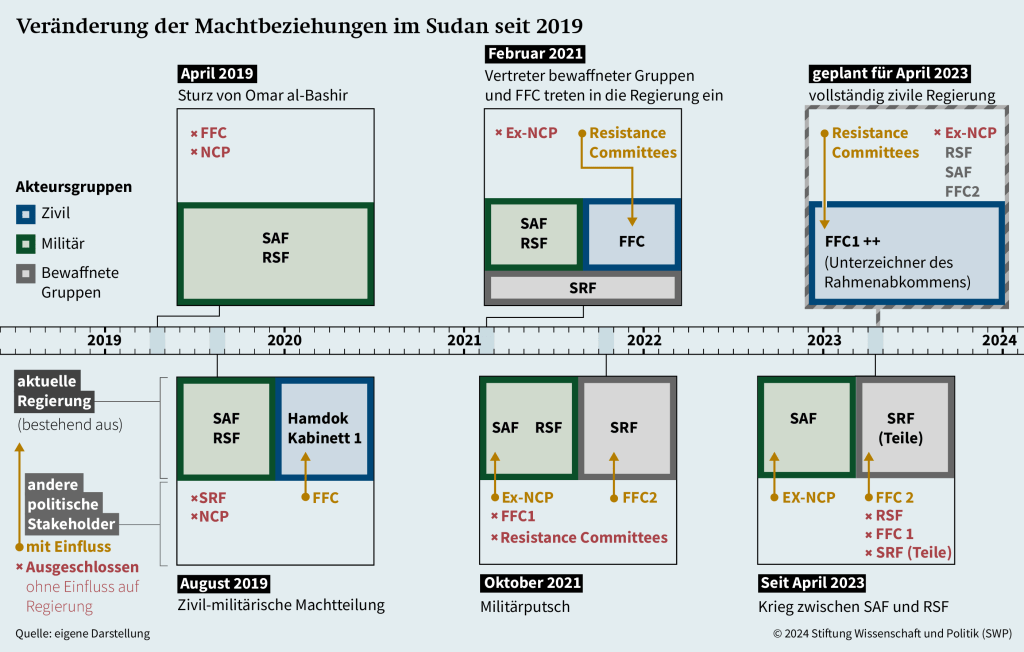
Dennoch scheiterte der Übergangsprozess nach nur gut zwei Jahren mit dem Militärputsch vom Oktober 2021. Angesichts der vielen Putsche in Sudans Geschichte, zuletzt zum Sturz Bashirs, überraschte es nicht, dass die Militärs wieder die ganze Macht an sich rissen. Anders jedoch als bei früheren erzwungenen Beendigungen ziviler Regierungsführung in Sudan und bei Transitionsprozessen in der Nachbarschaft gelang es den Sicherheitskräften nicht, eine stabile Putschregierung zu bilden. Stattdessen ließen sie sich auf Verhandlungen über die Bildung einer zivilen Regierung ein, die im April 2023 kurz vor dem Abschluss standen. Ungewöhnlich war auch, dass der Krieg innerhalb des Sicherheitssektors ausbrach, zwischen zwei militärisch nahezu gleich starken, wenn auch in ihren Fähigkeiten komplementär aufgestellten Sicherheitskräften. Der Krieg entsprang im Zentrum des repressiven Apparats, nicht in dessen Peripherie und auch nicht zwischen diesem und der Demokratiebewegung. Damit steht der Krieg zwischen SAF und RSF auch für grundsätzliche Veränderungen im politischen System Sudans.
In dieser Studie wird untersucht, wie die angedeuteten Verschiebungen politischer Macht zustande kamen und in einem Krieg gipfelten, der Sudans gesellschaftliche, politische und wirtschaftliche Integrität in Frage stellt. Der Schwerpunkt der Analyse liegt auf den Machtressourcen der wichtigsten Akteursgruppen und ihrem wechselseitigen Aushandlungsverhalten nach dem Sturz Bashirs im April 2019. Allerdings reichen die Wurzeln dieser Veränderungen in die Zeit vor Bashir zurück, als die sudanesische Regierung begann, die Bekämpfung von Aufständen bewaffneter Gruppen in der marginalisierten Peripherie an ethnische Milizen auszulagern. Zivile Oppositionsgruppen wiederum üben sich schon seit rund einem Jahrzehnt in Techniken gewaltfreien Widerstands und organisieren sich auf Graswurzelebene. Mit der Entmachtung Bashirs und der Bildung einer Übergangsregierung im August 2019 kamen diese und weitere längerfristige Entwicklungen wie in einem Brennglas zusammen.
Die gewaltsame Eskalation der Spannungen zwischen SAF und RSF war das Ergebnis zweier gescheiterter Prozesse: des demokratischen Übergangsprozesses und des auf ihn folgenden Putsches. Im ersten gelang es den demokratischen politischen Akteuren nicht, ihren Zusammenhalt zu wahren und die Macht des Sicherheitssektors substantiell zu reduzieren. Die Übergangsregierung unter Premierminister Hamdok setzte auf eine vertiefte Partnerschaft mit den Sicherheitskräften, konnte dabei aber weder deren Unterstützung noch die der demokratischen Protestbewegung gewinnen. Anstatt das Terrain für zivile Politik institutionell zu sichern, verfolgten die politischen Parteien eine Nullsummenpolitik, sowohl untereinander als auch zunehmend gegenüber dem Militär. Auf der anderen Seite misslang es den Sicherheitskräften, ihre Herrschaft zu festigen, nachdem sie die zivilen Mitglieder aus der Regierung entfernt hatten. Deshalb erklärten sich die Sicherheitskräfte ab Sommer 2022 bereit, die Regierungsgewalt an eine zivile Regierung abzutreten. Immerhin gab es keine geeinte politische Kraft, die als Steigbügelhalter für eine Militärregierung dienen wollte. Das war der fortwährenden zivilgesellschaftlichen Mobilisierung und internationalem Druck zu verdanken. Zudem vertiefte der Putsch die Differenz zwischen SAF und RSF, die auf unterschiedliche politische Partner setzten, welche einander wiederum als Hauptgegner sahen: Die SAF stützten sich auf die islamistischen Loyalisten des Bashir-Regimes, während die RSF versuchten, durch Übernahme einer demokratischen Rhetorik wichtige politische Parteien für sich zu gewinnen (welche sich freilich um Unabhängigkeit bemühten).
Dass nach Äthiopien ein weiterer Übergangsprozess in der Region in massiver Gewalt endete, gibt Anlass dazu, den vorherrschenden internationalen Ansatz zur Förderung solcher Transitionen zu überdenken. Die Verantwortung für den Krieg tragen die Konfliktparteien, aber Sudans internationale Unterstützer und seine politische Elite hätten mehr tun können, die Bedingungen zu entschärfen, die diese Eskalation ermöglichten. Sie hätten stärkere Anreize für die Etablierung demokratischer Institutionen setzen und mehr Druck auf die Sicherheitskräfte ausüben können, damit diese ihre wirtschaftlichen und finanziellen Ressourcen, auch im Ausland, in den Dienst des Gemeinwohls stellen.
Um Übergangsprozesse wie in Sudan effektiver voranzubringen, sollte ein veränderter internationaler Ansatz angewandt werden, der auch Orientierung für Friedensgespräche bietet. Nichtinklusive Abkommen in Sudans Geschichte bildeten immer wieder den Nährboden für Gewalt. Ein erneutes Machtteilungsabkommen, das die Sicherheitskräfte in die Politik einbindet, würde ein hohes Risiko bergen, diese Gewaltgeschichte fortzuschreiben. Stattdessen sollten internationale Akteure so weit wie möglich die internationalen Finanz- und Unterstützungsnetzwerke der Sicherheitskräfte eindämmen, zivilgesellschaftlichen Akteuren flexibler Rückhalt gewähren und in einem künftigen Übergangsprozess größeren Wert darauf legen, dass demokratiefördernde Veränderungen auf nationaler und lokaler Ebene institutionell verankert werden. Im Zentrum einer möglichen Nachkriegsordnung Sudans sollte eine umfassende Sicherheitssektorreform stehen.
Ausgangslage
Am 11. April 2019 endete die Herrschaft von Omar al‑Bashir, als ihn seine eigenen Sicherheitskräfte entmachteten.1 Seit dem 30. Juni 1989 hatte er, gestützt auf die National Congress Party (NCP) als Teil einer islamistischen Bewegung, an der Spitze eines autoritären Staates gestanden. Am Ende scheiterte sein Herrschaftssystem an seinen eigenen Widersprüchen. Die Bedingungen, die zu Bashirs Fall und dem Ende der NCP-Regierung geführt hatten, wirkten nach und erschwerten es deren ehemaligen Kräften später, wieder die Macht zu übernehmen.2
Zusammenbruch und Hinterlassenschaft der NCP-Herrschaft
Das NCP-Regime konnte nie auf eine breite Basis in der Gesellschaft bauen, sondern musste sich durch andere Mechanismen stabilisieren. Dazu zählten gewaltsame Repression, der Kauf der Loyalität von Oppositionsparteien und Teilen der Bevölkerung sowie internationale Unterstützung. Seine relative Blüte bestand während des Ölbooms von 1999 bis zur Sezession Südsudans 2011. Mit der friedlichen Abspaltung des Südens im Juli 2011 verlor Sudan 70 Prozent seiner Staatseinnahmen, da die meisten Ölquellen im Süden liegen. Eine wachsende Goldproduktion konnte diesen Einbruch nicht wettmachen, den die Regierung eine Zeitlang mit der Monetarisierung des aus ihm resultierenden Budgetdefizits auszugleichen versuchte, also einer massiven Erhöhung der im Umlauf befindlichen Geldmenge durch die Zentralbank.3 Diese Strategie trieb jedoch die Preise in die Höhe – und die Menschen bereits vor 2018 auf die Straße.
Die Fähigkeiten des NCP-Regimes zur Repression schwanden, weil sowohl die islamistische Bewegung als auch die Sicherheitskräfte aus jeweils unterschiedlichen Gründen auseinanderbrachen. Unzufrieden mit der Abspaltung Südsudans und der mangelnden Konsolidierung der islamistischen Herrschaft, wandten sich führende Mitglieder von der Bewegung ab und gründeten eigene islamistische Parteien.4
Bashir entglitt die Kontrolle über den Sicherheitssektor. SAF-Angehörige stellten sich 2019 auf die Seite der Demonstranten, ebenso wie Kinder hochrangiger SAF-Generäle. So verbündeten sich die SAF, der Geheimdienst und paramilitärische Kräfte gegen Bashir, um eine offene Auseinandersetzung zwischen Teilen der Sicherheitskräfte zu verhindern. Diese hätte ihre jeweiligen politischen und wirtschaftlichen Privilegien gefährdet. Nicht zuletzt entfremdete die gewaltsame Repression wichtige Teile der sudanesischen Wirtschaftselite, die ihre langfristigen Interessen durch drohende Instabilität gefährdet sahen und ebenfalls Söhne und Töchter in der Demokratiebewegung hatten.5
Schließlich konnte sich Bashir nicht mehr auf internationale Unterstützung verlassen. Er versuchte zwischen den beiden damaligen Blöcken in der arabischen Welt um Katar einerseits sowie um die Vereinigten Arabischen Emirate (VAE) und Saudi-Arabien andererseits zu balancieren, war am Ende aber zu abhängig von der finanziellen Unterstützung durch die letzteren beiden. VAE und Saudi-Arabien waren enttäuscht, weil Bashir sich in der Katarkrise am Golf ab 2017 neutral verhalten und nicht von den heimischen Islamisten in der Regierung getrennt hatte. So entschieden sie, die Zahlungen an Bashir einzustellen, da sie ihn als unzuverlässig einstuften.6
Auch ohne Bashir blieb das Patronagesystem der »Ermächtigung« (Tamkeen) bestehen, das er und seine Herrschaftselite geschaffen hatten. Das System hatte zur Folge, dass die Ministerien voller unqualifizierter Personen waren, während der Geheimdienst die eigentliche Regierungsmacht ausübte. Der Sicherheitssektor kontrollierte einen großen Teil der Wirtschaft.7 Nach Jahrzehnten von US-Wirtschaftssanktionen lagen dessen Produktivkräfte weitgehend brach. Jahrzehntelang hatte der Staat mit Hilfe von Milizen und Sicherheitskräften die Peripherien und ländliche Gebiete ausgepresst. Per Gesetz wurden Frauen diskriminiert und in ihrer persönlichen Bewegungs- und Handlungsfreiheit eingeschränkt. Obwohl Sudan sich um Annäherung sowohl an Golfstaaten als auch in jüngerer Zeit an westliche Staaten bemühte, verfügte das Land kaum über belastbare außenpolitische Partnerschaften.
Die Transition als Chance für den Beginn einer Transformation
Mit Bashirs Sturz ging auch eine Gelegenheit für tieferen Wandel des militarisierten politischen Systems einher, das er entscheidend geprägt hatte. Forschungen zu Regimewandeln zeigen, dass gewaltfreie Bewegungen größere Erfolgschancen haben als gewalttätige Aufstände.8 »Erfolg« meint hier allerdings den Moment des Umsturzes, nicht notwendigerweise dauerhafte Demokratisierung. Die Forschung zu demokratischen Transitionen betont seit langem, dass die Beteiligung von Kräften des früheren Regimes im Sinne eines verhandelten Übergangs (»pacted transition«) die besten Aussichten für einen friedlichen Wechsel eines politischen Regimes bietet.9
Soll ein verhandelter Übergang erfolgreich sein, muss der innen- und außenpolitische Druck auf die Übergangsregierung hoch bleiben.
Solche »verhandelten Revolutionen« folgen oft dann, wenn auf die Person eines Herrschers ausgerichtete Regierungssysteme zusammenbrechen. Weitere begünstigende Faktoren sind die Spaltung und teilweise die Unterstützung für den Wandel durch den Sicherheitsapparat, die Ablehnung von Gewalt durch die Reformkräfte, verbunden mit expliziter Unterstützung für Gewaltfreiheit, die Offenheit gegenüber liberalen internationalen Akteuren sowie eine eher schwache Staatlichkeit.10 Diesen Übergangsprozessen zugrunde liegen oft Aushandlungen zwischen Reformern des alten Systems und moderaten Kräften der Opposition. Dabei kommt es darauf an, dass der innere und äußere Druck auf die Kräfte des früheren Regimes auch nach Beginn der Transition bestehen bleibt, damit diese sich einem weiteren Verlust ihrer Macht im Zuge der Stärkung von Rechtsstaat, Mitbestimmung und wirtschaftlicher Öffnung fügen. Gewaltfreie Transitionen führen dann eher zu Demokratie, wenn sie Protestbewegungen auch nach dem Wechsel einbinden bzw. jene die Beteiligung aktiv einfordern und wenn die zivile politische Elite gemäßigte Ziele verfolgt und kompromissbereit ist.11
Im Falle Sudans war es das Zusammenwirken von vier Faktoren, welche eine verhandelte Transition begünstigten.12 Da war erstens die andauernde Mobilisierung einer breiten gesellschaftlichen Bewegung im ganzen Land, vor allem getragen von jungen Menschen. Die ersten Proteste tauchten im Dezember 2018 in der Peripherie auf, nämlich in Atbara im Norden und Ed-Damazin im Süden, bevor sie Khartum erreichten. Dabei war diese Bewegung resilient selbst gegenüber heftiger Repression. Ein Wendepunkt war der »Millionenmarsch« am 30. Juni 2019, bei dem trotz Internet- und Telefonsperren Hunderttausende auf die Straße gingen, nachdem die Sicherheitskräfte am 3. Juni das zentrale Protestcamp vor dem Militärhauptquartier in Khartum gewaltsam aufgelöst hatten. Die Sicherheitskräfte hätten diese Bewegung nur mit dauerhafter und skrupelloser bewaffneter Gewalt unterdrücken können.
Diese Option stand ihnen wegen ihrer Spaltung – dies war der zweite entscheidende Faktor – nicht offen. Es blieb attraktiv für Teile der Sicherheitskräfte, sich als die wahren Vertreter der Revolution darzustellen und um die Gunst der Bevölkerung zu buhlen. Massive Gewaltanwendung gegen die Zivilbevölkerung hätte diesen Graben zwischen den Sicherheitskräften vertieft und das Risiko einer bewaffneten Auseinandersetzung im Sicherheitssektor erhöht, da sich möglicherweise eine Kraft, wenn auch nur rhetorisch, auf die Seite der Zivilgesellschaft geschlagen hätte.
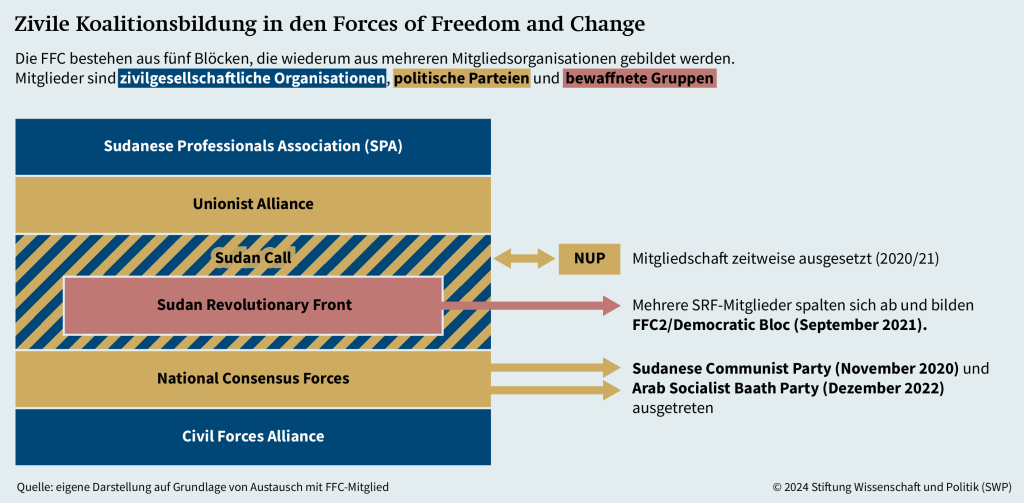
Drittens waren die Gegner des Sicherheitssektors zumindest Anfang 2019 noch gut organisiert. Mit der Erklärung für Freiheit und Wandel vom 1. Januar 2019 bildete sich eine gemeinsame zivile Front, die politische Parteien, Gewerkschaften, Graswurzelbewegungen und bewaffnete Gruppen einschloss – die Forces of Freedom and Change (FFC). In Gestalt der Sudanese Professionals Association (SPA) gab es eine Organisation, die als Transmissionsriemen innerhalb der FFC zwischen der alten Garde der politischen Parteien13 und den jungen Aktivistinnen und Aktivisten der Straße agieren konnte. SPA und FFC konnten im Namen der Demokratiebewegung verhandeln, woraus die Übergangsverfassung vom 17. August 2019 entstand.
Schließlich waren die regionalen und internationalen Akteure, die Einfluss in Sudan hatten, zu Anfang des Übergangsprozesses relativ geschlossen. Hatten arabische Mächte noch das Militär mit einer großzügigen Finanzspritze von drei Milliarden US-Dollar kurz nach dem Fall Bashirs bedacht,14 setzten sie sich nach dem Massaker vom 3. Juni 2019 für Verhandlungen zwischen Demokratiebewegung und Militär ein, weil sie massive Instabilität in Sudan fürchteten. Die USA, die Europäische Union (EU), die Afrikanische Union (AU) und die Vereinten Nationen (UN) unterstützten den demokratischen Übergangsprozess ebenfalls, nicht zuletzt weil seine tragenden Akteure in der zivilen politischen Szene Sudans im weiteren Sinne liberal waren. Sie richteten sich ausdrücklich gegen die gesellschaftliche Unterdrückung durch das islamistische Bashir-Regime mit seiner Kleiderordnung für Frauen, rückwärtsgewandten Scharia-Gesetzgebung und Sittenpolizei.
Machtressourcen und Herausforderungen der zentralen Akteure
Jeder Übergangsprozess ist, vereinfacht gesagt, von einem Tauziehen zwischen Kräften des (fortschrittlichen) Wandels und Beharrungskräften des ancien régime gekennzeichnet. Tatsächlich ziehen die wichtigsten Akteure einer Transition sogar oft in mehr als zwei Richtungen, so auch in Sudan. Dabei bringen alle Akteure unterschiedliche Machtressourcen zur Geltung, über die sie aufgrund ihrer Organisation und Ausrichtung verfügen. Solche Ressourcen betreffen vier grundsätzliche Felder politischer Auseinandersetzung in jedem Staatswesen: Sicherheit, Wirtschaft, Legitimität sowie internationale Beziehungen. Die Verteilung dieser Machtressourcen bildet den strukturellen Rahmen, in dem der politische Wettbewerb eines Übergangsprozesses stattfindet. Für die Handlungsmacht der politischen Akteure spielen dazu Faktoren wie ihre Fachexpertise, ihre Erfahrung und ihre organisatorischen Fähigkeiten im Verhältnis zu den anderen Akteuren eine Rolle, sowie ihre Bereitschaft, Koalitionen einzugehen und Kompromisse zu schließen.15
Konstitutiv für einen Übergangsprozess nach Jahrzehnten autoritärer Herrschaft ist der Wandel der Machtverhältnisse. Im Gegensatz zu stabilen autoritären oder demokratischen Regimen besteht erhebliche Unsicherheit darüber, welche »Spielregeln« im politischen Raum noch gelten, und daher auch, wer welche Ressourcen wie einsetzen kann.16 Der Sturz Bashirs und die Unfähigkeit des Militärs, angesichts fortwährender Proteste allein zu regieren, wirbelten die politischen Beziehungen in Sudan durcheinander.
Im Wettbewerb dieser Kräfte ist entscheidend, »wer schneller lernen kann und diese Lernerfolge erfolgreicher einsetzen kann«.17 Die handelnden Akteure interpretieren jede Maßnahme oder politische Aussage als eine Runde in einem Spiel, das die Macht der einzelnen Spieler definiert. Dieses Spiel bedeutet, dass die jeweiligen Akteure stets versuchen, ihren Handlungsspielraum zu erweitern, dabei aber nie genau wissen, wie weit sie gehen können, ohne dass es zu einer Zerreißprobe kommt. Zwar bietet die Fluidität eines Übergangsprozess die Chance für tiefgreifendere Veränderungen am politischen System als sonst. Aber ein zu schneller Wandel macht auch einen Rückfall in den Autoritarismus wahrscheinlicher, weil die demokratischen Kräfte noch nicht abgesichert und ihre Vorstellungen noch nicht ausreichend institutionell verankert sind. Zu vorsichtiger oder zu langsamer Wandel beinhaltet gleichwohl das Risiko, dass dieselben oder neue Eliten die auf Ausbeutung gerichteten Institutionen des Staates für sich nutzen (»state capture«)18 oder erneute Protestwellen einer mobilisierten Zivilgesellschaft einen Umsturz herbeiführen. Eine Balance zwischen diesen beiden Kräften, die einen wirklich nachhaltigen Wandel hin zu einer
stabilen liberalen Demokratie ermöglicht, erreichen auf Anhieb nur sehr wenige Übergangsprozesse.19
Zentral für den Ausgang von Übergangsprozessen sind daher sowohl die Machtressourcen als auch die Dynamik, die aus dem Lern- und Anpassungsverhalten und den Strategien der wichtigsten Akteure entsteht. Nach dem Fall Bashirs waren dies vor allem die politischen Parteien, die Demokratiebewegung in der Zivilgesellschaft, die Sicherheitskräfte und die bewaffneten Gruppen. Im Hintergrund wirkten darüber hinaus wirtschaftliche Eliten und Angehörige des früheren Regimes mit, deren Rolle im Einzelnen jedoch schwer zu durchschauen ist.
Vertrauensverlust gegenüber politischen Parteien
In einem Übergangsprozess von einem autokratischen zu einem demokratischen System kommt politischen Parteien eine entscheidende Rolle zu. Mit ihrem Personal und ihrer Programmatik bilden sie eine Alternative zur bisherigen Regierungspartei sowie einen Transmissionsriemen zur sozialen Bewegung, welche den Übergangsprozess angestoßen hat. Gleichwohl sind sie selbst geschwächt von der autoritären Herrschaft. Ihnen mangelt es an Regierungserfahrung, sie verfügen nur über eingeschränkten Rückhalt in der Bevölkerung und sind möglicherweise in einem Nullsummenverständnis von Politik gefangen, was Kooperation erschwert. Diese Probleme sind allesamt in Sudan sichtbar.
Die Nullsummenpolitik der politischen Parteien beförderte die Polarisierung des zivilen Sektors.
Sudan weist ein vielfältiges Spektrum politischer Parteien auf. Dazu gehören die beiden »traditionellen« Parteien und ihre Abspaltungen, die National Umma Party (NUP) und die Democratic Unionist Party (DUP). Beide sind aus Verbindungen islamischer Orden mit der aufstrebenden handeltreibenden Klasse entstanden, die bis in die britische Kolonialzeit zurückreichen.20 Daneben gab es früher die »modernen« Parteien an den jeweiligen Rändern des politischen Spektrums: die Sudanese Communist Party (SCP) und die National Islamic Front (NIF, später National Congress Party, NCP) mit ihren jeweiligen Ablegern. Die NCP wurde nach Präsident Bashirs Sturz verboten. Schließlich existiert eine Reihe kleinerer, aber durchaus einflussreicher Parteien, welche aus Universitätspolitik (wie die Sudanese Congress Party) oder panarabischen Verbindungen (Baath Party) entstanden sind.
Die Parteien leiden unter erheblichem Vertrauensverlust in der Bevölkerung und besonders im gewaltfreien Widerstand. Aktivist:innen werfen ihnen vor allem die wiederholte Kooperation mit dem Militär und Militärregierungen vor. Kooption gibt es seit langem. Alle Phasen ziviler Herrschaft wurden durch Putsche beendet, bei denen das Militär mit einzelnen politischen Parteien zusammenarbeitete: Die NUP (1958), die SCP (1969) und die NIF (1989) sahen es jeweils als opportun an, sich mit dem Militär gegen ihre innenpolitischen Gegner zu verbünden.21 Die Nullsummenmentalität vieler politischer Führer beförderte die Polarisierung und führte dazu, dass sie sich vor allem um ihr politisches Überleben kümmerten und Eliten sich »wie Diktaturen« verhielten, wenn sie an die Regierung kamen.22 Außerdem entstammt das politische Führungspersonal einer dünnen sozialen Schicht, die weniger unter den Folgen ihrer Fehler leiden musste als die Gesamtbevölkerung.23
Eine besondere Schwierigkeit für die Zusammenarbeit der politischen Parteien untereinander während der Übergangsregierung 2019–2021 lag darin, dass völlig unklar war, wie viel Rückhalt die einzelnen Parteien in der Bevölkerung hatten. Meinungsumfragen gab es nicht. Bevölkerungs- und Wirtschaftsdaten waren überwiegend veraltet oder lückenhaft. Die letzten demokratischen Wahlen hatten 1986 stattgefunden,24 als die Mehrheit der Bevölkerung von heute noch gar nicht geboren war. Damals hatte die NUP die meisten Stimmen erhalten. Unter der NIF/NCP-Herrschaft galt die NUP auch als wichtigste Oppositionspartei. Bereits in den Oppositionskoalitionen gegen Bashir war die NUP daher unzufrieden, wenn sie auf einer Stufe mit kleinen Kader-parteien wie der Baath-Partei in den jeweiligen Entscheidungsgremien vertreten war, »die es nie in ein gewähltes Parlament geschafft hatten«.25
Führende Vertreter der politischen Parteien sprachen offen über ihre strukturellen Schwächen, ihre mangelnde Erfahrung und unzulängliche politische Ausbildung. »Wir waren nicht vorbereitet, als Bashir gestürzt wurde. Wir hatten den Wandel nicht so schnell erwartet«, sagte ein NUP-Vertreter.26 Ein Mitglied des Politbüros der Sudanese Congress Party meinte, politische Parteien seien zwar nicht reif, aber sie würden auch nicht reifer, wenn sie nicht Teil der Regierung seien.27
Dennoch brachten die politischen Parteien Machtressourcen ein, über die andere Akteure in dieser Form (bis dato) nicht verfügten. Die jeweiligen Parteiführungen waren Ansprechpartner für nationale und internationale Konsultationen. Auch verfügten die Parteien über ein gewisses Maß an politischer Organisation, die es ihnen ermöglichte, an Wahlen und Verhandlungen teilzunehmen. Schließlich besaßen sie politisch-taktische Expertise, die sie in Verhandlungen mit anderen Stakeholdern, besonders dem Militär, einbrachten.
Gewaltfreier Widerstand
Sudan besitzt eine lange Tradition gewaltfreier Proteste. 1964, 1985 und 2019 mündeten gewaltfreie Protestbewegungen in den Sturz von Militärregierungen. Die Organisationen des zivilen Widerstands entwickelten sich in einem Kontext extremer autoritärer Repression unter dem NCP-Regime. Dieses verbot Gewerkschaften und Berufsverbände, welche zusammen mit Universitäten führende Rollen bei den früheren Aufständen gespielt hatten, und etablierte regimetreue Gewerkschaften. Der Geheimdienst (National Intelligence and Security Service, NISS) knüpfte ein dichtes Überwachungsnetz, das es demokratisch orientierten Akteuren erschwerte, sich effektiv zu organisieren. Fragmentierung und Kooption bildeten daher beträchtliche Herausforderungen für zivile Akteure. So erhoben sich zwar immer wieder Proteste gegen das NCP-Regime, beispielsweise inspiriert von den Erfolgen in Ägypten und Tunesien 2011 oder aufgrund steigender Preise 2013, aber es fehlte an der Organisation, »welche in der Lage war, die Proteste anzuführen und ihnen eine Richtung zu geben«.28 Angesichts von bewaffneter Gewalt, Verhaftungen und Infiltrationsversuchen galt es, resilient zu sein.
Anfangs spielte die SPA eine wichtige Vermittlerrolle zwischen Protestbewegung und Parteien.
Das Verhältnis zwischen der Demokratiebewegung, in Sudan oft schlicht als »die Straße« bekannt, und der politischen Elite ist ausschlaggebend für die Erfolgsaussichten zivilen Widerstands.29 Eine zentrale Rolle nahm dabei die Sudanese Professionals Association (SPA) ein, ein Zusammenschluss inoffizieller Gewerkschaften und Berufsverbände, gegründet im Juli 2018. Als sich im Dezember 2018 landesweit Wut gegen die NCP-Regierung wegen der Erhöhung von Brotpreisen breit machte, sprang die SPA darauf an. Sie stellte das gesuchte Bindeglied zwischen den protestierenden Massen und den existierenden, elitär ausgerichteten Parteien her.
Eine Lehre aus früheren Protesten sowie den Erfahrungen des arabischen Frühlings bestand darin, eine möglichst breite Koalition aufzustellen.30 Diese würde, so hoffte man, es den Behörden erschweren, den Protest zu brechen. Daher verfasste die SPA eine Grundsatzerklärung, der sich alle relevanten oppositionellen Kräfte im Land anschlossen. Ausdrückliches Ziel dieser Erklärung für Freiheit und Wandel war es, »politische Rückendeckung« für die Protestierenden zu schaffen.31
Die breite Mobilisierung ist vor allem ein Erfolg dezentraler, informeller Zusammenschlüsse, der lokalen Widerstandskomitees (Local Resistance Committees). Deren Anfänge liegen etwa um 2013. Besondere Verbreitung fanden sie im Zuge der Proteste seit Dezember 2018, weswegen einige sie auch als »Hauptinnovation der Dezemberrevolution« bezeichnen.32 Vor allem junge Menschen finden sich in den lokalen Widerstandskomitees wieder. Jugendaktivist:innen profitierten von jahrelangem Training in gewaltfreien Taktiken, Organisation, Genderfragen und Führungsqualitäten nach den Protesten von 2013. Deren Taktiken machten es den umfangreichen Überwachungsnetzwerken des Regimes schwer, diese Gruppen zu infiltrieren.33
Gerade bei jungen Menschen, die in einem Klima gesellschaftlicher und politischer Repression und wirtschaftlichen Niedergangs groß geworden waren, erzeugte die Zusammenarbeit in den Widerstandskomitees ein enormes Gefühl der Selbstermächtigung angesichts patriarchaler Machtstrukturen.34 Dieses ermöglichte es der revolutionären Bewegung, Mobilisierung trotz massiver Gewalt und eigener Not aufrechtzuerhalten. Freiwillige engagierten sich auch in der Basisversorgung, beispielsweise im Rahmen von »Emergency Response Rooms« nach Ausbruch des Kriegs, die sich um die humanitäre Versorgung der lokalen Bevölkerung beispielsweise mit Gemeinschaftsküchen und medizinischer Koordination kümmern.35
Die lokalen Widerstandskomitees besitzen erhebliche Machtressourcen in der innenpolitischen Auseinandersetzung. Sie verfügen über hohe Legitimität in ihren Nachbarschaften und sind dort fest verankert. Es gibt sie im ganzen Land, in Städten und ländlichen Gegenden. In einem von der sudanesischen Übergangsregierung in Auftrag gegebenen Mapping kam das Carter Center für das Jahr 2021 auf 7.238 Jugendorganisationen, darunter 5.289 Widerstandskomitees36 – eine Verbreitung, mit der keine politische Partei Schritt halten kann.37 Die Gewaltfreiheit der Komitees setzt sie von anderen jungen Menschen ab, die bewaffneten Gruppen, Milizen und Sicherheitskräften beitreten. Der wirtschaftlichen Macht des Sicherheitssektors stellte die zivile Bewegung Streiks und Blockaden entgegen.
Die lokalen Widerstandskomitees sind kein einheitlicher Akteur, der ohne Weiteres in Verhandlungen eingebunden werden könnte. Ihre Mitglieder vertreten unterschiedliche politische Positionen. Um in einem repräsentativen System konkret Einfluss zu nehmen, sind sie daher auf einen Transmissionsriemen angewiesen, wie ihn politische Parteien grundsätzlich darstellen. Später entwickelten die Widerstandskomitees ihre eigenen Koordinationsmechanismen auf bundesstaatlicher Ebene, um ihre politischen Vorstellungen zu artikulieren.
Spaltung der Sicherheitskräfte
Das Militär ist so eng mit Staat und Gesellschaft in Sudan verbunden, dass es nicht nur ihm gefällige Regierungen durch Putsche an die Macht brachte, sondern Teile des Militärs revolutionären Bewegungen auch dabei halfen, diese Regierungen wieder zu stürzen. Dies hatte vor allem mit der gesellschaftlichen Nähe von Polizei- und Militärkräften zu den Führern der jeweiligen Aufstände zu tun, die in der Regel aus der oberen Mittelschicht im Zentrum Sudans stammten.38
Die Spaltung des Sicherheitssektors hat tiefe Wurzeln. Immer wieder gab es eine Entfremdung zwischen der Regierungsspitze, die durch einen Putsch ins Amt gekommen war, und dem restlichen Militär.39 So begann bereits Jafa’ar Nimeiri nach seinem Putsch 1969 mit dem Aufbau konkurrierender Sicherheitsorgane, um sein Regime vor einem Staatsstreich zu schützen (»coup proofing«).40 Daneben lagerten Regierungen seit den 1980er Jahren, zuerst unter Premierminister Sadiq al-Mahdi (NUP), die Aufstandsbekämpfung in diversen Konflikten an parastaatliche, oft ethnisch oder religiös definierte Milizen aus.41
So entstanden neben den regulären Streitkräften (SAF) und der Polizei unter anderem die Rapid Support Forces (RSF), der General Intelligence Service (GIS, früher NISS) mit seinen Operationseinheiten sowie die Popular Defense Forces. Aufgrund ihrer Größe, ihrer politischen Rolle seit dem Sturz Bashirs und schließlich dem Kriegsausbruch im April 2023 sind die RSF von besonderer Bedeutung.
Die RSF gingen aus arabischen Milizen der Region Darfur im Westen Sudans hervor, welche die Bashir-Regierung dort zur Aufstandsbekämpfung einsetzte, oft verbunden mit gezielter Gewalt gegen die Zivilbevölkerung. Dort waren sie als »Janjaweed« bekannt. RSF-Führer Mohamed Hamdan Dagalo, genannt Hemedti, gehört den Mahariya an, einem Stamm der nördlichen Reizegat-Nomaden aus Darfur. Während des vorläufigen Höhepunkts der Gewalt in Darfur 2003/04 stieg Hemedti zu einem wichtigen Milizenführer auf. Nach einer kurzen Phase der Rebellion gegen den Staat wurde er 2008 Sicherheitsberater des Gouverneurs des Bundesstaats Süd-Darfur.42 2013 schuf Präsident Bashir die RSF, zunächst unter der Kontrolle des NISS. In zwei Großoffensiven 2014 und 2015 besiegten und vertrieben die RSF in Koordination mit regulären Armee-Einheiten bewaffnete Gruppen aus Darfur. Während der Folgejahre stiegen die RSF in den Schmuggel von Migranten und in die Goldproduktion ein. Außerdem wurden RSF-Truppen in großer Zahl im Jemenkrieg unter Führung der VAE und Saudi-Arabiens eingesetzt (neben einem kleineren SAF-Kontingent).43 Aus diesen Quellen wuchs die Finanzkraft der RSF und ihres Führers stark an.44 2017 war ein wichtiges Jahr für die RSF: Hemedtis Konkurrent Musa Hilal wurde verhaftet, und die RSF wurden auf der Basis eines eigenen Gesetzes in eine »reguläre Streitkraft« unter der Hoheit des Oberkommandierenden der Sicherheitskräfte, das heißt Präsident Bashir, verwandelt. In der Folge wurden die RSF de facto zu Bashirs persönlicher Schutzgarde.
SAF und RSF verbindet das Ziel, Dominanz über den sudanesischen Staat zu behalten bzw. vollständig zu erlangen. Ihre Vorstellungen vom Staat unterscheiden sich jedoch. Das SAF-Offizierskorps sieht die Streitkräfte als einzige wirklich »nationale«, gesamtgesellschaftliche Institution an (obgleich die SAF-Führung überwiegend aus den arabischen Stämmen Zentralsudans kommt). Ihr strategisches Interesse besteht darin, die Fragmentierung des Sicherheitssektors sowie des Staates und der Gesellschaft wieder zurückzudrängen. Plurale zivile Politik, geprägt von demokratischen Auseinandersetzungen, sehen sie als Rezept für Fragilität und einen Staatszusammenbruch, wie ihn mehrere Länder in der weiteren Nachbarschaft Sudans (Jemen, Libyen, Somalia) erlebten.45
Die SAF und die RSF unterscheiden sich in ihren Vorstellungen vom Staat.
Die RSF sind weitaus weniger institutionalisiert als die SAF. Ihre Führung besteht größtenteils aus Mitgliedern der Dagalo-Familie. Hemedtis Stellvertreter ist sein Bruder Abdel Rahim Dagalo, der auch das wichtigste mit den RSF verbundene Unternehmen, Al‑Junaid, leitet. Es ist vor allem in der Förderung und dem Export von Gold aktiv. Angehörige des Stamms der Reizegat bilden den Kern der RSF und stellen die meisten ihrer Kommandeure. In den Rängen finden sich Kämpfer aus vielen anderen Ethnien aus Sudans Peripherie sowie Staatsangehörige der Länder des zentralen Sahel. Viele junge Männer schlossen sich, überwiegend aus finanziellen Gründen, den RSF an, denn diese zahlen vergleichsweise hohe Gehälter.46 Allerdings gibt es weiterhin Kräfte in den RSF, die eine Ideologie von »arabischer Vorherrschaft« verfolgen. Diese motivierte die »Janjaweed«-Milizen bereits in den 2000er Jahren, genozidale Gewalt gegen nichtarabische Gruppen aus den Stämmen der Fur, Zaghawa und Masalit auszuüben.47 Die RSF streben Dominanz über den Sicherheitssektor an und wollen dazu eine neue Armee aufbauen, welche die alten SAF-Strukturen ersetzen würde. Insgesamt nutzen die RSF stärker informelle und persönliche Beziehungen als die SAF und versuchen vor allem mit Hilfe materieller Ressourcen und ethnischer Verbindungen Einfluss zu nehmen, während die SAF auch ihren Zugang zu öffentlichen Institutionen nutzen. Diese verschiedenen Vorgehensweisen erklären auch die unterschiedlichen Haltungen der SAF und der RSF zu einer zivilen Regierung. Setzen die RSF in erster Linie auf einen schwachen Staat mit geringer Regulierung, wollen die SAF eher den Staat unter ihrer autoritären Kontrolle behalten.
Die jeweiligen Sicherheitskräfte verfügen über beträchtliche Machtressourcen, die sie nicht nur gegen zivile Akteure, sondern auch gegeneinander einsetzen können. Am offensichtlichsten ist die Rolle der Sicherheitskräfte für die Sicherheit des Landes, denn sie können zu ihr beitragen, sie aber auch beeinträchtigen. Darüber hinaus besitzen sie große wirtschaftliche und finanzielle Macht.48 Die SAF kontrollieren etwa ein Viertel der Wirtschaft, die RSF gar die Hälfte.49 Weitere Machtressourcen bestehen in ihren privilegierten, oft personalisierten Außenbeziehungen. Die SAF pflegen enge Beziehungen mit Ägypten, RSF-Führer Hemedti hat intensive Verbindungen zu den VAE. Sowohl SAF als auch RSF arbei-teten mit der Wagner-Gruppe und der russischen Regierung zusammen und hatten ein gutes Verhältnis zu Saudi-Arabien.
Den Sicherheitskräften fehlen jedoch drei wichtige Ressourcen: ein ziviler Unterstützungsapparat nach dem Wegfall der NCP sowie innenpolitische Legitimität und westliche Unterstützung. Die Stellung der RSF ist prekärer als die der SAF, da sie als paramilitärische Einheit erhebliche Gewalt gegen die Zivilbevölkerung ausgeübt hat. Dagegen wird die Existenz der SAF von Parteien und Demokratiebewegung zumindest nicht in Frage gestellt.
Opportunistische Führer bewaffneter Gruppen
Als Begleiterscheinung von Sudans anderen bewaffneten Konflikten und als Folge des Umgangs sudanesischer Regierungen mit Aufständen existieren zahlreiche bewaffnete Gruppen im Land. Grob lassen sich hierbei Gruppen aus dem westlichen Darfur von solchen aus dem Kontext des Nord-Süd-Konflikts sowie aus dem Osten Sudans unterscheiden. Wichtige Gruppen schlossen sich nach der Unabhängigkeit Südsudans 2011 zur Sudan Revolutionary Front (SRF) zusammen, deren Mitglieder jedoch weitgehend eigenständig blieben.50 2014 trat die SRF dem Bündnis Sudan Call bei, das sowohl Oppositionsparteien als auch bewaffnete Bewegungen umfasste und sich gegen die NCP-Herrschaft wandte.
Ein wichtiger Unterschied bestand zwischen den Gruppen, die zum Zeitpunkt der Proteste 2018/19 noch substantielle Truppen in Sudan hatten, und denen, die de facto militärisch besiegt waren und lediglich über einige versprengte Einheiten in Libyen und Südsudan verfügten. Territorium kontrollierten insbesondere die Sudan People’s Liberation Army/ Movement-North (SPLA/M-N) unter Führung von Abdel-aziz al-Hilu sowie die Sudan Liberation Army (SLA-AW) mit Abdel Wahid al-Nur an ihrer Spitze. Die SPLA/M-N beherrscht Gebiete in den Nuba-Bergen und in Blue Nile, die SLA-AW das Territorium um den Berg Jebel Marra in Darfur. Ihre lokal verankerte Macht erlaubte ihnen, sich zurückhaltend gegenüber Verhandlungen mit der neuen zivil-militärischen Regierung in Khartum zu verhalten, zumal sie keine größeren Kämpfe mit den Sicherheitskräften mehr ausfechten mussten.
Grafik 1
Anders war die Situation bei Gruppen aus Darfur wie der Fraktion der SLA, geführt von Mini Minawi (SLA-MM), und dem Justice and Equality Movement (JEM) unter Gebreil Ibrahim. Zum Zeitpunkt von Bashirs Fall verfügten sie in Sudan über keine eigenen Truppen mehr und in Libyen und Südsudan lediglich über Einheiten, die oft für andere bewaffnete Akteure tätig waren, wenn es ihnen opportun erschien.51 Zudem besaßen sie anscheinend nur wenig Rückhalt in der Bevölkerung. Umso mehr waren sie daher an Verhandlungen mit den neuen Autoritäten interessiert, um Zugang zu Posten und Renten zu erhalten, die ihnen wiederum ermöglichen würden, ihre stark dezimierten Bewegungen zu vergrößern. Ihre Machtressourcen bestanden in ihrem transaktionalen Verhandlungsgeschick aus früheren Gesprächen, worin sie Hemedti ähnelten, und den Renten, die sie für ihre teils neu rekrutierten Mitglieder in den Friedensverhandlungen vereinbaren konnten. Sowohl die Sicherheitskräfte als auch die zivilen Kräfte in den FFC bemühten sich, die Vertreter der bewaffneten Gruppen für ihre jeweilige Sache einzubinden.
Zwischenfazit
Keine Akteursgruppe verfügte nach dem Sturz Bashirs allein über ausreichend Machtressourcen, um sich gegen alle anderen durchzusetzen. Die Sicherheitskräfte (allen voran SAF und RSF) kontrollierten einen Großteil der sudanesischen Wirtschaft sowie militärische und polizeiliche Zwangsmittel. Auf diese Weise sorgten sie dafür, dass die zivilen Akteure sie nicht ignorieren konnten. Ihre Spaltung schwächte sie gleichwohl entscheidend, zumal sie nach dem Sturz der NCP kein ziviles Vehikel mehr für die Ausübung von Regierungsgeschäften besaßen. Ihnen fehlte es an Legitimität in der Bevölkerung, die große Ausdauer und Kreativität bei der Selbstorganisation bewies. Die Demokratiebewegung konnte zwar Proteste organisieren und auf der lokalen Ebene zur Grundversorgung der Bevölkerung beitragen. Für Verhandlungen mit dem mächtigen Sicherheitssektor und mit internationalen Akteuren zur Unterstützung der Transition war sie jedoch auf politische Parteien angewiesen, die ihre jeweils eigenen Interessen verfolgten. Der Übergangsprozess fußte somit auf einem äußerst fragilen und gleichzeitig dynamischen Verhältnis dieser Akteursgruppen, das sich aus der unterschiedlichen Verteilung von Machtressourcen ergab. Die daraus entstehende Ungewissheit eröffnete gleichzeitig einen Raum, in dem es besonders auf die Entscheidungen der beteiligten Akteure ankam.
Scheitern der zivil-militärischen Transition
Die Erfolgschancen der Transition, die 2019 begann und 2021 jäh gestoppt wurde, hingen maßgeblich von zwei Aushandlungsprozessen ab: Es ging darum, das Verhältnis zwischen den zivilen und militärischen Teilen der Übergangsregierung sowie das Verhältnis der zivilen Akteure untereinander zu klären (siehe Grafik 1, S. 17). Die Verantwortung für das vorzeitige Ende der Transition liegt bei den putschenden Sicherheitskräften. Allerdings hätten die zivilen Akteure die Gefahr eines erneuten Putsches zumindest verringern können.
Partnerschaft statt Distanz zum Sicherheitssektor
In der sudanesischen Zivilgesellschaft wurde intensiv diskutiert, ob bereits die Verfassungserklärung von August 2019, die eine Beteiligung des Sicherheitssektors an der Übergangsregierung vorsah, die Chancen für echte Veränderungen unterminierte, und ob andere Regelungen möglich gewesen wären. Schließlich hatten die Menschen beim zentralen Protestcamp vor dem Militärhauptquartier eine »Madaniya« gefordert, eine zivile Herrschaft, und sich nicht mit dem Austausch des Präsidenten durch das Militär zufriedengegeben. Einige Beobachter:innen glauben, der hohe interne und internationale Druck auf die zivilen Verhandler habe dazu geführt, dass sie einem »unreifen Deal« zustimmten, der viele Widersprüche, Unklarheiten und Lücken enthielt.52 Ein zentrales Problem war in jedem Fall, dass das Militär diese Schwächen der Übergangsverfassung für sich auszunutzen wusste, während die zivile Seite selbst diejenigen Gelegenheiten unzureichend ergriff, die sie dem Dokument zufolge gehabt hätte.
Die Übergangsregierung entschied sich, die notwendige Zusammenarbeit mit dem Sicherheitssektor zur Partnerschaft aufzuwerten. »The Sudanese model is based on a partnership between civilians and the military to build a democratic state and the rule of law«, sagte Premierminister Abdalla Hamdok im Dezember 2019.53
Eigentlich sah die Übergangsverfassung von 2019 eine begrenzte Rolle des Militärs vor. Es stellte fünf von elf Mitgliedern des Souveränitätsrats sowie dessen Vorsitz für die ersten 21 Monate der Übergangszeit. Außerdem wurden die Minister für Verteidigung und Inneres vom Militär nominiert. Laut Übergangsverfassung sollte der Souveränitätsrat vordringlich formelle Aufgaben übernehmen, welche früher dem Präsidenten oblagen, beispielsweise die Bestätigung von Minister:innen, Gouverneuren und Mitgliedern des Übergangsparlaments sowie die Ausfertigung von Gesetzen. In der Übergangsverfassung war ausdrücklich festgelegt, dass »bestätigen« sich lediglich auf die »formell notwendige Unterschrift« beziehe, damit eine Entscheidung in Kraft treten könne. Falls der Rat sich nicht innerhalb von 15 Tagen äußerte, würde die Entscheidung bzw. das Gesetz auch so in Kraft treten.54 Die eigentliche exekutive Gewalt sollte beim Premierminister liegen.55
Zudem wurden die Aufgaben der Übergangsregierung mangelhaft gewichtet. Die Liste in der Übergangsverfassung und ihre Konkretisierung durch Premierminister Hamdok suggerierten, dass alle Ziele einander ergänzen könnten. Anhänger:innen dieses impliziten Verständnisses einer »liberalen Transition«, in der Frieden, Demokratie, Menschenrechte und marktwirtschaftliche Reformen zusammenkommen sollten, vernachlässigten jedoch die bedeutsamen Zielkonflikte bei der Verwirklichung eines solchen Übergangs.56 Hamdok sprach zwar stets davon, dass die Transition »nichtlinear« und »unordentlich« sei, präzisierte aber nicht, wie er mit den sich daraus ergebenden Rückschlägen umzugehen gedachte.
Viele politische Fragen des Übergangsprozesses ließen sich nicht an Technokraten delegieren.
Als »technokratische« Regierung sollte Hamdoks erstes Kabinett eigentlich die Auseinandersetzungen vermeiden, welche bisherige Koalitionen geplagt hatten. Doch viele grundsätzliche Fragen des Übergangsprozesses waren elementar politischer Natur, betrafen also die Verteilung von Werten, prinzipielle Zielkonflikte und das ständige Tauziehen der Vertreter:innen entgegengesetzter Interessen. Wie sollte das Verhältnis von Staat und Markt bei der Stabilisierung der Wirtschaft aussehen? Welches Gewicht sollten Gewaltunternehmer im Friedensprozess und über diesen hinaus in den Institutionen der Übergangsregierung erhalten? Welche Kompromisse sollten bei der Aufarbeitung von Verbrechen und der Entflechtung der Wirtschaft von den alten Sicherheitseliten im Interesse der Stabilität des Übergangsprozesses geschlossen werden? Antworten auf diese Fragen ließen sich nicht an mutmaßliche Technokraten delegieren, sondern erforderten eine breite und intensive öffentliche Debatte.
Diskussionen über die Zusammenarbeit mit dem Sicherheitssektor nahmen oft eine polarisierte Form an, so als gäbe es nur die Wahl zwischen enger Partnerschaft und vollständiger Loslösung des Militärs von allen zivilen Bereichen. Die FFC waren in zwei Lager gespalten. Das eine wurde von den Kommunisten geführt und wollte das Momentum der Mobilisierung nutzen, um das politische System zu transformieren und eine rein zivile Regierung zu bilden. Das andere Lager unter Führung der NUP, der Sudanese Congress Party und weiterer Parteien setzte sich für eine Regierung mit Beteiligung des Militärs ein. Das Ziel lautete, die Machtbalance während der Tran-sition allmählich zugunsten der zivilen Seite zu verändern. Die kommunistische Strategie, das Militär komplett von der Macht auszuschließen, bezeichnete ein führender Vertreter der FFC bereits im Dezember 2019 als »eine sehr gefährliche Strategie, die zu einem Bürgerkrieg in Sudan führen wird, weil es riesige Differenzen innerhalb des Militärs gibt«. Wenn die zivile Seite mehr einfordere, könnte der Druck diese Differenzen zwischen SAF und RSF verstärken. Dies würde zu einem »Kampf sogar hier in Khartum führen«. Danach werde der zivile Einfluss auf null zurückgehen.57Alle anderen würden dann auch zu den Waffen greifen, um ihre Vorstellungen durchzusetzen, und die Unterstützung von Seiten der Bevölkerung würde keine Rolle mehr spielen.
Angesichts dieser Risiken setzten die Mainstream-Parteien der FFC auf einen eher reformistischen Umgang mit den Sicherheitskräften. Das Problem dieser Vorgehensweise war, dass sie »das politische Überleben der Generäle und ihren anhaltenden Einfluss sicherte«, so eine Analyse, obwohl allen Beteiligten klar war, dass die Sicherheitsakteure das größte Hindernis für die politischen Ziele der revolutionären Bewegung sein würden.58 Außerdem bauten die Vertreter:innen dieser Strategie darauf, die Einigkeit des zivilen Lagers über die vielen kontroversen, aber notwendigen Entscheidungen des Übergangsprozesses zu erhalten. Doch die explizite Zusammenarbeit mit Akteuren, welche letztlich für die gewaltsame Auflösung der Sitzblockade in Khartum verantwortlich waren, beschädigte nachhaltig das Vertrauen zwischen FFC und Protestbewegung.
Entgegen ihren anfänglichen Zielen gelang es den FFC nicht, während der Übergangsregierung ihre Macht zu Lasten des Militärs zu vergrößern. FFC-Vertreter:innen waren enttäuscht von Hamdoks Rücksichtnahme auf die Sicherheitskräfte, der sich mit öffentlicher Kritik des Militärs stets zurückhielt.59 So gab Hamdok der Forderung des Militärs nach, dass alle Entscheidungen des Kabinetts vom Souveränitätsrat genehmigt werden müssten.60 Im Ergebnis fand sich Hamdok zwischen den Stühlen und ohne eigene Macht wieder.
Unter Hausarrest wurde Hamdok für kurze Zeit nach dem Putsch vom 25. Oktober 2021 zur Galionsfigur der großflächigen Proteste, die sofort nach Bekanntwerden des Putsches ausbrachen und von den lokalen Widerstandskomitees organisiert wurden. Allerdings verspielte er dieses Kapital, indem er einer gemeinsamen Erklärung mit Militärführer Burhan am 21. November 2021 zustimmte. Das brachte ihn zwar wieder ins Amt, doch in der Präambel der Erklärung wurde Burhans beschönigende Umschreibung des Putsches verwendet, es sei notwendig, »den Pfad der demokratischen Korrektur zu vollenden«.61 Entrüstet erklärten jene FFC-Minister:innen, die nicht im Gefängnis saßen, am darauffolgenden Tag ihren Rücktritt. In der Folge gelang es Hamdok nicht, eine neue Regierung zu bilden, so dass er am 2. Januar 2022 zurücktrat. Seine Glaubwürdigkeit bei der Demokratiebewegung war dahin.
Nullsummenpolitik und mangelnde zivile Institutionalisierung
Die Einheit der zivilen Front im Rahmen der FFC bröckelte nach kurzer Zeit (siehe Grafik 2). Dies erschwerte es den zivilen Akteuren, das Militär für seine eigenmächtigen Erweiterungen der ihnen verfassungsrechtlich zustehenden Kompetenzen zur Verantwortung zu ziehen und demokratische Mechanismen zu institutionalisieren Die Gründe für diese Fragmentierung liegen nicht allein in den Spaltungsbestrebungen der Sicherheitskräfte oder einer bloßen Vielfalt von politischen Positionen, sondern zu einem Gutteil auch in den eng gefassten Machtinteressen der politischen Parteien. Diese waren stets um Sichtbarkeit und Einfluss bemüht und stark von der Nullsummenpolitik des ihnen bekannten autoritären Kontexts geprägt.
Kaum war Bashir gestürzt, traten die politischen Unterschiede in den FFC zu Tage. SPA-Mitgründer Nagi al-Assam berichtet, wie seine Mitstreiter und er Zeit und Energie darauf verwendeten, Auseinandersetzungen zwischen den politischen Parteien in den FFC zu schlichten, die nur auf den eigenen Vorteil bedacht waren.62 Bereits während der Verhandlungen über die Verfassungserklärung, die in der äthiopischen Hauptstadt Addis Abeba stattfanden, sonderten sich die bewaffneten Gruppen der SRF von den FFC ab. Dadurch wurden die Friedensverhandlungen zur Aufgabe für die Übergangsregierung. Die SPA, die während der Proteste gegen Bashir einen wichtigen Transmissionsriemen zwischen der gewaltfreien Widerstandsbewegung und den politischen Parteien gebildet hatte, verlor an Bedeutung, als sich einige Mitglieder unter kommunistischem Einfluss von den FFC abwandten. Einige Mitgliedsorganisationen der SPA warfen der Kommunistischen Partei vor, die Vorstandswahlen bei der ersten SPA-Konvention für ihre Zwecke zu manipulieren.63 Die NUP kritisierte, dem Führungsrat der FFC sei es nicht gelungen, die zahlreichen Differenzen in der Koalition einzuhegen.64 Wenig später unterbrach sie ihre Aktivitäten in den FFC und forderte baldige Wahlen, bei denen sie sich gute Chancen ausrechnete.65
In allen großen Fragen von Sudans Übergangsprozessen kämpften die politischen Parteien um ihre eigene Sichtbarkeit. So protestierten die FFC gegen den graduellen Subventionsabbau im Haushalt 2020, den die von den FFC selbst nominierte Regierung vorsah. Daraufhin beließ die Regierung die Subventionen und vertagte die Diskussion auf eine nationale Wirtschaftskonferenz, die wegen der Covid-19-Pandemie jedoch erst im Herbst 2020 stattfand.
Auch der Friedensprozess mit den bewaffneten Gruppen barg aus Sicht der FFC-Parteien die Gefahr, sie an den Rand zu drängen. Die Vertreter des Sicherheitssektors dominierten die Verhandlungen in der südsudanesischen Hauptstadt Juba, was FFC-Vertreter später als großen Fehler bezeichneten.66 Die bewaffneten Gruppen, die das Friedensabkommen von Juba (Juba Peace Agreement, JPA) am 3. Oktober 2020 unterschrieben, hatten für sich zuvor eine Quote von 25 Prozent der Kabinettsposten sowie drei zusätzliche Positionen im Souveränitätsrat ausgehandelt, und das, obwohl ihre Bedeutung für die Sicherheitslage in den meisten Konfliktregionen eher marginal war. Tatsächlich stiegen die Zahlen der Opfer bewaffneter Gewalt nach dem Friedensabkommen an.67 Nun drängten die FFC-Parteien Hamdok auch zu einer sichtbareren Regierungsbeteiligung, nachdem sie schon bei der Frage des Subventionsabbaus ihre Vetomacht demonstriert hatten. So wurde am 10. Februar 2021 das neue »politische Kabinett« mit Mitgliedern der Gruppen, die das JPA unterzeichnet hatten, sowie Politiker:innen der FFC ins Amt eingeführt.68
Allerdings verschlechterte der Eintritt der FFC-Politiker:innen auch das Verhältnis zwischen dem zivilen und dem militärischen Teil der Übergangsregierung. Deren zivile Mitglieder standen jetzt stärker in der Pflicht, Fortschritte bei der Aufgabenbewältigung zu erreichen. Im März 2021 einigten sich die Partner in der Regierung darauf, vom Militär kontrollierte Unternehmen unter zivile Aufsicht zu bringen.
Trotz dieser Vorstöße für eigene Sichtbarkeit gelang es den FFC nicht, wichtige Bestandteile des Übergangsarrangements zu etablieren. Es sollten Institutionen geschaffen werden, um die immer mehr vom Militär dominierte Exekutive zu kontrollieren, eine Plattform für Deliberation politischer Vorhaben zu bieten, die Vorhaben der Transformation auf eine breitere gesellschaftliche Grundlage zu stellen und für juristische Schiedsmechanismen zu sorgen. Diese Institutionen hätten eine erneute Machtergreifung des Militärs zumindest erschwert. Sie hätten aber auch den individuellen Einfluss der oft kleinen Mitgliedsparteien der FFC verringert.
Die geplante Übergangsversammlung wurde nie eingesetzt.
So wurde die Einsetzung einer Übergangsversammlung mit geplant 300 Delegierten (Transitional Legislative Council, TLC), welche Gesetze beschließen und die Regierungsarbeit kontrollieren sollte, immer wieder verschoben und fand letztlich nicht statt. Bereits im September 2019 hatte RSF-Führer Hemedti den bewaffneten Gruppen versprochen, die Versammlung erst nach Abschluss eines Friedensabkommens zu installieren.69 Proteste von Seiten der FFC verhallten ungehört.70 Später konnten sich die FFC-Mitglieder nicht auf die Verteilung der Abgeordneten unter den einzelnen Mitgliedsparteien einigen: Das Gremium sollte komplett ernannt werden, doch gab es keine verlässliche Grundlage für die Aufteilung der Mandate. FFC-Vertreter verwiesen später auf Blockaden aus dem Sicherheitssektor, der allen Ernennungen zustimmen musste, räumten aber ein, dass die meiste Schuld für die Verzögerung bei ihnen selbst lag.71
Die Übergangsregierung bemühte sich außerdem kaum darum, die zivilen Strukturen auf kommunaler und bundesstaatlicher Ebene zu stärken. Zum Zeitpunkt des Putsches im Oktober 2021 gab es zwar in allen 18 Bundesstaaten Gouverneure, die von der zivilen Regierung ernannt worden waren, aber keine Minister:innen. Einige kleinere Parteien in den FFC lehnten frühe Kommunalwahlen ab. Diese hätten der Bevölkerung erlaubt, sich in ihrer unmittelbaren Umgebung an öffentlichen Institutionen zu beteiligen, aber auch die Macht dieser Parteien auf der nationalen Ebene in Frage gestellt.72
Schließlich ernannte die Übergangsregierung kein neues Verfassungsgericht, nachdem es das alte aufgelöst hatte. Deshalb konnten die vielen Unklarheiten und Lücken der Übergangsverfassung nicht auf juristischem Wege beseitigt werden, sondern wurden de facto vom Justizministerium bearbeitet. Dieses besaß aber weder die Kapazität noch die Autorität für verbindliche Entscheidungen.73
Die Schwierigkeiten entsprangen nicht den verschiedenen Ausrichtungen der politischen Parteien. Deren Pluralität war eher eine Stärke, insofern sie die unterschiedlichen Strömungen in der sudanesischen Gesellschaft widerspiegelte. Doch das beständige Dominanzstreben erschwerte es den Parteien, einen institutionellen Rahmen zu festigen, innerhalb dessen sie ihre Interessen hätten wahrnehmen können. Zudem fiel es den Sicherheitskräften leichter, die Macht zu ergreifen, wenn sie lediglich die wichtigsten zivilen Führer verhaften lassen mussten.
Scheitern des Militärputsches
Dass sich mit Bashirs Fall etwas Grundsätzliches in der sudanesischen Politik geändert hatte, wurde spätestens nach dem Militärputsch 2021 deutlich. Die Sicherheitskräfte konnten zwar relativ leicht eine nationale Krise heraufbeschwören und Hamdok sowie die FFC-Minister:innen absetzen. Eine neue stabile Regierung konnten sie jedoch nicht auf die Beine stellen. Das alte Muster von Repression, Kooption und ziviler Fassade funktionierte nicht mehr. Nach 2019 scheiterte damit bereits zum zweiten Mal der Versuch, eine reine Militärregierung zu installieren.
Transaktionale Handlungsmuster greifen nicht mehr
Es gelang den Sicherheitskräften, die angespannte Situation im Frühherbst 2021 zu einer nationalen Krise zu steigern, welche den Boden für den Staatsstreich bereitete. Nach einem Putschversuch mutmaßlich durch Anhänger des NCP-Regimes im September 2021 spitzte sich die Lage zu. Eine wochenlange Blockade des Hafens in Port Sudan verschärfte die wirtschaftliche Versorgungslage in Khartum. Die Blockade wurde vom High Council for the Tribes of the Beja unter Führung des ehemaligen NCP-Abgeordneten Sayed Tirik organisiert, vorgeblich aus Frustration über das Ostsudan-Protokoll des Friedensabkommens von Juba.74 Anfang Oktober gründeten 16 politische und bewaffnete Gruppen eine rivalisierende FFC-Fraktion.75 Unter Führung von Gebreil Ibrahim und Mini Minawi, die ihre Regierungsposten der Zusammenarbeit mit dem Sicherheitssektor verdankten, organisierte diese FFC2 genannte Fraktion Proteste und eine mehrtägige Sitzblockade vor dem Präsidentenpalast, bei der unverhohlen eine Militärregierung gefordert wurde.76
Am 25. Oktober 2021 riefen die Sicherheitskräfte den Ausnahmezustand aus. Ihr eigentliches Ziel, mittels einer Technokratenregierung eine zivile Fassade für ihre Herrschaft zu schaffen, erreichten sie nicht. Außerdem hatten die Sicherheitskräfte gehofft, Hamdok mit seinen guten internationalen Verbindungen im Amt behalten zu können.77 Die FFC2-Parteien waren zu schwach, um eine sogenannte Expertenregierung einzusetzen, und die restlichen FFC1-Parteien sowie unabhängige Technokraten weigerten sich, als Steigbügelhalter des Militärs zu agieren.
Der massive Druck durch anhaltende Demonstrationen und Streiks hatte großen Anteil daran, dass keine zivile Fassade für eine Militärregierung aufgebaut werden konnte. Anders als die Sicherheitskräfte – nicht zuletzt mit Blick auf weitere Putsche in dieser Zeit – erwartet hatten, begrüßten keine jubelnden Massen den Staatsstreich, sondern zahlreiche Demonstrierende wandten sich dagegen. Nach dem Putsch waren mehr Demonstrationen zu verzeichnen als während der (kürzeren) Proteste gegen Bashir 2018/19, zwei Drittel davon außerhalb des Bundesstaats Khartum.78 Zwar setzten die Sicherheitskräfte tödliche Gewalt gegen diese Proteste ein, bei denen bis März 2023 über 120 Menschen starben.79 Doch die repressiven Maßnahmen der Sicherheitskräfte blieben hinter dem Ausmaß des Massakers vom Juni 2019 zurück.80
Die Widerstandskomitees ließen sich nicht von Sicherheitseliten kooptieren. Vielmehr wandten sie sich nach der Erklärung Hamdoks mit Burhan vom 21. November 2021 auch von den politischen Parteien in den FFC1 ab. Daraufhin begannen die Komitees einen aufwendigen Prozess, um eine Charta mit politischen Forderungen zu formulieren.81 In deren Zentrum stand die Etablierung eines Übergangsparlaments, das die Arbeit einer neuen Übergangsregierung effektiv überwachen sollte. Dezentralisierung und lokale Politik sollten eine wichtige Rolle spielen – genau die Bereiche, welche die FFC in ihrer Regierungszeit vernachlässigt hatten.82 Die Mitglieder des Übergangsparlaments sollten von Basisversammlungen aller Nachbarschaften ernannt werden.83 Die Widerstandskomitees luden politische Parteien und andere zivile Kräfte ein, sich ihnen anzuschließen. Sie selbst lehnten direkte Verhandlungen mit den Sicherheitskräften unter deren damaliger Führung ab.84
Ein weiterer Faktor für das Scheitern des Militärs, eine Fassadenregierung einzusetzen, war das Verhalten internationaler Geber und Finanzinstitutionen nach dem Putsch. Diese suspendierten ihre bilaterale Zusammenarbeit, stoppten bereits zugesagte Zahlungen in Höhe von rund einer Milliarde US-Dollar 2021 sowie weiteren zwei Milliarden pro Jahr (2022 und 2023) und unterbrachen den Entschuldungsprozess.85 In der Folge schnellten die Preise in die Höhe; allein der Brotpreis im Bundesstaat Khartum versechsfachte sich binnen drei Monaten.86 Gleichzeitig stellte die Regierung das Family Support Programme mit seinen Direktüberweisungen an bedürftige Familien ein, weil die internationalen Mittel dafür nicht mehr flossen. Der wirtschaftliche Niedergang nach dem Putsch betraf auch die Mitglieder der Sicherheitskräfte. Es gab Berichte über Plünderungen durch Uniformierte, die nicht von den Unternehmensbeteiligungen der Sicherheitskräfte profitierten. All diese Schwierigkeiten verschärften zudem das Verhältnis zwischen SAF und RSF.
Aufstieg der RSF ins politische Zentrum Sudans und Spannungen im Sicherheitssektor
Vielleicht den tiefgreifendsten Wandel in Sudans politischem System bildete der Aufstieg der RSF zu einer der beiden schlagkräftigsten bewaffneten Einheiten des Landes, deren Führung gleichzeitig einen großen Teil der Wirtschaft kontrollierte und politischen Einfluss ausübte. Die Präsenz zweier etwa gleich starker Sicherheitskräfte in Form der SAF und RSF erhöhte das Risiko für einen Bürgerkrieg in einer Situation, in der beide miteinander um die Kontrolle des Staates wetteiferten und es keine übergeordnete Instanz (Präsident Bashir) bzw. gemeinsamen Gegner (die zivile Komponente in der Übergangsregierung) mehr gab (siehe Grafik 1, S. 17). Denn weder SAF-Führer Burhan noch RSF-Chef Hemedti konnten ohne Rückgriff auf Dritte dem jeweils anderen glaubwürdig versichern, Abmachungen zur Umstrukturierung des Staates zu respektieren. Beide hatten einen Anreiz, die Macht des jeweils anderen zu übernehmen. Typischerweise bereitet eine solche Konkurrenzsituation den Boden für einen Putsch oder eine Säuberungsaktion, das heißt den Ausschluss eines Konkurrenten und seiner Verbündeten aus der Herrscherelite, zumal wenn die Konkurrenz eine ethnische Dimension hat.87
Weil beide konkurrierende Sicherheitskräfte etwa gleich stark waren, wuchs die Bürgerkriegsgefahr.
Nach dem Fall Bashirs gewannen die RSF so viel Macht, dass die SAF nicht in der Lage waren, sie durch den Austausch ihrer Führer zu übernehmen. Eine offene Konfrontation, das wurde zunehmend klar, bedeutete Krieg. Aus dem Putschrisiko wurde somit ein Kriegsrisiko, erst recht nach dem Wegfall der zivilen Komponente mit dem Putsch vom Oktober 2021.
Die RSF unter Hemedtis Führung waren zum Zeitpunkt von Bashirs Sturz im April 2019 bereits ein mächtiger und reicher Akteur, vor allem seit dem lukrativen Söldnereinsatz im Jemenkrieg im Auftrag der VAE. Der Einfluss der RSF wuchs jedoch noch weiter, als die Übergangsregierung gebildet wurde. Hemedti hatte sich selbst zum Stellvertreter Burhans ausgerufen und behielt diese Position, als der Übergangsmilitärrat Teil des Souveränitätsrats der Übergangsregierung wurde. Dass der Souveränitätsrat eine ihm ursprünglich nicht zugedachte exekutive Rolle erhielt, vermehrte auch Hemedtis politischen Einfluss. Derweil rekrutierten die RSF in vielen Teilen Sudans neue Mitglieder, so dass sie laut Schätzungen ihre Personalstärke innerhalb von vier Jahren nahezu verdreifachten.88
Islamistische Anhänger des NCP-Regimes behielten großen Einfluss in den SAF und auf Burhan selbst. Die SAF-Führung schaute auf Hemedti und seine Familie als Emporkömmlinge aus der Peripherie herab, und einfache Soldaten misstrauten ihm wegen der Rolle der RSF bei der Niederschlagung des Protestcamps im Juni 2019.
SAF und RSF setzten auch auf unterschiedliche internationale Partner, deren Rivalität sie sich für ihre innenpolitische Konkurrenz zunutze machten. Hatten sie nach dem Sturz Bashirs noch auf die gemeinsame Unterstützung durch Ägypten, die VAE und Saudi-Arabien zählen können, verschlechterte sich auch das Verhältnis dieser Regionalmächte untereinander.89 Berichten zufolge spielte Ägyptens Geheimdienst in den Wochen vor dem Putsch 2021 eine entscheidende Rolle, indem er zwischen SAF und RSF vermittelte und damit deren Machtergreifung erst ermöglichte.90 Die VAE und Saudi-Arabien unterstützten Bemühungen der Vereinten Nationen, nach dem Putsch Gespräche zwischen den Militärs und den FFC zu arrangieren. Als Teil der Quad-Gruppe mit den USA und Großbritannien begleiteten sie die vertraulichen Gespräche, welche am 5. Dezember 2022 im Rahmenabkommen resultierten.
Das Rahmenabkommen sah vor, dass eine rein zivile Regierung gebildet werden sollte. Die VAE zeigten ihre Wertschätzung für die Einigung: Gut eine Woche später unterschrieben die Abu Dhabi Ports Group und Invictus Investment ein vorläufiges Investitionsabkommen zum Bau eines Hafens in Nordsudan im Wert von sechs Milliarden US-Dollar.91 Ägypten organisierte demgegenüber ein Treffen von Führern bewaffneter Gruppen und politischer Parteien unter dem Mantel der FFC2 (unter ihnen Minawi und Ibrahim), welche die Verhandlungen und später das Rahmenabkommen ablehnten. Aus Sicht einiger FFC1-Politiker waren Ägyptens Bemühungen darauf ausgelegt, den gesamten Prozess zu unterminieren.92
Solange Hamdok und die FFC Teil der Regierung waren, sorgten sie dafür, dass die Spannungen zwischen SAF und RSF nicht ausuferten. Mit dem Putsch änderte sich diese Dynamik. Burhan, nicht zuletzt unter Druck von Hardlinern in der Militärführung, holte Tausende Anhänger des NCP-Regimes zurück in den öffentlichen Dienst und die Justiz, um Kontrolle über den Staatsapparat zu erlangen. Zwar war die NCP zu sehr in Verruf geraten, als dass es möglich gewesen wäre, ihr Verbot offiziell aufzuheben und sie formell erneut an der Regierung zu beteiligen. Doch ihre Mitglieder und ehemaligen Führer wie die früheren Außenminister Ali Karti und Ibrahim Gandour kehrten ins öffentliche Leben zurück, nachdem die Militärregierung sie nach dem Putsch aus dem Gefängnis entlassen hatte.93 Der Wiederaufstieg der NCP-Anhänger musste Hemedti alarmieren, den diese des Verrats bezichtigten.
Sudans erneuter Krieg und seine Folgen
Im Frühjahr 2023 waren die Bedingungen vorhanden, die den Ausbruch massiver bewaffneter Gewalt in der sudanesischen Hauptstadt am 15. April ermöglichten und deren schnelle Beendigung beträchtlich erschwerten. Die Sicherheitskräfte nutzen jeden Spielraum, um sich nach und nach wieder mehr Einfluss zu verschaffen. Viele Beteiligte betrachteten Politik weiterhin als Nullsummenspiel, bei dem die Gewinne des einen Verluste für den anderen bringen. Die FFC-Parteien hatten es nicht vermocht, die Revolution institutionell tiefer zu verankern.
Hemedti konnte immer mehr Macht auf sich und die RSF konzentrieren.
Gleichzeitig griffen die alten transaktionalen Handlungsmuster des Sicherheitssektors nicht mehr, nämlich sich mit Repression und Kooption an der Macht zu halten. Opportunistische Vertreter bewaffneter Gruppen und Ableger politischer Parteien trugen zur Spaltung des zivilen Lagers bei, indem sie in der engeren Zusammenarbeit mit dem Sicherheitssektor den eigenen Vorteil in Form von Posten suchten, welche angesichts mangelnder gesellschaftlicher Basis ihr politisches Überleben sichern sollten. Das Militär bekam jedoch beständig Absagen von Personen aus der sudanesischen Elite, die sie für Ministerposten angefragt hatte. Hemedti war seit dem Sturz Bashirs in die höchste Liga der sudanesischen Politik aufgestiegen und konnte immer mehr Macht auf sich und die RSF konzentrieren. Der Putsch von 2021 und die folgende Weigerung der FFC1-Parteien, sich vom Militär kooptieren zu lassen, brachte RSF und SAF in direkte Konkurrenz um die politische und militärische Führung des Staates. Aus Sudans traditionellem Putschrisiko wurde das Risiko für einen bewaffneten Konflikt im Zentrum des Staates – genau das Szenario, vor dem zivile Politiker wie Khalid Omer Yousif seit Jahren gewarnt hatten. Von Anfang an bildete die Konkurrenz innerhalb des Sicherheitssektors die größte Gefahr für die sudanesische Transition.
Kriegsausbruch als Folge einer Eskalationsspirale
Der Ausbruch des bewaffneten Konflikts zwischen SAF und RSF am 15. April 2023 war die Folge einer Eskalationsspirale, die wiederum aus einem Sicherheitsdilemma resultierte. Rein rational betrachtet konnte ein Krieg zwischen SAF und RSF weder im Interesse des einen noch des anderen sein, weil keine schnelle militärische Klärung zu erwarten war und eine andauernde bewaffnete Auseinandersetzung beide schwächen würde. Die Konfliktlinie zwischen SAF und RSF war nicht neu; beide kannten die Fähigkeiten des jeweils anderen. In den Wochen zuvor hatten sie Truppen an strategischen Orten zusammengezogen, um für einen möglichen Angriff des Kontrahenten gewappnet zu sein – oder auch die Gelegenheit für eine schnelle Machtergreifung zu nutzen. Letzte Vermittlungsbemühungen von Mitgliedern des Souveränitätsrats sowie den UN bis in die Nacht vor dem Tag des Kriegsausbruchs scheiterten mit den Gefechten am Morgen des 15. April.
Es ist unbekannt, wer den ersten Schuss abfeuerte. Beide Parteien beschuldigen sich gegenseitig. Einige Quellen deuten darauf hin, dass SAF-Generäle in Abstimmung mit Akteuren des früheren NCP-Regimes ihrer Entmachtung zuvorkommen wollten, die ihnen durch die Einsetzung einer zivilen Regierung oder einen Putsch der RSF womöglich gedroht hätte. Dazu passt, dass die SAF sich zunächst mit den RSF und den Unterzeichnern des Rahmenabkommens auf einen Plan für eine phasenweise zu verwirklichende Integration der RSF binnen zehn Jahren einigten,94 sich Ende März 2023 jedoch wieder davon distanzierten.95 Für Aufsehen sorgte zudem, dass Tut Gatluak – Berater von Südsudans Präsident Salva Kiir Mayardit, Adoptivsohn von Omar al-Bashir und Chefvermittler für das Friedensabkommen von Juba – seine Familie wenige Tage vor Kriegsausbruch aus Khartum in Sicherheit brachte.96 Selbst wenn die Initiative zur Gewaltanwendung von einer SAF-Einheit ausgegangen sein sollte, waren die RSF besser vorbereitet. Sie verfügten überall in der Hauptstadtregion über Waffendepots und drangen bereits am Morgen des ersten Kriegstags in das Gästehaus des Präsidenten ein, der nur mit Mühe in das nahe Militärhauptquartier fliehen konnte.97
Aus der immer weiter gewachsenen Spannung zwischen SAF und RSF war eine Situation entstanden, deren Dynamik beide Seiten nicht mehr kontrollieren konnten. Da der Kampf nun einmal begonnen war, führten sie ihn mit großer Härte fort.
Konfliktdynamik zwischen Bürgerkrieg und Vernichtung
Der Krieg metastasierte innerhalb weniger Monate, so dass man von sich überlagernden Konflikten auf verschiedenen Ebenen sprechen kann. Neben den Konflikten um politische und militärische Dominanz im Bundesstaat Khartum sowie um strategische Infrastruktur im Rest des Landes gibt es eine anders gelagerte Dynamik in Teilen der Region Darfur. Satellitenbilder und die Aussagen von nach Tschad Geflüchteten zeigen, dass die RSF und die arabischen Milizen gezielt Angehörige der Masalit vertreiben, ihre Dörfer niederbrennen, Frauen vergewaltigen und Zivilisten massenhaft töten.98 Die RSF werfen den Masalit vor, sich ihnen im Kampf gegen die SAF nicht anzuschließen und sich stattdessen von den SAF bewaffnen zu lassen. Arabische Stämme verfolgen darüber hinaus eigene, lokale Ziele, auch aus Unmut über das Friedensabkommen von Juba, das beispielsweise eine Rückkehr der (nichtarabischen) Binnenvertriebenen vorsah. Selbst wenn die RSF-Führung ihre Bekenntnisse zur Aufarbeitung von Verbrechen ernst meinen sollte, wäre sie darauf bedacht, diese Stämme nicht von sich zu entfremden, und würde sie daher auch kaum zur Zurückhaltung gegenüber der Zivilbevölkerung drängen.
Darüber hinaus nutzten einige bewaffnete Gruppen den Kriegsausbruch für ihre Zwecke. Die SPLA/M‑N unter Abdel-aziz al-Hilu hat mehrere Stellungen der SAF in Südkordofan erobert und damit ihr Territorium vergrößert.99 Ähnliche Ziele verfolgt die SLA-AW in Jebel Marra. Im November 2023 kündigten JEM und SLA-MM ihre bisherige militärische Neutralität auf, nachdem Angehörige der von ihnen gebildeten gemeinsamen Truppe zum Schutz von Versorgungskonvois zunehmend unter Beschuss der RSF geraten waren.100 Burhan dankte den ehemaligen Rebellengruppen für ihre Beteiligung an SAF-Operationen im Februar 2024.101 Diese nichtstaatlichen Gewaltakteure verfolgen ihre jeweils eigenen Ziele, die nur vorübergehend mit denen der SAF oder (weniger) der RSF zusammenfallen.
Die RSF kontrollieren einen Großteil der Stadt Khartum sowie weite Teile der Region Darfur im Westen Sudans, der südlichen Bundesstaaten West‑ und Nordkordofan und des Bundesstaats Al‑Dschazira im Zentrum des Landes. Dagegen halten die SAF Teile Omdurmans, Khartums Schwesterstadt am Nil, sowie im Norden, Osten und Zentrum Sudans. Das Land bewegt sich auf eine De-facto-Spaltung zu. Eine schnelle militärische Entscheidung ist nicht zu erwarten. SAF und RSF besitzen unterschiedliche militärische Fähigkeiten. Weil die SAF eine Luftwaffe, schwere Artillerie und Panzer haben, sind sie mehr auf die Verteidigung fester Orte konzentriert. Im Gegensatz dazu verfügen die RSF über eine hochmobile Infanterie auf Pick-up-Trucks, die zusätzlich mit tragbaren Flugabwehrraketen und Drohnen ausgestattet ist. Um Luftangriffen zu entgehen, verteilte sich die RSF schnell über die Stadt Khartum und nahm Wohnhäuser in Beschlag, welche die SAF mit Explosivwaffen beschossen.102 Mittlerweile haben die RSF mehrere Stützpunkte der SAF eingenommen und dort weitere schwere Waffen erbeutet. Die RSF profitieren von Waffenlieferungen der VAE über Tschad, die SAF dagegen von Lieferungen türkischer Drohnen durch Ägypten sowie von Drohnen und weiteren Waffen aus Iran.103
SAF-Chef Burhan rief die Bevölkerung auf, sich zu bewaffnen.104 Die SAF eröffneten Rekrutierungscamps in den von ihnen kontrollierten Gebieten, und auch die RSF rekrutierten weitere Kämpfer. Teilweise wechseln Einheiten zwischen beiden Parteien die Loyalität. Folge dieser Aufrufe und Rekrutierungen ist eine weitere Militarisierung der Gesellschaft. Damit schrumpft der Raum für die zivilen Kräfte erheblich, sich politisch bemerkbar zu machen.
Auch in Gebieten, die nicht direkt von Kämpfen betroffen sind, leiden Menschen große Not.
In Khartum sind wichtige Teile der Infrastruktur wie die Versorgung mit Wasser, Elektrizität und Telekommunikationsdiensten zerstört. Ein Drittel der Bevölkerung des Bundesstaats Khartum, mehr als 3,5 Millionen Menschen, ist innerhalb des ersten Dreivierteljahres geflohen, darunter ein großer Teil der politischen und wirtschaftlichen Elite des Landes. Die von den SAF kontrollierten Ministerien haben ihre Regierungsaktivitäten nach Port Sudan verlegt. Im Laufe des Jahres 2023 wurde Sudan zum Land mit den meisten Binnenvertriebenen weltweit (über 9 Millionen, zusätzlich zu mehr als 1,8 Millionen Geflüchteten).105 Die Zentralisierung des Staates und der Wirtschaft in der Hauptstadtregion erwies sich im Krieg als besonders nachteilig für das Land. Während der Kampfhandlungen in und um Khartum wurden viele Märkte, Geschäfte und Banken zerstört, sodass auch die Versorgung des restlichen Landes mit Gütern des täglichen Bedarfs und mit Finanzmitteln stark beeinträchtigt ist.106 So leiden Menschen große Not auch in Gebieten, die nicht direkt von Kämpfen betroffen sind.107
Aussichten für eine zukünftige politische Ordnung nach dem Krieg
Die ersten Monate seit Kriegsbeginn sahen eine Fülle von internationalen Vermittlungsversuchen, die alle nach kurzer Zeit ins Stocken gerieten. Es war die Afrikanische Union, welche bereits am 20. April 2023 die größte Staatengruppe zusammenbrachte, um einen sogenannten erweiterten Mechanismus zu initiieren. Neben allen Nachbarstaaten umfasste sie die arabischen Länder sowie die ständigen Mitglieder des Sicherheitsrats, die EU, Deutschland und andere Geber.108 Doch die Bemühungen der AU verzögerten sich. Währenddessen verkündete die zwischenstaatliche Behörde für Entwicklung (Intergovernmental Authority on Development, IGAD) eine Roadmap und präsentierte ein Quartett von Vermittlern in Gestalt der Staatspräsidenten Äthiopiens, Dschibutis, Südsudans und Kenias (das den Vorsitz innehat).109 Parallel dazu brachten die USA und Saudi-Arabien Verhandlungsdelegationen von SAF und RSF nach Dschidda, wo diese im Mai 2023 eine humanitäre Prinzipienerklärung unterschrieben und im November 2023 ein humanitäres Forum schufen, geleitet von der UN-Koordinierungsstelle für humanitäre Angelegenheiten (United Nations Office for the Coordination of Humanitarian Affairs, UN OCHA). Nachdem zahlreiche Waffenstillstandsversprechen beider Seiten nicht eingehalten worden waren, wurden die Verhandlungen vertagt. An diesen Verhandlungen beteiligten die USA und Saudi-Arabien weder ihre Quad-Kollegen VAE und Großbritannien noch andere Länder und bezogen auch keine zivilen Vertreter ein.110 Sowohl AU als auch IGAD versprachen Konsultationen mit sudanesischen Stakeholdern aus dem zivilen Spektrum, konnten sich aber (Stand Februar 2024) nicht darauf einigen, wer zu den Beratungen eingeladen werden sollte. Die Spannungen zwischen den arabischen Regionalmächten offenbarten sich auch in den Vermittlungsangeboten. In Abgrenzung zu den Dschidda-Gesprächen brachte Ägypten Staats- und Regierungschefs von Sudans Nachbarstaaten für eine Initiative nach Kairo, lud dazu jedoch nicht die Konfliktparteien ein.
Zivile Zusammenschlüsse und Erklärungen gab es verschiedene. Im Oktober 2023 einigte sich eine Versammlung gesellschaftlicher und politischer Akteure in Addis Abeba auf die Gründung einer Coordination of Civil Democratic Forces (Taqaddum), deren Vorbereitungsausschuss der frühere Premierminister Hamdok leitet. Uneinigkeit besteht vor allem darüber, wer solchen Koalitionen beitreten darf und wie genau die Ziele formuliert werden sollen. Gegen den Krieg an sich zu sein reicht für einige nicht aus, weil unter dieser Maxime SAF und RSF gleichbehandelt würden, obwohl die SAF zumindest institutionell als nationales Militär größere Legitimität aufwiesen und die RSF für massive Plünderungen in Khartum und Gewalt gegen die Zivilbevölkerung verantwortlich seien. Taqaddum sah sich Kritik ausgesetzt, sich einseitig zu positionieren, als Hamdok und Hemedti am 2. Januar 2024 eine gemeinsame Erklärung unterzeichneten, die ein Ende des Kriegs und den Wiederaufbau des Staates versprach.111 Andere wollen eine möglichst breite Front schaffen und dabei Sympathisanten des früheren Regimes einbeziehen, was einige FFC-Führer vehement ablehnen.112 Dass viele Angehörige von Eliten geflohen sind oder vertrieben wurden, erschwert die Koordination. Eine Schlüsselfrage, die bereits die SPA und die FFC umtrieb, ist der Aufbau einer handlungsfähigen Organisation einschließlich der Besetzung von Führungsgremien.113 Das Verhältnis zwischen politischen Parteien und restlicher Zivilgesellschaft innerhalb der Koalition bleibt angespannt.
Der Krieg wird erst enden, wenn es Chancen für eine neue politische Ordnung gibt.
Klar ist, dass der Krieg in Sudan nur enden wird, wenn es Aussicht auf eine neue politische Ordnung gibt. Ein vollständiger militärischer Sieg von SAF oder RSF ist auf absehbare Zeit wenig wahrscheinlich. Erfolgversprechend scheint weder eine erneute Machtteilung zwischen SAF und RSF noch zwischen Sicherheitssektor und politischen Parteien, wie sie nach dem Fall Bashirs 2019 versucht wurden. In der Vergangenheit stärkten internationale Friedensvermittlungen stets ein System, das Gewaltanwendung zur Durchsetzung politischer Interessen legitimierte.114 Wegen der ausufernden Verbreitung von Milizen und bewaffneten Gruppen, die oft ihre jeweils eigenen Ziele verfolgen und Territorium kontrollieren, wird ohnehin kein Prozess genügen, der sich allein auf SAF und RSF oder gar auf Burhan und Hemedti konzentriert. Angesichts der geopolitischen Spannungen scheint auch eine einheitliche hochrangige internationale Vermittlung nicht in Sicht. Noch ferner liegen militärische oder andere sicherheitspolitische Garantien gewichtiger internationaler Akteure. Solche Garantien wären aber nötig, um ein Abkommen zur Klärung des zukünftigen Verhältnisses von SAF und RSF einschließlich der Auflösung von Milizen und der Integration von Kämpfern durchzusetzen.
Einbindung statt Rechenschaft: Diskussion über den internationalen Ansatz in Sudan
Der Kriegsausbruch in Sudan hat auch eine Debatte über den Ansatz westlicher Akteure während der Übergangsprozesse in Sudan ausgelöst. Die Umsetzung der Reformvorhaben der Übergangsregierung hing entscheidend von der Kooperation des Sicherheitssektors ab. Doch der internationale Druck jenseits von Statements traf im Ergebnis eher die Bevölkerung. Internationale Akteure gingen bei ihren Entscheidungen immer wieder auf die Prioritäten der Sicherheitskräfte ein und respektierten deren Machtressourcen, obwohl der gewaltfreie, andauernde Widerstand der sudanesischen Zivilgesellschaft diese in Frage stellte.
Im Bereich Sicherheit entschied sich der UN-Sicherheitsrat auf Antrag der sudanesischen Regierung, die gemeinsame hybride Mission von UN und AU in Darfur (UNAMID) zum 31. Dezember 2020 zu beenden. Damit lag die Verantwortung für die physische Sicherheit allein bei den sudanesischen Sicherheitskräften, und das in einer Region, in der sich verschiedene Bevölkerungsgruppen vom politischen Wandel in Khartum mehr Einfluss erhofften und darüber in Konflikt gerieten.115 Als mächtigste Sicherheitskräfte in Darfur gingen die RSF gestärkt aus dem Abzug UNAMIDs hervor.
In der Wirtschaft spielten die Sicherheitskräfte ebenfalls die dominante Rolle. Sie kontrollierten den größten Teil der Wirtschaftsleistung und profitierten am meisten von den Steuerprivilegien. Die Auflagen für den multilateralen Entschuldungsprozess und die Mobilisierung internationaler finanzieller Unterstützung sahen jedoch nicht vor, die Ressourcen des Sicherheitssektors anzuzapfen, sondern in erster Linie Subventionen zu streichen und das Wechselkursregime zu liberalisieren. Immerhin leisteten die Sicherheitskräfte 2020 einen einmaligen freiwilligen Beitrag von zwei Milliarden US-Dollar zum Staatshaushalt, ein Sechstel der geplanten Ausgaben.116 Recherchen über die wirtschaftlichen Ressourcen der Sicherheitskräfte legen nahe, dass in den Folgejahren weitere Beiträge möglich gewesen wären.117
Dabei sahen sich Sudans internationale Partner immer wieder vor eine ähnliche Herausforderung gestellt. Sollten sie Prozesse unterstützen, welche sudanesische Eliten überwiegend miteinander ausgehandelt hatten und die zumindest auf dem Papier die Möglichkeit für weitere Reformschritte boten? Oder sollten sie sich heraushalten bzw. gezielter Druck ausüben, weil sie den Versprechen der Sicherheitskräfte und politischen Eliten keinen Glauben schenkten?
Gleichwohl erzeugten die institutionellen Voraussetzungen und politischen Entscheidungen der internationalen Partner einige Zielkonflikte. Ohne den Abzug UNAMIDs hätten Aufstellung und Ausbildung einer gemeinsamen Schutztruppe der Unterzeichner des Friedensabkommens von Juba, welche für Sicherheit sorgen sollte, gründlicher und mit weniger Zeitnot angesichts der eskalierenden Gewalt in Teilen Darfurs erfolgen können. Sudans Löschung von der Liste terrorismusfördernder Länder, Voraussetzung für Wirtschaftshilfen und Entschuldung, machten die USA davon abhängig, dass Sudan seine diplomatischen Beziehungen zu Israel normalisierte.
Die scheinbar pragmatischen Ansätze, die Sudans internationale Partner zusammen mit der Hamdok-Regierung und den FFC verfolgten, stärkten immer wieder diejenigen, die über materielle Macht verfügten, vor allem das Militär und die Sicherheitskräfte. Diese Art der Rücksichtnahme war jedoch fragwürdig angesichts des gut organisierten gewaltfreien Widerstands. Einige beteiligte Diplomaten kritisierten diese Prioritätensetzung im Nachhinein.118
Immer wieder suchten zentrale internationale Akteure wie die Quad nach einem Deal mit den Militärs zur Machtteilung, selbst nachdem deren Vertreter sie offen belogen hatten.119 Nach Hamdoks umstrittener Vereinbarung mit Burhan vom 21. November 2021 sorgte UN-Generalsekretär Antonio Guterres für Unmut bei den Widerstandskomitees in Sudan mit dem Appell an den »common sense« aller Beteiligten und nannte es »sehr gefährlich für Sudan«, die Vereinbarung in Frage zu stellen.120 Diese Art von internationaler Unterstützung half die Position der Generäle zu konsolidieren, die innenpolitisch massiv unter Druck standen.
Gleichzeitig trafen die Strafmaßnahmen internationaler Akteure die Bevölkerung hart. Weltbank und internationale Geber setzten sofort nach dem Putsch große Teile ihrer Hilfen aus. Mitglieder von Widerstandskomitees und Vertreter von Entwicklungsorganisationen hatten wenig Verständnis dafür, dass selbst Mittel für Projekte abseits direkter Kontrolle der Putschregierung dauerhaft ausgesetzt wurden, auch wenn der wirtschaftliche Druck die Putschisten zu isolieren half.121 Weder die USA noch die EU konnten sich bis Kriegsbeginn auf gezielte Sanktionen gegen Unternehmen oder Personen aus dem Sicherheitssektor einigen,122 mit Ausnahme von US-Sanktionen gegen die sudanesische Central Reserve Police.123 Zumindest im Nachhinein argumentierten Beteiligte wie der damalige US-Sondergesandte für das Horn von Afrika, Jeffrey Feltman, dass mehr Druck die Abwägungen der Sicherheitskräfte möglicherweise verändert hätte: »Wir vermieden es, Konsequenzen für wiederholte Akte der Straflosigkeit zu ziehen, die sonst möglicherweise einen Wechsel des Kalküls erzwungen hätten. Stattdessen beschwichtigten wir reflexhaft die beiden Warlords und banden sie ein. Wir betrachteten uns als pragmatisch. Im Rückblick scheint Wunschdenken eine bessere Beschreibung zu sein.«124
Wäre ein anderer Ansatz erfolgreicher gewesen? Die wichtigste Rolle spielten sudanesische Akteure und Dynamiken. Debatten zwischen internationalen Akteuren spiegelten teilweise die Diskussionen, die es auch in der sudanesischen Zivilgesellschaft gab. Vielleicht bestand ein zentrales Problem darin, dass der Umgang mit Sudans Gewaltakteuren entweder auf volle Rücksichtnahme oder komplette Zurückweisung hinauslief. Beide Positionen waren unrealistisch. Die hoch mobilisierte Zivilgesellschaft ließ sich nicht wieder verdrängen, auch mit Gewalt nicht. Genauso wenig ließ sich die Dominanz der Sicherheitskräfte über Gewaltmittel und wirtschaftliche Ressourcen wegverhandeln. Während Sudans Transition hätte mehr Priorität daraufgelegt werden müssen, die Macht der Sicherheitskräfte stückweise zu reduzieren, vor allem durch tiefere institutionelle Reformen, internationale Anreize und mehr Distanz.
Schlussfolgerungen und Empfehlungen
Der Krieg in Sudan ist Ausdruck der enormen Risiken, die der Wandel eines festgefahrenen, von Gewaltunternehmern dominierten autoritären Regimes birgt. Bashirs Sturz war eine Folge der Widersprüche seines Systems, aber nicht dessen Ende. Letztlich ist der Krieg zwischen SAF und RSF eine Spätfolge der Art und Weise, wie das NCP-Regime Aufstände durch Milizen bekämpfen ließ und eine Konkurrenz im Sicherheitssektor aufbaute, um die eigene Herrschaft abzusichern. Seit 2019 ist es den zivilen Kräften nicht gelungen, die Kapazitäten des Sicherheitssektors substantiell zu reduzieren. Vielmehr gab die Machtteilung in der Übergangsregierung den Sicherheitskräften die Gelegenheit, deren Arbeit zu torpedieren und sich im Fall der RSF in der politischen Struktur des Landes festzusetzen. Da die FFC1 stets einen erneuten Militärputsch fürchten mussten, gerieten sie mindestens implizit in eine Abhängigkeit von den RSF, die Hemedti auszunutzen wusste. Sowohl Hamdok als auch den FFC1 fiel es schwer, diejenige Machtressource entschieden einzusetzen, die ihr größtes Pfund hätte sein können: die Legitimität einer gut organisierten und mobilisierten Zivilgesellschaft.
Deutschland unterstützte Sudans Übergangsprozesse auf vielfältige Weise. Die Bundesregierung gründete die Kontaktgruppe der Friends of Sudan mit, veranstaltete die erste Partnerschaftskonferenz für Sudan und handelte im UN-Sicherheitsrat zusammen mit Großbritannien das Mandat der politischen Mission UNITAMS aus. Heiko Maas war im September 2019 der erste westliche Außenminister, der die Übergangsregierung in Khartum traf, gefolgt von Bundespräsident Steinmeier im Februar des darauffolgenden Jahres.125 Damit änderte Deutschland seinen außenpolitischen Kurs, hatte die Bundesregierung doch ähnlich wie andere westliche Regierungen noch kurz vor Bashirs Sturz auf eine Annäherung an dessen Regime gesetzt.126
Der Bundestag beschloss 2020, die bilaterale Entwicklungszusammenarbeit mit Sudan nach dreißig Jahren Pause wieder aufzunehmen.127 Deutschland beteiligte sich auch an Verhandlung, Ausgestaltung und Finanzierung sowohl des Family Support Programme als auch des multilateralen Entschuldungsprozesses. Mit dem Putsch fielen diese Ansatzpunkte für deutsche Unterstützung jedoch weg.
Für Geberländer wie Deutschland war es schwierig, einen effektiven Zugang zur sudanesischen Demokratiebewegung in ihrer gesamten Breite zu finden. Direkt fördern kann das Auswärtige Amt nur Organisationen, die offiziell registriert sind, wovor viele zivilgesellschaftliche Bewegungen zurückschreckten. Mittlerorganisationen wie die Friedrich-Ebert-Stiftung und das Goethe-Institut konnten einige Projekte im Bereich Demokratieförderung übernehmen. Die Diskussionen über die Wirtschaftsreformen und Finanzhilfen orientierten sich aber überwiegend an der Regierung als direktem Gegenüber. Geber wie die Bundesregierung standen vor der Herausforderung, Projekte aufzusetzen, die einerseits den zivilen Teil der Übergangsregierung direkt unterstützen sollten, aber gleichzeitig resilient gegen Veränderungen wie einem erneuten Putsch sein sollten. Auf das Family Support Programme traf zwar ersteres, nicht aber letzteres zu.
Aus diesen Erfahrungen sollte Deutschland lernen, um einen Beitrag zu leisten, den verheerenden Krieg zu beenden und das Fundament für einen neuen Übergangsprozess zu legen.
Die Bundesregierung sollte sich bei ihren regionalen Partnern, welche die Führung in der Vermittlung behalten sollten,128 für einen breiten und inklusiven Mediationsansatz stark machen. Neben Vertretern von SAF und RSF sollten sowohl bewaffnete Gruppen mit Kontrolle über Territorium als auch ein Spektrum ziviler Akteure in einem Multi-Stakeholder-Format beteiligt werden. Wo von zivilen Akteuren wie den Mitgliedern des Zusammenschlusses Taqaddum gewünscht, sollte Deutschland Angebote unterbreiten, die deren Kapazität stärken können, sich wirkungsvoll an einem politischen Prozess zu beteiligen.
Deutschland sollte zivile sudanesische Akteure darin unterstützen, Ansätze für den Umgang mit Gewaltunternehmern in einer zukünftigen politischen Ordnung zu entwickeln. Wichtige Themengebiete dafür betreffen eine Sicherheitssektorreform, eine Übergangsjustiz und die Förderung von Rechtsstaatlichkeit. Jeglicher Waffenstillstand, den regionale Akteure mit den Konfliktparteien vereinbaren mögen, wird nur dann zu längerfristigem Frieden führen können, wenn es zumindest die Aussicht auf Eckpunkte einer neuen politischen Ordnung gibt. Die zentrale Herausforderung wird darin bestehen, dass sich auch die Sicherheitskräfte in dieser Ordnung wiederfinden und gleichzeitig einem Abbau ihrer wirtschaftlichen und politischen Macht – wahrscheinlich nur unter Druck – zustimmen.
Deutschland sollte sich dafür einsetzen, das materielle und militärische Unterstützungsnetzwerk der sudanesischen Gewaltunternehmer auszutrocknen. Firmen, die im EU-Binnenmarkt agieren, sollte verboten werden, Geschäfte mit RSF, SAF und ihren jeweils wichtigsten Unternehmen zu machen. Dazu sollten die EU-Mitgliedstaaten sich auf weitere Namen für das im Oktober 2023 eingerichtete Sanktionsregime einigen.129 Zusätzlich zu sudanesischen Firmen sollten diese Maßnahmen insbesondere emiratische Unternehmen treffen, die Gold von den RSF kaufen und von denen eines wohl sogar einen Sitz in Deutschland hat.130 Um das komplexe Firmengeflecht des sudanesischen Sicherheitssektors und seine internationalen Geschäftspartner aufzudecken, sollte Deutschland ferner einschlägige Investigationskapazitäten bei der EU stärken. Verknüpft werden sollten die Sanktionen mit einer kohärenten politischen Strategie, den Einfluss der Gewaltunternehmer zurückzudrängen und den Krieg zu beenden.
Deutschland sollte bei den Mitgliedern des UN-Sicherheitsrats darauf hinwirken, das UN-Waffenembargo von Darfur auf ganz Sudan auszudehnen und damit auch das Mandat der UN-Expertengruppe. Grundsätzlich haben sich sowohl die ständigen Mitglieder des UN-Sicherheitsrats als auch die Nachbarstaaten bereits gegen militärische und finanzielle Unterstützung für die Konfliktparteien ausgesprochen.131
In der Zusammenarbeit mit einer zukünftigen Übergangsregierung in Sudan sollte die institutionelle Verankerung von Reformen stärker im Vordergrund stehen. Das hieße unter anderem, eine parlamentarische Versammlung zu bilden sowie die zivile Kontrolle und Beteiligungsformate auf der Ebene der Bundesstaaten und jener der Kommunen zu stärken. Zwar bedarf es selbst unter Friedensbedingungen großer Ausdauer, den sudanesischen Staat im Sinne der Bevölkerung umzubauen. Dennoch sollte eine neue zivile Regierung ermutigt werden, wichtige Posten in Justiz und Verwaltung nach Kompetenz und nicht nach politischen oder sonstigen sachfremden Kriterien zu besetzen.
In der Zwischenzeit sollte die Bundesregierung mit internationalen und nichtstaatlichen Organisationen zusammenarbeiten, welche die sudanesische Zivilgesellschaft und deren politische Selbstorganisation auch unter Kriegsbedingungen langfristig unterstützen. Das sollte die Bereitstellung von Plattformen, Expertise, finanzieller Förderung und Ausbildung von Fähigkeiten einschließen.132 Sudanesische Akteure haben gezeigt, dass sie trotz der immensen Herausforderungen von Krieg und Vertreibung in der Lage sind, sich zu vernetzen und zu organisieren.133
Stabilisierung in fragilen Kontexten stellt eine besondere Herausforderung für eine feministische Außenpolitik (FAP) dar. Erklärtes Ziel von Stabilisierung ist es, auch in den schwierigsten Gemengelagen von Gewaltkonflikten und terroristischer Bedrohung konstruktive Beiträge zur Konfliktbearbeitung zu leisten. Dies bedeutet oft, mit und in den bestehenden lokalen Machtstrukturen zu arbeiten, um kurzfristig und pragmatisch Verbesserungen der Sicherheitslage zu erreichen.1 Demgegenüber gehört es zum Wesenskern feministischer Ansätze in der Außen- und Entwicklungspolitik, patriarchale, neokoloniale und andere Machtstrukturen kritisch zu beleuchten und eine Transformation gesellschaftlicher Verhältnisse anzustreben.
Die feministische Kritik an internationaler Stabilisierungsarbeit problematisiert verschiedene Aspekte. Vor dem Hintergrund eines postkolonialen Verständnisses geht es um die Motive derjenigen externen Akteur:innen, die sich um Stabilisierung in anderen Teilen der Welt bemühen. Der rhetorische Einsatz für Frieden, Demokratie und Menschenrechte verschleiere einseitig definierte nationale Interessen, etwa zur Eindämmung irregulärer Migration.2 Und wessen Sicherheit soll bei Stabilisierungsvorhaben im Vordergrund stehen, wenn diese möglicherweise auf die Zusammenarbeit mit patriarchalen, ausbeuterischen lokalen Eliten setzen, deren Dominanzstreben für Gewaltkonflikte verantwortlich ist?3 Genderrollen sowie das Sicherheitsempfinden von Frauen und anderen marginalisierten Gruppen könnten dabei trotz gegenteiliger Zielsetzungen aus dem Blick geraten. Überdies wird vor einer Militarisierung des humanitären Raums durch eine zu enge Verknüpfung von politischen Zielen der Konfliktbearbeitung mit humanitärer Unterstützung gewarnt.4 Die Staatszentriertheit von Stabilisierungsansätzen ist aus feministischer Perspektive ebenfalls diskussionswürdig, da es häufig gerade der Staat ist, der Gewalt beispielsweise durch den Einsatz übergriffiger Sicherheitskräfte ausübt anstatt Frauen bzw. generell die Zivilbevölkerung davor zu schützen.
Der Status quo in der deutschen Stabilisierungspolitik
Weltweit ist Deutschland seit 2017 das größte Geberland im Bereich der zivilen Konfliktbearbeitung.5 Das Auswärtige Amt (AA) verfügte im Jahr 2023 über 565 Millionen Euro für die drei Säulen seines integrierten Friedensengagements: Krisenprävention, Stabilisierung und Friedensförderung.6 Auch andere Ressorts, insbesondere das Bundesministerium für wirtschaftliche Zusammenarbeit und Entwicklung (BMZ), fördern Projekte, die in einem weiteren Sinne der Stabilisierung in fragilen Kontexten dienen. Im letzten Berichtsjahr 2022 lagen die etwas breiter gefassten weltweiten Ausgaben der Bundesregierung für »zivile Friedensförderung, Konfliktprävention und Resolution« insgesamt laut der Organisation für wirtschaftliche Zusammenarbeit und Entwicklung (OECD) bei 960 Millionen US-Dollar (etwa 875 Millionen Euro).7
Den Begriff Stabilisierung verwendet im deutschen Kontext nur das AA. Es versteht darunter einen Beitrag, »politische Prozesse zur Einhegung von Gewalt zu unterstützen, legitime Governance-Strukturen zu stärken und erste Schritte hin zu einer Versöhnung zwischen Konfliktparteien zu ermöglichen«.8 Stabilisierung umfasst mit der Stärkung staatlicher Institutionen, der Sicherheitssektorreform (SSR), Programmen zu Entwaffnung, Demobilisierung und Wiedereingliederung (DDR), Rechtsstaatsförderung (RSF) oder Friedensmediation eine Reihe von Instrumenten.9 Wichtige Partnerländer und ‑regionen, die das AA immer wieder nennt, sind die Ukraine, die Tschadsee-Region und der Nordosten Syriens. Häufig arbeitet die Bundesregierung, etwa im Rahmen der Stabilisierungsfazilitäten des UN-Entwicklungsprogramms (UNDP), mit anderen Geberinnen und internationalen Organisationen zusammen
Genderfragen spielen in der deutschen Friedensarbeit seit längerem eine Rolle.
Genderfragen spielen in der deutschen Friedensarbeit bereits seit längerem eine Rolle. Der Nationale Aktionsplan zur Umsetzung der Agenda »Frauen, Frieden und Sicherheit« (WPS) ist ein Ausdruck davon.10 In seinen Leitlinien zur feministischen Außenpolitik (FAP) erwähnt das AA Stabilisierung in der zweiten Leitlinie: »Bei Maßnahmen der Krisenprävention, Stabilisierung und Friedensförderung beziehen wir Frauen und marginalisierte Gruppen systematisch ein und berücksichtigen geschlechtsspezifische Risiken. Wir wollen Fortschritte zu gendergerechteren Gesellschaften erzielen und unser internationales Krisenengagement gendertransformativ gestalten.«11
Konkret nennt das AA vor allem Projekte zum Ausbau der Rechte, Ressourcen und Repräsentation von Frauen (zum Beispiel die Ausbildung und Entsendung von »Genderexpert*innen« durch das Zentrum für Internationale Friedenseinsätze [ZIF]).12 Damit bewegt sich das AA bei seinen Bemühungen um die Verbesserung der Position von Frauen und marginalisierten Gruppen weiterhin innerhalb des existierenden Systems von Konfliktbearbeitung, ohne die eigenen Ansätze grundsätzlich infrage zu stellen. Die Wirkung gendertransformativ ausgebildeter Expert:innen bleibt aber begrenzt, wenn der politische Wille fehlt, die daraus resultierenden Gesichtspunkte und Perspektiven in eine umfassendere Strategie einzubetten.
Sowohl in den FAP-Leitlinien als auch im Stabilisierungskonzept des AA finden sich zwar feministische Prinzipien, die über die 3R hinausgehen, doch deren praktische Bedeutung wird mitunter zugleich eingeschränkt. Ein Beispiel: Von »gendersensiblen Konfliktanalysen« erhofft man sich im Stabilisierungskonzept »neue Ansätze, Handlungsräume und Akteure«. »Zielkonflikte« bestünden aber insbesondere dort, wo »männlich dominierte Machtakteure« eingebunden werden müssten. Hier nehme sich das AA vor, seine prinzipiengeleitete Position vorzutragen und ansonsten eine »systematische Abwägung von kurzfristigen Zielen (beispielsweise ein Waffenstillstand) mit mittel- bis langfristigen Zielen einer gesellschaftlichen Transformation« anzustellen.13 Diese Aussage könnte suggerieren, dass Geschlechtergerechtigkeit eine mittel- bis langfristige Aufgabe ist, die im Gegensatz zu anderen Stabilisierungszielen steht. Allerdings zeigt der zitierte Absatz auch, dass das AA Spannungen zwischen den Zielen von Stabilisierung und FAP explizit anerkennt und zumindest den Versuch unternimmt, seine Handlungsweise in kritischen Situationen zu systematisieren. Das ist ein Fortschritt gegenüber früheren Regierungsdokumenten, in denen normative Ziele gleichberechtigt aufgelistet oder Zielkonflikte lediglich abstrakt benannt wurden, ohne zu konkretisieren, wie damit umzugehen sei.
Hinsichtlich der Ressourcen für Geschlechtergerechtigkeit schwankten die deutschen Ausgaben in den letzten Jahren stark. Im letzten Berichtsjahr 2022 wurden 50 Prozent der ODA-Mittel14 zur zivilen Konfliktbearbeitung für Projekte eingesetzt, die Geschlechtergerechtigkeit als Nebenziel (GG1-Kennung des OECD DAC) verfolgen, und 2,8 Prozent für solche mit Geschlechtergerechtigkeit als Hauptziel (GG2). Bis 2025 möchte das AA für diese Kategorien einen Mittelaufwand von 85 bzw. 8 Prozent erreichen.15 Entgegen der entsprechenden Gleichsetzung dieser Kennungen in den AA-Leitlinien sind sie nicht deckungsgleich mit den Zielen gendersensibler bzw. gendertransformativer Ausgestaltung. Ein Projekt kann sich beispielsweise zwar an Frauen als Hauptzielgruppe richten (GG2), ohne dass damit die Geschlechterbeziehungen an sich infrage gestellt werden.
Gerade einige machtkritische Impulse der feministischen Forschung können für Stabilisierungsvorhaben gewinnbringend sein.
Mögliche Beiträge feministischer Außenpolitik
Eine kritisch verstandene FAP vermag einen Beitrag dazu zu leisten, Stabilisierungsmaßnahmen effektiver, belastbarer und inklusiver als bisher zu gestalten. Sie bietet Anhaltspunkte, Annahmen, Konzepte und Vorgehensweisen, die unter Stabilisierungsexpert:innen bereits diskutiert werden, um die bisherige Praxis eingehender zu durchleuchten und teilweise auch neue Antworten zu finden. Gerade einige machtkritische Impulse der feministischen Forschung können für Stabilisierungsvorhaben gewinnbringend sein.
FAP kann helfen, einseitige liberale Friedensförderung zu überwinden
Sowohl in der feministischen Forschung als auch in jener zu Stabilisierung und Friedensförderung gibt es eine breite Kritik am sogenannten »liberalen Frieden«, also an der Idee, dass marktwirtschaftliche Reformen, demokratische Öffnung und die Beilegung bewaffneter Konflikte sich gegenseitig befördern.16 Der Fokus auf solche langfristigen Prozesse marginalisiert die Agency der Zivilgesellschaft,17 die politische Gewaltökonomie von Kriegen18 und die Ausgrenzungsmechanismen, die insbesondere Frauen betreffen,19 um nur einige Kritikpunkte zu nennen.
Die FAP-Perspektive hilft dabei, strukturelle Aspekte in den Blick zu nehmen, die dazu führen, dass Gewalt andauert. Die Einseitigkeit liberaler Friedensförderung lässt sich auch an den 3R im Kontext von Friedensprozessen aufzeigen: Frauen einzubinden (Repräsentation), ihre Rechte durch eine veränderte Gesetzgebung auszubauen oder Institutionen mit einem hohen Frauenanteil zu finanzieren (Ressourcen) ist zwar wichtig, reicht aber nicht aus. So können Frauengruppen an Friedensprozessen beteiligt sein, ohne dass ihre Anliegen beachtet werden. Oft werden nicht einmal die verbindlich vereinbarten Repräsentationsquoten erfüllt. Zum Beispiel schreibt das Juba-Friedensabkommen von 2020 für Sudan eine Frauenquote von 40 Prozent auf allen politischen Ebenen des Landes vor.20 Diese wurde nie verwirklicht: Die Umsetzung des Friedensabkommens stärkte hingegen den männlich dominierten Sicherheitssektor in Sudan und verschärfte die politische Krise vor dem Putsch.21
Ein intersektionaler Ansatz, der feministische und postkoloniale Perspektiven verbindet, führt zu der Frage, für wen eigentlich was stabilisiert werden soll. Externe Akteur:innen können nur dann erfolgreich Stabilisierung betreiben, wenn sie lokale Bemühungen legitimer Autoritäten unterstützen. Das Verhältnis zwischen staatlichen Institutionen und der Bevölkerung ist in fragilen Situationen oft zerrüttet. Staatliche Sicherheitskräfte in Nigeria riegelten zum Beispiel Dörfer ab, weil sie dort Aufständische vermuten, statt die Zivilbevölkerung vor Plünderungen und Zwangsrekrutierungen bewaffneter Gruppen wie Boko Haram zu schützen. Daher ist es das erklärte Ziel deutscher Stabilisierungsbemühungen im Nordosten Nigerias, die Legitimität staatlicher Institutionen zu untermauern, etwa indem Gemeinden in die Lage versetzt werden, die Versorgung mit elementaren Gütern und Dienstleistungen wie Wasser, Ernährung, Gesundheit und Bildung sicherzustellen.22 Die feministische Perspektive hilft dabei zu erkennen, dass staatliche Institutionen nur dann erfolgreich Stabilisierungsbemühungen realisieren können, wenn die Bevölkerung sie als legitim akzeptiert.
Analyse von Macht und Sicherheit
Stabilisierungsprojekte erfordern eine kontinuierliche Kontext- und Konfliktanalyse, die insbesondere die Ursachen, Akteure und Dynamiken bewaffneter Gewalt berücksichtigt. Als Expert:innen für kritische Machtanalysen können Feminist:innen zu diesen Analysen entscheidende Beiträge leisten. Mit gendersensiblen Konfliktanalysen23 lassen sich zentrale Dynamiken aufzeigen, die weit über die mangelnde Teilhabe von Frauen hinausgehen. Überdies tragen einige Genderrollen auch zu Gewalt bei,24 beispielsweise indem bestimmte Männlichkeitsvorstellungen bewaffneten Gruppen die Rekrutierung erleichtern, wie auch das AA erwähnt.25
Ein feministisches Sicherheitsverständnis stellt gängige Annahmen einer liberalen Stabilisierungspraxis infrage. Allzu oft verfolgen internationale Akteur:innen Abkommen und Deals mit existierenden (oft männlich dominierten) Eliten selbst dann, wenn diese nachweislich die Gewalt nicht eindämmen und das Sicherheitsgefühl der Bevölkerung nicht verbessern.26 »Stability and durability can simply mean that the men with guns continue to run the show and that the ›trains run on time‹«, schreibt Ní Aoláin.27
Statt am Erreichen des nächsten fragilen Eliten-Deals misst eine feministisch geprägte Stabilisierungspolitik Sicherheit an der konkreten Wahrnehmung von Frauen und anderen marginalisierten Bevölkerungsgruppen in ihrem täglichen Leben. Die Befragung von Betroffenen und andere Methoden, die Wahrnehmung der lokalen Bevölkerung regelmäßig zu erfassen, sollten ein wichtiges Instrument für Stabilisierungsvorhaben sein.28 Erst wenn alle Menschen sich in einem Ort sicher fühlen, können sie Vertrauen in die lokalen Institutionen gewinnen und darauf verzichten, bewaffneten Gruppen beizutreten.
Ein feministischer Ansatz für Konfliktbearbeitung
Zu realpolitischen Eliten-Deals und einem überschwänglichen liberalen Interventionismus als gängigen Ansätzen der Konfliktbearbeitung bietet FAP Alternativen an. Diese gründen in einer »feministischen Fürsorge-Ethik«, die bei der Suche nach neuen Ansätzen der Konfliktbearbeitung hilfreich sein kann. Sie entspringt einer »Fürsorge« (care), weil sie moralisches Handeln mit aufmerksamem, geduldigem Zuhören verbindet und sich darauf einlässt, Zielkonflikte immer wieder auszubalancieren und ihre Annahmen anzupassen – anstatt eine universalistische Gerechtigkeit zu propagieren, die sich durch ihre Abgrenzung von mutmaßlich rückwärtsgewandten lokalen Vorstellungen definiert.29 Feministisch ist diese Ethik, weil sie das (autoritäre) »Skript des Patriarchats« hinterfragt.30
Feministische Stabilisierung aus einer solchen »Fürsorge-Ethik« kommt nicht von außen, um lokale Konflikte zu lösen, sondern setzt sich mit den globalen, regionalen und lokalen Beziehungen auseinander, in deren Rahmen diese Auseinandersetzungen entstehen. Es geht eben nicht allein darum, Frauen stärker an politischen Prozessen zu beteiligen, weil diese per se friedfertiger wären, sondern darum, die Hierarchisierung zwischen Gruppen – beispielsweise Männern und Frauen, Eliten und Bevölkerung, jungen und alten Menschen – und die ihnen zugeschriebenen Handlungsweisen in der Gesellschaft generell zu hinterfragen. Feministische Stabilisierungspolitik achtet besonders auf den lokalen Kontext und akzeptiert, dass die Wirksamkeit und moralische Eindeutigkeit von Maßnahmen oft mit Unsicherheiten behaftet sind.31
Selbstreflexion und Lernprozesse
Schließlich können feministische Ansätze durch empathische Selbstreflexion einen wichtigen Beitrag zu Monitoring, Evaluation und Lernprozessen leisten. Diese sind vor allem in hochvolatilen Stabilisierungskontexten von großer Bedeutung, in denen Projektverantwortliche eng und agil steuern müssen, um Projekte an sich schnell verändernde Umstände anzupassen. Mangels eines universal anwendbaren Stabilisierungsrezepts sind das ständige Ausprobieren und Justieren von Maßnahmen entscheidend.32
FAP kann lokalen und internationalen Stabilisierungsakteuren dabei helfen, über alle Arten von Machtstrukturen ebenso zu reflektieren wie über die eigene Rolle. Internationale Stabilisierungsakteure bringen beispielsweise ihre eigenen Gendernormen in fragile Kontexte mit und legen teilweise eine »international fraternity« mit lokalen männlichen Eliten an den Tag.33 So gibt es immer wieder Botschafter:innen, die mit Stolz auf ihre Beziehung zum autoritären Präsidenten ihres Gastlands im Bürgerkrieg verweisen und ihn bei jeder Gelegenheit umarmen. Diplomat:innen sowie andere Stabilisierungsakteure sollten aber ihre notwendige Empathie in politischen Prozessen nicht mit Sympathie für Kriegsfürsten verwechseln. Darüber hinaus gilt es aus Sicht der FAP, das häufige rhetorische Bekenntnis vieler Stabilisierungsakteure zur Zusammenarbeit mit lokalen Organisationen auch in der Praxis ernst zu nehmen – etwa indem lokale Graswurzelorganisationen möglichst bereits in die Konzeption von Projekten einbezogen werden.
FAP kann dort frische Impulse geben, wo sie über die Förderung von Geschlechtergerechtigkeit hinausgeht.
Fazit
FAP hilft, Stabilisierung besser, gerechter und kontextsensibler als bisher zu gestalten, indem sie tradierte Annahmen im Gesamtansatz, in der Analyse, in Prozessen, Projektdesign und Wirkungsüberprüfung hinterfragt. Sie kann insbesondere dort frische Impulse liefern, wo sie über die Förderung von Geschlechtergerechtigkeit hinausgeht. Mit seinen FAP-Leitlinien bleibt das AA hier noch unter den Möglichkeiten eines feministischen Ansatzes. Feministische Analysen zeigen die ungleichen, oft konfliktantreibenden Machtstrukturen auf, die durch eine mangelnde Geschlechtergerechtigkeit, aber auch einseitig definierte Geschlechterrollen und Ausgrenzungsmechanismen entlang weiterer Unterscheidungsmerkmale entstehen.
Bei der Weiterentwicklung und Umsetzung einer feministischen Stabilisierungsarbeit geht es nicht allein um normativ-menschenrechtliche Fragen. Vielmehr vermag die Einbeziehung feministischer Perspektiven auch einen Beitrag zum pragmatischen Anspruch von Stabilisierung in fragilen Kontexten zu leisten,34 wenn es beispielsweise darum geht, Empathie statt Überheblichkeit ins Zentrum von Konfliktbearbeitung zu stellen.
Es liegt im Wesen von Stabilisierung, sich am Status quo zu orientieren, weil dessen Veränderung kaum kurzfristig zu erreichen ist und die Wiederherstellung von Ordnung Priorität hat. Nach dieser Logik handeln auch Diplomat:innen, die Ausdruck eines zwischenstaatlichen Systems sind, das sich oft schwer damit tut, in fragilen Kontexten tragfähige Partnerschaften jenseits nationaler, oft bevölkerungsferner Regierungen aufzubauen. Machtkritische Aspekte feministischer Außen- und Entwicklungspolitik umzusetzen ist daher kein leichtes Unterfangen. Feministische Argumente können jedoch zu laufenden Reflexionsprozessen über die Ausrichtung von Stabilisierung anregen, die darauf zielen, das Verhältnis zwischen Bevölkerung und Regierung zu verbessern.
Somaliland soll Äthiopien Zugang zum Meer gewähren. Als Gegenleistung will es als Staat anerkannt werden. Gerrit Kurtz erklärt, welche Interessen hinter diesem Deal stecken und wie dieses Vorgehen die Stabilität am Horn von Afrika gefährdet. Moderation: Dominik Schottner.