The Destabilising Role of the United Arab Emirates in African Conflicts

SWP Comment 2026/C 19, 13.05.2026 (with Wolfram Lacher and Stephan Roll)

The United Arab Emirates (UAE) has become one of the most aggressive external actors in African conflicts, from Ethiopia, Libya and Somalia to Sudan. The leadership in Abu Dhabi obstinately denies its support for belligerents, yet it has maintained it even during the US-Israeli war against Iran – despite the serious repercussions for the UAE. Its role impedes efforts at conflict resolution and exacerbates humanitarian crises and regional instability. It undermines Europe’s interest in reliable trade routes, the prevention of forced displacement and regional integration. Germany and its Euro­pean partners should accord much greater weight to the UAE’s destabilising actions in their bilateral relations, criticise them more explicitly and consider sanctions. The context of the war with Iran, as well as tensions between the UAE and Saudi Arabia, offers an opening for a change in policy in Abu Dhabi.

The Iran war has eclipsed a development that had attracted increasing attention among the European public in late 2025: the role of the UAE in African conflicts, particularly in light of the devastating humanitarian consequences of the ongoing war in Sudan. This war reached a new peak in October 2025, when the Rapid Support Forces (RSF) captured the city of El-Fasher in North Dar­fur and subsequently committed massacres leading to an estimated tens of thousands of deaths. The UAE is regarded as the RSF’s most important military, logistical and financial backer. Even after the start of the war with Iran, numerous suspicious cargo flights departed from the Emirates to Ethiopia, apparently to transport supplies across the border to the RSF. The UAE’s in­volvement in African conflicts, however, extends far beyond Sudan. As early as 2014, it supported Khalifa Haftar’s Libyan Arab Armed Forces (LAAF) in the Libyan civil war, including during their offensive against the internationally recognised government in Tripoli in 2019–20. In Ethiopia, the gov­ernment of Abiy Ahmed relied on drones from the UAE to repel an offensive by Tig­rayan rebels in autumn 2021. A hallmark of Emirati interventions is the reluctance to deploy its own military forces. Instead, it exerts its influence mainly through local partners, many of them quasi-state or non-state armed groups.

Support for disruptive actors

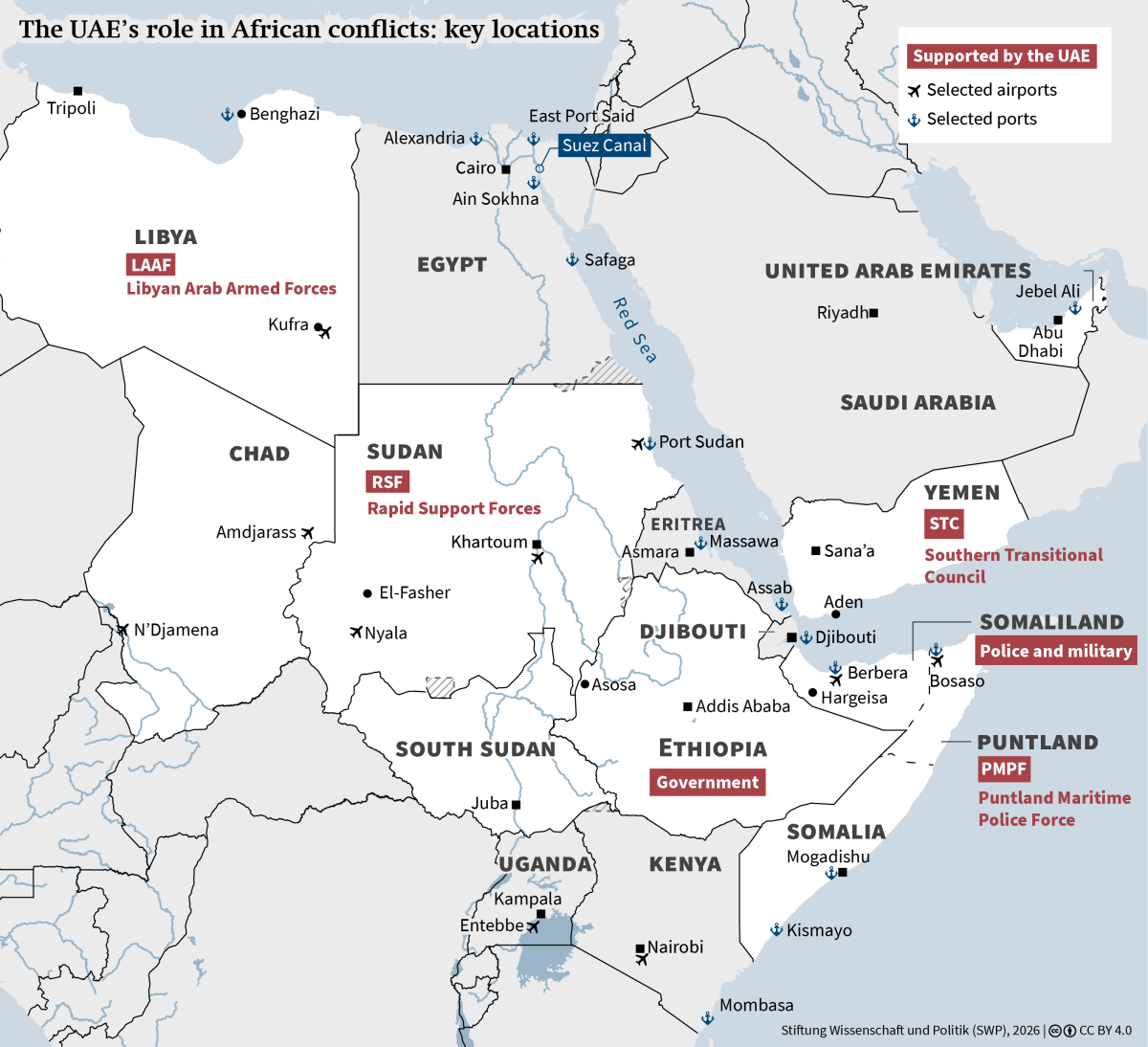
The UAE’s allies include Haftar’s LAAF in Libya, the RSF under Mohamed Hamdan Dagalo (Hemedti) in Sudan, the Puntland Maritime Police Force (PMPF) as well as the police and military forces of Somaliland in northern Somalia. According to numerous reports, the UAE supplies these groups, as well as the Ethiopian government, with weapons systems that are often decisive to the course of wars, such as advanced long-range drones. The UAE has also carried out its own air strikes against the government in Tripoli and in the Somali region of Punt­land, where it attacked a cell of the so-called Islamic State.

Three of the UAE’s local partners – the LAAF, the RSF and the PMPF – have tense or even hostile relations with their respec­tive central governments. They originate from para-state militias and control their own territory. Support for the Ethiopian government, particularly during the war in the country’s north in 2020–22, departs from this pattern, as in that case the Emir­ates strengthened the internationally recog­nised government against the Tigray Defense Forces (TDF). Nevertheless, all of these actors – and the UAE itself – are pursuing a disruptive agenda with regard to their political systems and aiming to shift the local balance of power.

The UAE’s toolkit also includes recruiting foreign fighters and mercenaries, transporting them to battlefields or deploying them for logistical support. As early as 2010, the UAE deployed a South African-run private military company to establish the PMPF in Somalia, allegedly for combating piracy. It later paid Sudanese mercenaries who fought on Haftar’s side in Tripoli. And in Sudan, the Emirati security firm Global Secu­rity Services Group organised the recruitment, transport and payment of several hundred Colombian mercenaries, including via a military base in the Emir­ates. When the US government imposed sanctions on the actors involved in 2025 (with the exception of the aforementioned Emirati security firm in question), it stated that these men had reinforced the RSF with “tactical and technical expertise, served as infantry and artillery personnel, as drone pilots, vehicle operators and instructors, some of whom even trained children for combat”.

Emirati activities in these conflict zones do not occur in isolation, but form part of a transnational network established by the UAE. Supplies to the RSF were routed, among other places, via LAAF-controlled areas of Libya (above all Kufra in the south), via N’Djamena and Amdjarass in Chad, and in some cases via stopovers in Kenya, Uganda and Rwanda. Bosaso in Puntland served as a base for supporting the PMPF, but also for transporting weapons from Yemen and Colombian mercenaries for the RSF. The UAE continually adapts these routes to respond to changes in the mili­tary situation or the positions of local rulers. To gain influence in the countries that form part of this logistical network, it deploys large sums of money. For instance, during a visit in June 2023, the UAE prom­ised Chadian President Idriss Déby a loan of US$1.5 billion. Emirati loans also helped the governments in Ethiopia and Kenya to overcome short-term financial difficulties. At the same time, the UAE profits from the export and smuggling of gold from conflict zones such as Sudan.

The Emirates denies most of these activities, particularly direct military support for parties to the conflict such as the RSF. After a 2024 report by the United Nations (UN) panel of experts referred to “credible” evi­dence of Emirati support for the RSF, there was no mention of this in the subsequent report, though it did appear in the leaked draft of that same report. The UAE points to the published, apparently amended version as proof of its alleged non-interference and even calls for a UN arms embargo for the whole of Sudan, whereas at present it applies only to Darfur.

The UAE has gone to considerable lengths to avoid international criticism. For instance, Emirati Minister of State Lana Nusseibeh spent four days in Brussels in November 2025 to meet with Members of the Euro­pean Parliament. In the Parliament’s reso­lution on Sudan, adopted at the same time, the UAE’s support for the RSF is not men­tioned, following opposition from the Euro­pean People’s Party to amendments tabled by left-wing parliamentary groups.

Economy, geopolitics and self-enrichment

The specific interests underlying the UAE’s actions in individual conflicts often remain unclear. Decisions are made within a small circle, with Mohammed bin Zayed Al Nah­yan, the Emir of Abu Dhabi and Emirati President, at its centre. Moreover, the thresh­old for intervention is low, as the UAE until recently bore hardly any political costs for these activities. These interventions do not necessarily follow a coherent overarching strategy. Nevertheless, certain underlying motives can be identified. For instance, the UAE’s security policies are frequently ex­plained by external economic interests. Indeed, in recent years the Emirates has emerged as one of the most important eco­nomic partners of numerous African states. The state-owned logistics groups DP World and AD Ports Group, based in Dubai and Abu Dhabi, operate or are developing ports and associated infrastructure in, among other places, Somalia, Senegal, Tanzania, Mozambique, Angola and Egypt. These port projects form part of strategically significant economic corridors designed to transport raw materials such as minerals, agricultural and energy commodities to international markets.

For the UAE, these corridors are essential also because they secure long-term access to strategic resources and trade routes. Such investments reflect an Emirati strategy to diversify the economy away from oil. Mili­tary interventions can therefore be under­stood as a means of safeguarding these eco­nomic interests.

However, given the impact of the UAE’s regional policies, this is at best a partial explanation. The UAE’s involvement often contributes to the destabilisation of eco­nomic spaces, suggesting additional motives that are not primarily economic. Foremost among these is the Emirates’ ambition to gain greater influence in the region and, with it, greater international significance. The primary aim is to hold its own against sig­nificantly stronger regional powers, such as Iran, but above all against its larger neigh­bour on the Arabian Peninsula, Saudi Arabia. Tensions between the two “brother states”, such as those that escalated in Yemen at the end of 2025, are by no means new. Whereas border disputes and wrangling over competences within the Gulf Coopera­tion Council used to dominate, the rivalry is now manifested predominantly in com­peting economic development and regional strategies. Both states are pursuing ambi­tious plans to establish themselves as cen­tral hubs for trade, logistics and investment between Africa, Asia and Europe. Since Riyadh forced Abu Dhabi to withdraw from southern Yemen, it has become clear just how serious these tensions are – with acute regional repercussions. Saudi Arabia, like Egypt and Somalia, temporarily closed its airspace to UAE supply missions bound for the RSF. Consequently, Ethiopia gained in importance as a logistical hub for such deliveries. Even the war with Iran, which has severely affected both the UAE and Saudi Arabia, did little to ease bilateral ten­sions. These tensions were also the reason why the Third International Sudan Confer­ence in Berlin on 15 April 2026 initially failed to produce a joint final declaration. At the end of April 2026, the UAE also announced its withdrawal from the OPEC+ oil cartel, a move likely to further strain its relationship with Saudi Arabia.

The ideological opposition of the ruling Al-Nahyan family in Abu Dhabi to the Mus­lim Brotherhood also significantly shapes its regional policies. The family seeks to preserve its authoritarian model of rule and opposes Islamist movements that pursue social mobilisation and demand political participation. Abu Dhabi therefore pursues a policy of actively containing such actors, which is reflected in both domestic repres­sion and an interventionist foreign policy. This became particularly evident during the blockade of neighbouring Qatar between 2017 and 2021, which was largely driven by Abu Dhabi. Qatar’s leadership was accused of supporting the Muslim Brotherhood in the region.

In African conflicts, too, the UAE often supports local actors such as the RSF, which explicitly opposes the Muslim Brotherhood or groups aligned with it. Yet, at times, the Emirates demarcation from other Islamist actors remains blurred. Security alliances are pragmatic in nature and do not neces­sarily align with the officially stated goals of counter-terrorism.

Finally, personal networks of members of the ruling families in Abu Dhabi and Dubai also play a role. Mansour bin Zayed, for instance, a brother of the President and chairman of the sovereign wealth fund Mubadala, has, according to media and research reports, close ties to local power actors in African conflicts, including Haftar in Libya and Dagalo in Sudan. Trade in and smuggling of gold and other resources pro­vide lucrative sources of revenue for both the RSF and the regular Sudanese military (Sudanese Armed Forces, SAF), as well as for their business partners in the UAE.

Escalation and spread of conflicts

The conflicts in Sudan, Ethiopia, Libya and Somalia each have their own causes and are not merely proxy wars. Nevertheless, exter­nal military and financial support – in this case from the UAE – encourages the con­flicting parties to pursue their goals by force. This has consequences: The war in Sudan has created the world’s largest humani­tarian crisis, measured by the number of people who, according to the UN, are de­pendent on humanitarian aid (33.7 mil­lion), have been displaced (at times more than 15 million) or are suffering from extreme hunger. The RSF, a partner of the UAE, is responsible for targeted violence against the Sudanese civilian population. This includes sexual violence, hostage-taking, looting, displacement, attacks on medical facilities and mass killings. Much of this violence is directed against members of non-Arab minorities such as the Masalit in West Darfur and the Zaghawa in North Darfur. The city of El-Fasher, which the SAF and its allies controlled until October 2025 as the last provincial capital in Darfur, was besieged by the RSF for a year and a half. During its capture of the city, the RSF pro­ceeded in such an organised manner against the non-Arab civilian population that a UN fact-finding mission described it as having the hallmarks of genocide.

The UAE’s logistical network, established primarily to support the RSF, is helping to link conflicts in various countries more closely. Since autumn 2025, the UAE has set up a training camp for the RSF in Beni­shangul-Gumuz in western Ethiopia. Mili­tary equipment intended for the RSF, some of it apparently arriving via the city of Berbera in Somaliland, also appears to be rerouted via a base of the Ethiopian armed forces. At the same time, the RSF has launched an offensive in the south of Sudan’s Blue Nile state, in which it is ap­parently also deploying units from South Sudan.

The UAE’s logistical support to the RSF via Chad threatens the fragile balance there. Several ethnic groups in Darfur – and therefore the local parties to the conflict – have close ties to Chad, from where some of the fighters also originate. President Déby at least temporarily allowed the UAE to use the country as a logistical hub to support the RSF. This fuels tensions within the Chadian military elite, since the RSF recruits pre­dominantly from Arab groups and fights against units drawn from the Zaghawa – Déby’s own group. Repeated clashes be­tween the RSF and the Chadian army in the border area suggest that the conflict could escalate.

Libya illustrates the potential long-term consequences for Europe of Emirati inter­ventionism. There, the UAE’s early interven­tion in support of Haftar was a key reason why his attack on Tripoli in April 2019 turned into a protracted civil war. It lasted for more than a year and resulted in a per­manent Turkish and Russian military presence in the country. Whether the UAE financed the involvement of the Russian Wagner Group in this conflict, as the US Defense Intelligence Agency claimed in 2020, remains unclear. What is certain, how­ever, is the UAE’s close cooperation with Wagner during the war: Wagner’s logistics relied in part on transport flights from the UAE, the UAE deployed Pantsir air defence systems that were operated by Wagner personnel, and the latter provided target coordinates for Emirati drones. The Emirates therefore shares some of the responsibility for the now entrenched Rus­sian military presence in Libya, and thus for the country’s ongoing division.

The humanitarian consequences of the conflicts in which the UAE intervenes are far-reaching – although the UAE itself remains largely insulated from them. The massive refugee crisis caused by the war in Sudan weighs particularly heavily on neigh­bouring states. However, it has also led to a growing number of Sudanese refugees arriving in Europe via the Mediterranean. Among arrivals in Italy, both the number and the proportion of Sudanese nationals doubled between 2024 and 2025, from 3 to 6 per cent. In Greece, Sudanese refugees already constituted the second-largest group in 2025, accounting for more than a fifth of the total.

Undermining international conflict resolution

A consistent pattern emerges not only in the UAE’s interventions, but also in its ap­proach to international conflict resolution. The Emirates participates in diplomatic pro­cesses aimed at ending conflicts, but it uses the international stage primarily to present itself as an ostensibly constructive actor.

The most prominent example of such diplomatic manoeuvring is the Quad for­mat (Egypt, Saudi Arabia, the UAE and the United States), which in September 2025 presented joint commitments for a ceasefire in Sudan. These included an end to external support, which, according to US intelligence reporting, the UAE in fact further intensified in 2025. These diplomatic initiatives served more to allow the RSF once again to present itself as a willing partner for a ceasefire while carrying out a massacre.

The UAE also positions itself as a humani­tarian donor for Sudan. At a conference or­ganised jointly with the African Union, the regional economic community IGAD and Ethiopia in February 2025, it pledged US$200 million, followed by a further US$500 mil­lion at a US conference in 2026. However, it is unclear where these funds are going, as the UAE contributed only around US$33 million to the UN-coordinated plan in 2025. Germany had already witnessed during the Berlin Libya Process (2019–20) how the UAE undermined diplomatic efforts: Despite pledges (together with Russia and Turkey) to cease support for the Libyan par­ties to the conflict, that support was in fact intensified. Even on the day of the Berlin Libya Conference in January 2020, trans­port aircraft flew from the Emirates to east­ern Libya. Consequently, the war did not end as a result of diplomatic efforts, but because of the military balance of power created by these interventions. Both Libya and, currently, Sudan demonstrate that, with­out pressure, including the UAE in con­flict resolution processes does not produce results.

The UAE’s actions also undermine a key instrument of multilateral conflict resolu­tion: arms embargoes. The UAE’s open dis­regard for the UN embargo on Libya from 2014 onwards, and particularly during the Tripoli war in 2019–20, likely encouraged states such as Turkey to adopt a similar approach. The same has applied to Sudan since 2023. A report from a UN panel of experts lists 458 flights involving heavy transport aircraft from military airports in the UAE or from the Emirati transhipment hub of Bosaso to eastern Libya between October 2024 and the end of 2025. These included 239 flights to Kufra, a hub for support to the RSF. These shipments likely violated both the UN arms embargo on Libya and that on Darfur. At the same time, it is clear that support for the SAF from Egypt, Saudi Arabia, Russia, Turkey, Iran and other countries is also fuelling the war.

In both conflicts, Western governments have been conspicuously reluctant to criti­cise the UAE, which also prevents them from pressing other intervening states more forcefully to comply with the embargoes. To date, no member of the UN Security Council has explicitly addressed the UAE’s support for the RSF in meetings. This leni­ency towards Emirati interventionism has contributed significantly to the loss of cred­ibility of the sanctions regimes.

Not a constructive partner

This analysis of Emirati interventions in Africa shows that the UAE has not, to date, been a reliable partner for European efforts at conflict prevention and resolution on the continent. Rather, the country acts as a spoiler whose interventions exacerbate local conflict dynamics, entrench war economies and drive state fragmentation. The conse­quences are not only disastrous for the societies affected, but also impact European interests – ranging from regional stability and migration to safeguarding multilateral order.

This assessment is by no means new. Even so, the UAE has so far not had to reckon with any tangible political consequences from Germany and its European partners for its actions. In the overall balance, other aspects of the bilateral relationship predominate: economic and trade interests; security co­operation, which has taken on even greater significance amid the Iran war; the UAE’s close cooperation with Israel; the strategic goal of preventing the Emirates from drift­ing further towards China or Russia; and, more recently, cooperation in the field of artificial intelligence.

There is an urgent need for a sober and comprehensive review of relations with the UAE, especially since other aspects have so far been neglected. These include, for in­stance, the Emirates’ ambivalent to obstruc­tive role in international climate negotiations, its pragmatic to friendly dealings with Russia, as well as its efforts to exert political influence in Europe – including relations with right-wing populist to far-right parties and support for networks spreading disinformation. Emirati foreign policy in Africa is therefore not an isolated shortcoming of an otherwise constructive partner. Rather, it should be understood as the expression of a consistent approach aiming to project power: The UAE promotes disruptive actors and systematically links military support with commercial and ideo­logical interests.

This approach could be intensified fur­ther in the future. Following the UAE’s withdrawal of its remaining troops from Yemen at the turn of 2025/26 due to differ­ences with Saudi Arabia, African theatres have become even more strategically impor­tant: as hubs along the trade and energy routes through the Red Sea, as locations for port and logistics projects as part of an expansionary foreign trade policy, as gate­ways to raw materials and as zones of mili­tary influence. The fact that logistical sup­port for the RSF in Sudan continued even amid Iranian attacks on the UAE demonstrates the importance the Emirates attaches to this policy. The Emirates’ recently ini­tiated cooperation with Israel in establishing a military presence in Somaliland like­wise reflects such ambitions.

At the same time, Abu Dhabi is likely to be far more interested now than before in not jeopardising its good relations with European states. Growing criticism of Emir­ati policy in Middle Eastern states, tensions with Saudi Arabia, and the economic and security vulnerabilities exposed by the Iran war present an opportunity to exert more effective pressure on the UAE. Specifically, Germany and its European partners have five courses of action available to them in order to encourage a more constructive Emirati regional policy.

First, the reputational dimension should be utilised more effectively towards Abu Dhabi. The UAE attaches great importance to its image as a modern, stable and respon­sible actor. Addressing its destabilising activ­ities more openly in international forums can generate political pressure. Instead of merely speaking in general terms about ex­ternal support for conflict actors in Africa, Germany should explicitly mention both the UAE and other states involved, without allowing itself to be drawn into Gulf rival­ries. Reputational damage can also have economic consequences, as in the case of the alleged involvement of the former head of DP World in the Epstein network – he resigned following the intervention of a Canadian pension fund.

Second, the EU should expand its financial sanctions and apply them more con­sistently, particularly where Emirati actors have been documented as violating UN em­bargoes or supporting belligerents.

Third, Germany’s arms export policy towards the UAE should be fundamentally reviewed. For despite the Emirates’ increased need to protect itself against Iranian attacks, the risk of German arms being transferred or used in third-country conflicts remains real. For instance, the UAE equipped Haftar’s offensive on Tripoli in Libya with Pantsir air defence systems mounted on MAN/Rhein­metall chassis. The French Galix defence system was deployed on UAE armoured vehicles in Sudan.

Fourth, stricter criteria could be applied in the enforcement of anti-money-launder­ing and transparency rules. European regu­lation should focus more on the role of Emirati financial centres as hubs for con­flict economies, informal capital flows and sanctions evasion. Although the UAE was removed from the Financial Action Task Force’s “grey list” in 2024 following the introduction of anti-money-laundering reforms, civil society organisations and transparency initiatives criticised this deci­sion as premature. They pointed to persis­tent structural deficits in enforcement, as well as the continued attractiveness of Emirati financial centres for problematic capital flows.

Fifth, diplomatic engagement also needs to be reassessed. The “strategic partnership” that Germany has maintained with the UAE since 2004 suggests a broad alignment of interests. Failing to at least suspend this part­nership in light of the UAE’s interventions in conflicts undermines Germany’s stated commitment to reliable, rules-based behaviour. Such a partnership makes sense only if the Emirates demonstrably reorients its policy in Africa towards de-escalation, thereby allowing Abu Dhabi’s considerable financial weight and political networks to be harnessed for constructive conflict reso­lution.

Dr Gerrit Kurtz is an Associate, Dr Wolfram Lacher a Senior Associate, and Dr Stephan Roll a Senior Fellow in the Africa and Middle East Research Division at SWP.

Horn von Afrika: Geopolitische Folgen

Erschienen in: Nicolai von Ondarza, Azadeh Zamirirad (Koord.), Perspektiven auf Trump II aus Europa, Nahost und Afrika, Berlin: Stiftung Wissenschaft und Politik, 20.01.2025 (360 Grad)

Am Horn von Afrika erhoffen sich einige Akteure, die Gunst der kommenden US-Administration für ihre jeweilige Agenda zu gewinnen. Transaktionale, kurzfristig orientierte Politik, die Donald Trump oft zugesprochen wird, ist hier bereits weit verbreitet. Dabei dürfte die neue US-Regierung diese Region primär vor dem Hintergrund ihrer globalen Konkurrenz mit China sowie als Fortsetzung der eigenen Nahostpolitik betrachten. Das schließt die enge Zusammenarbeit mit Ländern wie den Vereinigten Arabischen Emiraten (VAE), Ägypten und Saudi-Arabien ein, die eine zentrale Rolle am Horn von Afrika spielen. Die VAE haben beispielsweise massiv in Äthiopien, Somaliland und die sudanesischen Rapid Support Forces (RSF) investiert.

In Äthiopien unterstützten die USA während der ersten Präsidentschaft von Trump den damals neuen Premierminister Abiy Ahmed so klar, dass dieser sich ermutigt fühlen konnte, kompromisslos gegen die frühere Regierungspartei der Tigray People’s Liberation Front (TPLF) vorzugehen. Die von den Golfmächten geförderte Zusammenarbeit zwischen Abiy und Eritrea spielte dabei ebenfalls eine wichtige Rolle. Unter Biden spielten die USA eine wesentliche Vermittlungsrolle, um den Krieg zwischen der TPLF und der äthiopischen Regierung zu beenden und den Friedensprozess zu begleiten. Diese könnte jetzt zurückgefahren werden.

Somaliland hofft, von der neuen US-Regierung als völkerrechtlich unabhängig von Somalia anerkennt zu werden. Mehrere Republikaner befürworten einen entsprechenden Schritt. Eine Passage im »Project 2025« konservativer Organisationen verweist ebenfalls auf die Möglichkeit, Somaliland anzuerkennen. Eine größere militärische Zusammenarbeit mit Somaliland sollte in dieser Argumentation dem wachsenden chinesischen Einfluss im benachbarten Dschibuti Rechnung tragen, wo sowohl die USA als auch China eine Militärbasis betreiben. Gleichzeitig gibt es im republikanischen Lager Vorbehalte gegenüber der bisherigen militärischen Unterstützung der somalischen Regierung in Mogadischu. 

Die sudanesischen Streitkräfte, die sich seit April 2023 im Krieg mit den RSF befinden, bemühen sich um die Anerkennung als legitime Regierungsvertretung durch die USA. Auch hier gibt es Sympathien im republikanischen Lager. Allerdings müssten sich die Streitkräfte dafür wahrscheinlich von ihren aktuellen Verbündeten Iran, Russland und der Sudanesischen Islamischen Bewegung distanzieren. In jedem Fall müsste Washington die gegensätzlichen Einflüsse seiner Partner in Kairo und Abu Dhabi ausbalancieren. Die mangelnde Rücksichtnahme und teilweise offene Parteinahme der neuen Trump-Administration könnten somit die Spannungen am Horn von Afrika weiter verschärfen. 

Escalations Risks in the Horn of Africa

Threats from Egypt, Ethiopia, and Somalia Exacerbate Local Conflicts

SWP Comment 2024/C 50, 28.10.2024, together with Stephan Roll and Tobias von Lossow

In recent months, relations between Ethiopia, Egypt, and Somalia have deteriorated significantly. Previously separate disputes have become intertwined: namely the conflict between Egypt and Ethiopia over the use of Nile waters and the disagreement between Ethiopia and Somalia regarding the recognition of Somaliland. The three countries use threats to improve their respective positions in these conflicts. While an inter-state military escalation does not seem imminent at present, regional ten­sions are likely to rise, which could further empower the jihadist Al-Shabaab militia in Somalia. Germany and the European Union (EU) should recognise the highly com­plex interdependence of these lines of conflict, remind the countries concerned of their common interest in stabilising Somalia, and continue to advocate for dialogue in the Nile dispute. At the same time, it is also important to hold other influential actors more accountable to contribute to regional stability.

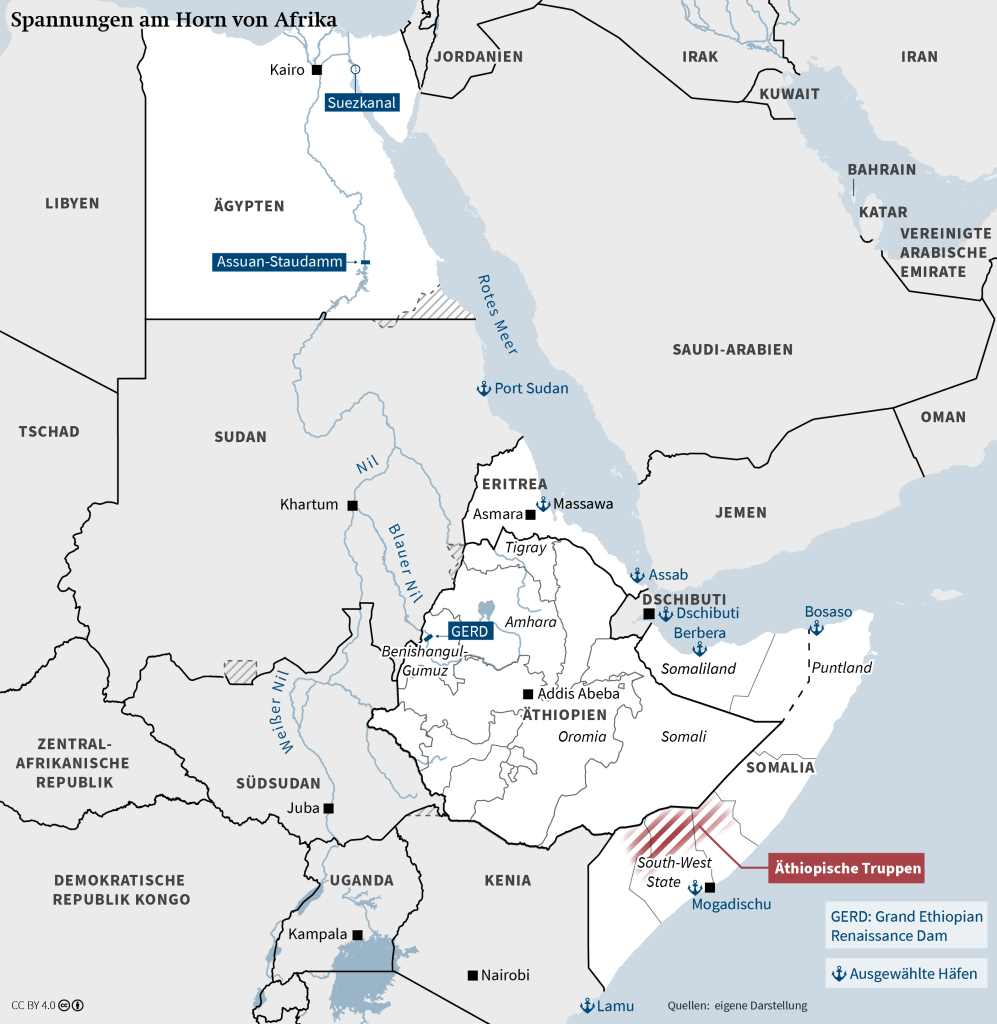
The immediate trigger for the current ten­sions is the supply of weapons from Egypt to Somalia as a result of a security agreement signed by the two countries in August 2024. In addition, there were reports that Egypt, with agreement from Somalia, is planning to send several thousand soldiers to the Horn of Africa to fight Al-Shabaab and replace the Ethiopian troops that have been stationed there thus far as part of the African Union (AU) mission, which expires at the end of this year. In response, Ethio­pian Prime Minister Abiy Ahmed warned that his country would “humiliate anyone who dares to threaten us”. Apparently as a deterrent, the Ethiopian military deployed heavy weapons at the border with Somalia.

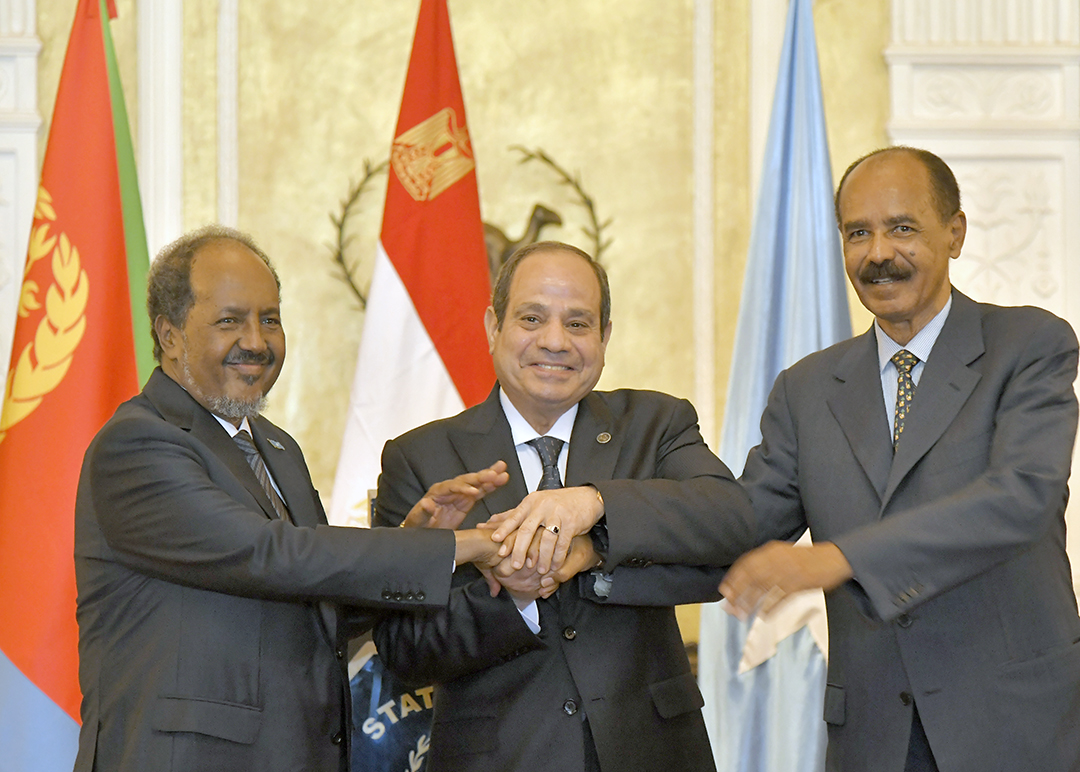
In Somalia, the foreign minister threat­ened to support armed groups in Ethiopia if Addis Ababa did not stop its steps towards diplomatic recognition of Somaliland. Somalia has received support not only from Egypt, but also from Eritrea: At a tripartite summit in October in Asmara, the presi­dents of the three countries agreed to inten­sify their security cooperation. At almost the same time, Egypt lodged a complaint with the United Nations Security Council (UNSC), accusing Addis Ababa of jeopardising its water security by commissioning the Grand Ethiopian Renaissance Dam (GERD). Ethiopia, in turn, claimed that Egypt had repeatedly threatened it with violence. It is apparent that two central conflicts in the Horn of Africa are becoming increasingly interlinked and are therefore intensifying.

Egypt’s water worries

Egypt’s conduct in the Horn of Africa can also be explained by its long-standing dis­pute with Ethiopia over the use of the Nile’s water. This past summer, the conflict has once again intensified with the fifth phase of filling the GERD’s reservoir. For Egypt, which meets over 90 per cent of its water needs from the Nile, the construction of the gigantic dam since 2011 at the upper reaches of the Blue Nile poses a significant threat to its own water supply and there­fore to national security. For years, Ethiopia has been vigorously pushing ahead with the completion of the dam project, which is intended to significantly contribute to meet­ing the country’s immense energy needs. In contrast, Egypt insists on its right to veto construction projects on the upper Nile and on a bilaterally agreed water shar­ing formula with Sudan. Cairo attributes both rights to treaties from the colonial era, which Ethiopia and the other upstream riparians reject as they were not part of these treaties.

Diplomatic efforts to resolve the water dispute, including the GERD negotiations in which external actors such as the United States of America (USA), the AU, and the United Arab Emirates (UAE) mediate, have largely stalled. The same applies to coopera­tion within the framework of the Nile Basin Initiative (NBI), which was established in 1999. In recent years, Cairo’s negotiating position has increasingly deteriorated. On the one hand, construction on the dam is significantly advanced, with the project nearing completion and electricity produc­tion already underway. The third and fourth turbines were connected to the grid in August 2024, with the rest of the 13 tur­bines due to follow in the coming months. On the other hand, Egypt has lost its key ally in the water conflict. Sudan, which long supported Egypt and pursued its own water interests, has effectively withdrawn from the negotiations as an independent actor due to its ongoing civil war. Khartoum also benefits from the GERD, particularly from protection against regular flooding.

In addition, with South Sudan’s ratification in July, the Nile Basin Cooperative Framework Agreement (CFA) came into force in October 2024. This agreement establishes the permanent Nile River Basin Commission (NRBC), which initially includes six upstream riparian states, albeit exclud­ing Egypt and Sudan. Concluding a frame­work agreement between all 11 riparian states, which sets out the principles, struc­tures, and institutions for joint, basin-wide water management, was one of the main objectives of the NBI. However, since up­stream and downstream riparian states failed to agree on such an accord for over ten years, Egypt and Sudan were ultimately left out when the CFA was signed in May 2010 by Ethiopia, Tanzania, Uganda, and Rwanda – followed soon after by Kenya and Burundi. After all signatories except Kenya had ratified the agreement, South Sudan became the sixth state that needed to implement the CFA.

Egypt’s attempts to bolster its negotiating position on the Nile through security agree­ments with various states in the region, such as South Sudan, the Democratic Republic of the Congo, Uganda, and Rwanda, have thus far been proven unsuccessful. Even after President Abdelfattah al-Sisi and Prime Min­ister Abiy agreed at a face-to-face meeting in Cairo in July 2023 to resolve the outstand­ing issues within four months, no progress was made. As a result, Egypt has started to intervene in the conflict between Ethiopia and Somalia to also exert pressure on Addis Ababa.

Ethiopia’s port ambitions

While Ethiopia and Somalia had previously maintained close diplomatic relations for several years, bilateral relations have rapidly gone downhill since the beginning of 2024. The reason? The Memorandum of Understanding (MoU) signed by Prime Minister Abiy and President Muse Bihi Abdi of Soma­liland in January. The MoU, the text of which has not been published, stipulates that Ethiopia will lease a 20-kilometre coastal strip for 50 years to establish a naval base there. In addition, Ethiopia is to be given economic access to a harbour of the de facto state. In return, Ethiopia promised Somali­land a stake in Ethiopian Airlines and held out the prospect of considering the recog­ni­tion of Somaliland as an independent state.

To date, no UN member state has recognised Somaliland’s independence, which the autonomous region proclaimed in 1991. Nevertheless, various states maintain pri­marily economic relations with Somaliland. For example, the UAE has invested several hundreds of million USD in the expansion of the port of Berbera, which is operated by the Emirati company DP World since 2017, as well as in logistical infrastructure with Ethiopia on both sides of the border. At the time, Ethiopia and DP World signed an agreement under which Addis Ababa was to contribute 19 per cent of the port expan­sion. However, Ethiopia lost this claim in 2022 after the war-torn country failed to provide the promised funds.

With the MoU, Ethiopia is now taking a different approach to achieving its goal of its own access to the sea. Abyi’s government sees this as compensation for a “historical mistake” made by his predecessors when they granted Eritrea independence in 1993 and thus gave up access to the sea. As a result, Ethiopia is now the most populous country without a coastline. Around 95 per cent of all Ethiopian imports and exports currently pass through the port of Djibouti. The annual fees for this are up to around US$1.5 billion, which Ethiopia must pay in scarce foreign currency.

The leadership in Mogadishu firmly rejected the MoU. Somalia views the recog­nition of Somaliland by Ethiopia, which could be followed by other states, as a vio­lation of its sovereignty. In April 2024, Somalia expelled the Ethiopian ambassador from the country and withdrew its own representative from Addis Ababa. Meanwhile, Ethiopia appointed an ambassador to Somaliland in August 2024.

Somali President Hassan Sheikh Mohamud successfully sought diplomatic support, both in the region and from international players, including the G7 states. In this con­text, Somalia and Egypt concluded a secu­rity agreement in August 2024. It was on this basis that Egypt delivered weapons to Mogadishu two weeks later.

Risk of war between Egypt and Ethiopia

Military threats from Egypt in its water dis­pute with Ethiopia are not new. However, a direct Egyptian attack on the GERD con­struction site was long considered unrealistic due to the limited range of Egypt’s Air Force. Furthermore, Egypt, as a downstream state, would not achieve its main objective through military action, as Ethiopia could then deliberately reduce the Nile water flow at the dam to exert pressure on Egypt. Now that the reservoir is filled, such an attack also harbours unpredictable risks for the water flow of the Nile and would trigger a catastrophic flood in Sudan. Nevertheless, the deployment of Egyptian troops in Soma­lia could increase the risk of a direct mili­tary conflict between the two countries.

Should hostilities actually occur, Cairo would undertake considerable risk. Al­though the country has by far the largest armed forces in Africa and an extensive arsenal of weapons, this does not necessarily translate into actual military power. For example, the armed forces suffered heavy losses in the fight against insurgent groups in the Sinai Peninsula after 2013. It was only in the past two years that the security situation was gradually brought under con­trol. Despite having troops stationed in Soma­lia, a military operation outside its own borders would be much more chal­lenging, not least due to the distance, while Ethiopia could act from its own territory. Should armed action by Egypt result in massive losses or even failure, this could lead the Egyptian population to openly ques­tion the role of the armed forces in the country’s politics and economy. Civil society is already critical of the army’s pre­occupation with managing a vast, inefficient economic empire.

There is also no conceivable international and regional backing for military action. Cairo is heavily dependent on the Gulf States and the USA. The UAE, in particular, has become Egypt’s most important state creditor in recent years. Meanwhile, the USA provides around US$1.3 billion annually in military aid, which makes up an integral part of Egypt’s defence budget. As both coun­tries also maintain close relations with Ethiopia, an Egyptian military move could jeopardize this critical financial support.

Cairo’s actions are therefore unlikely to aim at a direct military confrontation with Addis Ababa. Rather, the threat of escalation is intended to persuade external actors to become more involved in the Nile water dispute on Egypt’s behalf. There has been no such internationalisation of the conflict to date, although Cairo has sought this for years. Above all, Cairo would like to see Ethiopia’s regional opponents strengthened militarily.

In addition to local groups in Somalia and Ethiopia, Cairo is likely to focus on Eritrea. Asmara’s relations with Ethiopia have deteriorated significantly since 2022 when Eritrea fought alongside Ethiopian troops against the Tigray People’s Liberation Front (TPLF). Eritrea opposes the Pre­toria Agreement between the Ethiopian government and the TPLF, which ended that war, as it thwarted Eritrea’s goal of destroying the TPLF once and for all. Border disputes and Ethiopia’s quest for direct access to the sea, possibly again in Eritrea, are further exacerbating tensions. As a result, Asmara has emphatically intensified its relations with Cairo. The summit be­tween Egypt, Eritrea, and Somalia in Octo­ber is a visible sign of that rapprochement. Nevertheless, Eritrea is unlikely to simply become Egypt’s stooge. Instead, it would rather pursue its own interests in the medium term, namely the establishment of a buffer zone on Ethiopian territory. The Ethiopian federal government currently appears to tolerate the presence of Eritrean troops in northern Tigray.

Nevertheless, a direct clash between Egyptian and Ethiopian troops cannot be completely ruled out should Cairo actually station a significant number of soldiers in Somalia. This risk increases all the more if Ethiopia refuses to withdraw its troops from Somalia. Egypt could cite the defence of So­mali interests and create a naval blockade of Somaliland, or in the worst-case scenario, attempt to expel Ethiopian troops.

A “game of chicken” between Ethiopia and Somalia

Two factors significantly mitigate the risk of an armed conflict between Ethiopia and Somalia: the military balance of power and shared interest in fighting Al-Shabaab.

While Ethiopia’s army is strongly in­volved in fighting several insurgencies and weakened by the 2020–22 war in the north of the country, it remains one of the largest military powers in the region. It possesses drones, helicopters, fighter planes, and heavy weaponry, among other equipment. In contrast, the Somali security sector remains a work-in-progress. It is not even able to effectively protect Mogadishu from attacks by Al-Shabaab. The Somali security forces are divided between units under dif­ferent commands of the federal government, the federal member states, and clan militias that operate incoherently. Despite successes in training some units, the Somali security forces remain heavily dependent on international military and financial sup­port, including from the AU, EU, USA, Turkey, Kenya, and Ethiopia.

Ethiopia and Somalia have long been united in the fight against Al-Shabaab. Addis Ababa wants to contain the jihadist group’s capabilities in its neighbouring country, maintain a buffer zone, and thus prevent it from attacking Ethiopia. In July 2022, hundreds of Al-Shabaab fighters crossed the border and advanced around 150 kilometres into the Ethiopian interior until they were repelled. The invaders are said to have included many Ethiopian nationals from the Somali and Oromia regions.

Due to this threat situation, Ethiopia is currently deploying around 10,000 of its own soldiers in Somalia. Only about a third so far have been part of the AU Transition Mission in Somalia (ATMIS). Addis Ababa has deployed the rest on its own initiative. These troops co-operate closely with those of the respective Somali federal member states and local militias. The Somali federal government had tolerated these troops for years (similar to Kenyan units in the south of Somalia) because they serve to provide security in their areas of operation.

The threatening behaviour of Ethiopia and Somalia reflects this unequal balance of power. Ethiopia is calculating that Soma­lia cannot afford to expel the Ethiopian troops from the country because they are making a decisive contribution to the fight against Al-Shabaab. In this logic, Somali re­actions to the MoU with Somaliland would thus fizzle out. Conversely, the Somali gov­ernment has now announced that if Ethio­pia does not withdraw the MoU then Ethiopian troops need to leave the country by the end of December 2024 when ATMIS ends. Somalia is counting on the fact that Ethiopia cannot afford to withdraw. The question is who will give in first.

Escalation of internal conflicts as the real danger

While direct conventional armed conflict between the states involved is currently rather unlikely, both Ethiopia and Somalia are susceptible to both intentional and un­intentional escalations due to their internal divisions.

The biggest risk is that the Ethiopian-Somali disagreements could further boost Al-Shabaab. The group has already been able to benefit from the partial withdrawal of ATMIS because Somali security forces thus far have been unable to fill the gap. In addition, the so-called Islamic State is spreading in Puntland.

It is still unclear what exactly the successor mission to ATMIS, whose mandate ex­pires at the end of December 2024, will look like. In August 2024, the AU Peace and Security Council adopted an operational plan for a new mission under the name AU Support and Stabilisation Mission in Soma­lia (AUSSOM), which is supposed to replace ATMIS in January 2025. However, it has not yet been clarified which countries will pro­vide troops or how the mission will be financed. Egyptian troops could take the lead, along with a presumably smaller con­tingent offered by Djibouti. However, it remains to be seen who will provide the rest of the planned 12,000 soldiers (ATMIS cur­rently has around 12,600). More troops from the current contributors, namely Kenya and Uganda, are possible. In principle, AUSSOM is planned to continue for five years, grad­ually handing over increasing responsibility to the Somali security forces.

If the Ethiopian troops do indeed withdraw and are replaced by Egyptian troops, the latter are likely to have difficulties con­trolling the security situation, at least dur­ing the transition period. The Ethiopian armed forces have built up local networks over more than a decade and have equipped and trained local militias. Egypt would first have to painstakingly establish these con­tacts. Meanwhile, Al-Shabaab could con­tinue to spread both in Somalia and pos­sibly on the border with Ethiopia. Furthermore, it cannot be ruled out that weapons destined by Egypt for the Somali government could find their way to Al-Shabaab.

The AU is hoping for funding through a new mechanism created by the UNSC in December 2023. Under this mechanism, 75 per cent of future AU missions could be paid for from UN compulsory contributions. However, this requires approval by the UNSC. The UN and AU are scheduled to present a plan for the design and financing of AUSSOM by mid-November. The decision could come too late to guarantee a seamless transition from the current to the successor mission. For this reason, bridge financing is already being discussed, for which attention focusses on the most important source of funding to date: the EU. However, currently the EU opposes continued funding of an AU deployment.

Another dimension of the conflict is the relationship between the Somali federal government and Somali member states. There have already been several demonstrations in the Somali South-West State calling for the continued presence of Ethiopian troops. The President of the South-West State, Abdiaziz Laftagareen, also spoke out against the deployment of Egyptian troops and in favour of keeping the Ethiopian con­tingents deployed in his state.

Relations between Mogadishu and the federal member states are already strained. At the end of March, Puntland announced that it would withdraw from the country’s federal system after the federal government had pushed the first chapters of a constitutional reform through parliament. A few days later, Puntland representatives met with an Ethiopian state secretary. Ethiopia could continue to offer an open door to dis­satisfied political stakeholders in Somalia in the future and thus influence the politi­cal situation there. There have been armed clashes between Somali federal member states and the government in Mogadishu at various times in the past. Somalia’s foreign ministry has already accused Ethiopia of sup­plying weapons to Puntland.

Conversely, Ethiopia is exposed to the risk that armed groups in the country could be supported from outside. For example, external support for the Ogaden National Liberation Front (ONLF) in Ethiopia’s Somali State would be conceivable. Although the ONLF declared a ceasefire with the govern­ment in 2018, the movement complained in September 2024 about Ethiopian troop deployments, which it saw as a “militarisation” of the state and threat to peace.

Other intervention possibilities exist in Amhara, Oromia, Benishangul-Gumuz (where the GERD is located), and Tigray. In the past, the Ethiopian government has repeatedly accused Egypt of supporting various armed groups in Ethiopia. These in­clude Gumuz militias, which tried to block the main road to the GERD a few years ago, as well as the TPLF during the war in the north.

The currently most active centres of con­flict in Ethiopia are the regions of Amhara and parts of Oromia. The Fano militias in Amhara have benefited from past training by Eritrean forces– a support that may still be ongoing. In August 2024, Ethiopian and Kenyan intelligence services reported a co­operation between the Oromo Liberation Army, which is fighting the Ethiopian gov­ernment, and Al-Shabaab in Somalia.

Policy options for Germany and the EU

Germany and its European partners should take the geopolitical tensions in the Horn of Africa seriously and ensure that they are not exacerbated by one-sided positioning or ill-conceived financial incentives. Although an inter-state war is currently unlikely it cannot be completely ruled out due to mis­understandings, ill-considered missteps, and emotional responses on all sides. In any case, the tensions are making further regional cooperation more difficult at a time when there are already major chal­lenges in the region: the war in Sudan, the Houthis’ attacks on shipping in the Red Sea, and the strengthening of Al-Shabaab and the so-called Islamic State in Somalia.

It is important that Germany and the EU think about the complex conflicts in the region together and not in isolation. Euro­peans should not allow themselves to be tempted by the power games of Egypt, Ethiopia, and Somalia to support unilateral agendas in the name of dubious promises of stability.

Regarding Somalia, the Europeans should make it clear that transitional financing of AUSSOM from the European Peace Facility must not play to the hands of Egypt’s threat against Ethiopia. A possible compromise could be that if Somalia insists on Egyptian military involvement, such troops could be stationed in Mogadishu to train security forces there, while Ethiopian troops con­tinue to directly support the fight against Al-Shabaab in other states. The EU should continue to reject the unilateral recognition of Somaliland under international law.

In the conflict over the utilisation of the Nile water, Germany and the EU should work to ensure that the NRBC is not ex­ploited by individual riparian states to fur­ther weaken Egypt’s position when the CFA will be implemented. The NRBC should only be supported if its activities are truly basin-wide, comply with international legal standards, and thus implicitly protect Egypt’s Nile water interests. The Europeans should also work to maintain the NBI for the exchange of information on Nile water issues between NBRC members and other riparian states or to establish a comparable low-threshold (dialogue) platform that all Nile riparian states can join without obli­gation.

Finally, Europeans should continue to endeavour to better coordinate their overall engagement in the region. External actors with influence on the concerned governments should also be held accountable to promote conflict resolution approaches. Turkey is already serving as a mediator between Ethiopia and Somalia, albeit so far without success. The UAE has a special role to play: It has strong economic interests in the Horn of Africa, particularly through investments in harbour infrastructure and agriculture, and is one of the most impor­tant state creditors. Financial aid and – in the case of Ethiopia – military support have contributed significantly to the con­solidation of power of the current political leaderships in Cairo and Addis Ababa and increased their willingness to take foreign policy risks. Nevertheless, the UAE has lacked vision for regional order. Its con­tribution to constructive conflict resolution remains small – a fact that should be ad­dressed more assertively with Abu Dhabi.

Eskalationsrisiko am Horn von Afrika

Drohgebärden aus Ägypten, Äthiopien und Somalia verschärfen lokale Konflikte

SWP-Aktuell 2024/A 52, 21.10.2024, zusammen mit Stephan Roll und Tobias von Lossow

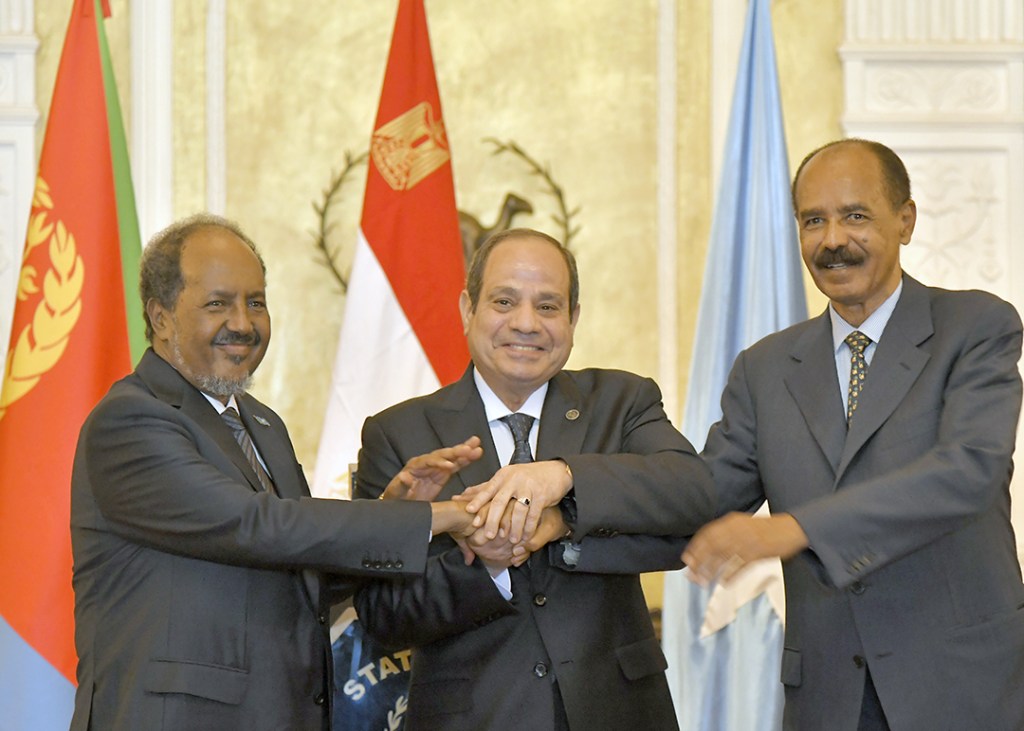
Der somallische Präsident Hassan Sheikh Mahmud, der ägyptische Präsident Abdelfattah al-Burhan und der eritreische Präsident Isaias Afwerki, Asmara, 10.Oktober 2024.

In den letzten Monaten haben sich die Beziehungen zwischen Äthiopien, Ägypten und Somalia deutlich verschlechtert. Neu ist dabei die Verknüpfung der bisher separat betrachteten Streitfälle zwischen Ägypten und Äthiopien um die Nutzung des Nilwassers und zwischen Äthiopien und Somalia um die Anerkennung Somalilands. Die drei Hauptakteure setzen derzeit vor allem auf Drohgebärden, um ihre jeweilige Position in diesen Konflikten zu verbessern. Zwar ist eine zwischenstaatliche militärische Eskalation derzeit unwahrscheinlich, jedoch dürften sich die regionalen Spannungen verschärfen und der jihadistischen Al-Shabaab-Miliz in Somalia weiteren Auftrieb geben. Deutschland und die EU sollten die sehr komplexe Verflechtung der Konfliktlinien anerkennen, die betroffenen Länder an das gemeinsame Interesse erinnern, Somalia zu stabilisieren, und sich weiterhin für Dialog im Nilstreit einsetzen. Gleichzeitig gilt es, auch andere einflussreiche Akteure stärker in die Verantwortung zu nehmen.

Der unmittelbare Auslöser der aktuellen Spannungen sind Waffenlieferungen Ägyptens an Somalia infolge eines Sicherheitsabkommens, das beide Länder im August 2024 geschlossen haben. Hinzu kamen Berichte, dass Ägypten im Einvernehmen mit Somalia plant, mehrere Tausend Soldaten zur Bekämpfung Al-Shabaabs ans Horn von Afrika zu entsenden und die äthiopischen Truppen abzulösen, die dort bislang unter anderem im Rahmen der Ende des Jahres auslaufenden AU-Mission stationiert sind. Der äthiopische Ministerpräsident Abiy Ahmed warnte daraufhin, sein Land werde „jeden erniedrigen, der es wagt, uns zu bedrohen“. Offenbar zur Abschreckung brachte das äthiopische Militär schwere Waffen an der Grenze zu Somalia in Stellung.

Der somalische Außenminister drohte seinerseits, bewaffnete Gruppen in Äthiopien zu unterstützen, sollte Addis Abeba seine Schritte hin zu einer diplomatischen Anerkennung Somalilands nicht stoppen. Unterstützung bekam das Land hierbei nicht nur von Ägypten, sondern auch von Eritrea: Auf einem Dreiergipfel im Oktober vereinbarten die Präsidenten der drei Länder eine Intensivierung ihrer Sicherheitskooperation. Nahezu zeitgleich warf Ägypten Addis Abeba im UN-Sicherheitsrat vor, seine Wassersicherheit durch die Inbetriebnahme des Grand Ethiopian Renaissance Dam (GERD) zu gefährden. Äthiopien beschuldigte wiederum Ägypten, seinem Land wiederholt Gewalt angedroht zu haben. All dies zeigt: zwei zentrale Konflikte am Horn von Afrika werden zunehmend miteinander verknüpft und verschärfen sich dadurch.

Ägyptens Wassersorgen

Ägyptens Vorgehen am Horn von Afrika erklärt sich auch aus seinem langjährigen Streit mit Äthiopien über die Nilwassernutzung, der sich durch die fünfte Phase der Befüllung des Stausees hinter dem seit 2011 errichteten GERD weiter zugespitzt hat. Aus Ägyptens Sicht, das über 90 Prozent seines Wasserbedarfs aus dem Nil deckt, stellt der Bau des gigantischen Staudamms am Oberlauf des Blauen Nils eine erhebliche Bedrohung für die eigene Wasserversorgung und damit für die nationale Sicherheit dar. Seit Jahren treibt Äthiopien die Fertigstellung der Anlage energisch voran, die einen entscheidenden Beitrag zur Deckung des immensen Energiebedarfs des Landes leisten soll. Demgegenüber beharrt Ägypten auf einem Vetorecht gegen Bauvorhaben am Oberlauf des Nils und auf einem bilateral mit Sudan vereinbarten Wasserverteilungsschlüssel. Beide Rechte führt Kairo auf Verträge aus der Kolonialzeit zurück, die Äthiopien und die anderen Oberlieger als Nichtbeteiligte nicht anerkennen.

Die diplomatischen Bemühungen, einschließlich der Verhandlungen zum GERD, bei denen externe Akteure wie die USA, die Afrikanische Union und die Vereinigten Arabischen Emirate (VAE) vermitteln, sind weitgehend zum Erliegen gekommen. Gleiches gilt für die die Zusammenarbeit im Rahmen der 1999 gegründeten Nile Basin Initiative (NBI). In den vergangenen Jahren hat sich Kairos Verhandlungsposition zunehmend verschlechtert. Zum einen sind die Bauarbeiten am Staudamm weit fortgeschritten, so dass das Projekt größtenteils abgeschlossen ist und die Stromproduktion begonnen hat. Im August 2024 gingen die dritte und vierte Turbine des Damms ans Netz, der Rest der insgesamt 13 Turbinen soll in den nächsten Monaten folgen. Zum anderen hat Ägypten seinen wichtigsten Verbündeten im Wasserkonflikt verloren. Sudan, das aufgrund seiner eigenen Wassernutzungsinteressen lange Ägypten unterstützte, ist infolge des Bürgerkriegs de facto als eigenständiger Akteur aus den Verhandlungen ausgeschieden. Zudem profitiert Khartum durchaus auch vom GERD, insbesondere beim Schutz vor regelmäßigen Überflutungen.

Mit der Ratifizierung durch Südsudan im Juli trat im Oktober 2024 zudem das Nile Basin Cooperative Framework Agreement (CFA) in Kraft. Das Abkommen sieht mit der Nile River Basin Commission (NRBC) eine permanente Flussgebietskommission vor, der zunächst nur sechs Oberliegerstaaten, nicht aber Ägypten und Sudan angehören. Der Abschluss einer Rahmenvereinbarung aller elf Anrainerstaaten, die Prinzipien, Strukturen und Institutionen für ein gemeinsames, beckenweites Wassermanagement fixiert, war ein Hauptziel der NBI. Weil Ober- und Unterliegerstaaten sich über zehn Jahre aber nicht auf ein solches Abkommen einigen konnten, blieben Ägypten und Sudan schließlich außen vor, als im Mai 2010 Äthiopien, Tansania, Uganda und Ruanda – wenig später auch Kenia und Burundi – das CFA unterzeichneten. Nachdem bis auf Kenia alle das Abkommen ratifiziert hatten, folgte mit Südsudan nun der zur Umsetzung erforderliche sechste Staat.

Versuche der ägyptischen Regierung, ihre Verhandlungsposition am Nil durch Sicherheitsabkommen mit verschiedenen Staaten der Region wie Südsudan, der Demokratischen Republik Kongo, Uganda und Ruanda zu stärken, blieben bisher erfolglos. Auch nachdem Präsident Abdelfattah al-Sisi und Ministerpräsident Abiy bei einem persönlichen Treffen in Kairo im Juli 2023 vereinbart hatten, die ausstehenden Streitfragen innerhalb von vier Monaten zu klären, gab es keine Fortschritte. Schließlich schaltete sich Ägypten in den Konflikt zwischen Äthiopien und Somalia ein, um auf diese Weise Druck auf Addis Abeba auszuüben.

Äthiopiens Hafenambitionen

Während Äthiopien und Somalia zuvor jahrelang enge diplomatische Beziehungen gepflegt haben, ging es im bilateralen Verhältnis seit Anfang 2024 rapide bergab. Der Grund: die Absichtserklärung, die Ministerpräsident Abiy und Präsident Muse Bihi Abdi von Somaliland im Januar unterzeichneten. Das Memorandum of Understanding (MoU), dessen Wortlaut nicht veröffentlicht wurde, sieht vor, dass Äthiopien einen 20 Kilometer langen Küstenstreifen für 50 Jahre pachtet, um dort eine Marinebasis zu errichten. Außerdem soll Äthiopien wirtschaftlichen Zugang zu einem Hafen des De-facto-Staats bekommen. Im Gegenzug versprach Äthiopien Somaliland eine Beteiligung an Ethiopian Airlines und stellte in Aussicht, die völkerrechtliche Anerkennung Somalilands zu prüfen.

Bislang hat kein UN-Mitgliedstaat die Unabhängigkeit Somalilands anerkannt, die die autonome Region 1991 ausrief. Gleichwohl unterhalten verschiedene Staaten eigene, vor allem wirtschaftliche Beziehungen mit Somaliland. So investierten die VAE mehrere Hundert Millionen US-Dollar in den Ausbau des Hafens von Berbera, den das emiratische Unternehmen DP World seit 2017 betreibt, sowie in die logistische Infrastruktur mit Äthiopien zu beiden Seiten der Grenze. Damals schlossen Äthiopien und DP World eine Vereinbarung, der zufolge sich Addis Abeba mit 19 Prozent am Hafenausbau beteiligen sollte. 2022 verlor Äthiopien diesen Anspruch jedoch, nachdem das kriegsgeschüttelte Land die versprochenen Mittel nicht bereitgestellt hatte.

Äthiopien setzt mit dem MoU nun auf einen anderen Weg, sein Ziel eines eigenen Zugangs zum Meer zu erreichen. Abyis Regierung sieht darin den Ausgleich eines „historischen Fehlers“, den seine Vorgänger begangen hätten, als sie Eritrea 1993 in die Unabhängigkeit entließen und damit den Meereszugang aufgaben. Äthiopien sei dadurch heute das bevölkerungsreichste Land ohne Küste. Derzeit erfolgen rund 95 Prozent aller äthiopischen In- und Exporte über den Hafen von Dschibuti. Dafür werden jährlich rund 1,5 Milliarden US-Dollar an Gebühren fällig, die Äthiopien in knappen Devisen bezahlen muss.

Die Führung in Mogadischu reagierte auf das MoU mit entschiedener Ablehnung. Eine Anerkennung Somalilands durch Äthiopien, der weitere Staaten folgen könnten, betrachtet Somalia als Verletzung seiner Souveränität. Im April 2024 verwies Somalia den äthiopischen Botschafter des Landes und zog seinen eigenen Vertreter aus Addis Abeba ab.

Der somalische Präsident Hassan Sheikh Mohamud bemühte sich erfolgreich um diplomatische Unterstützung, sowohl in der Region als auch von internationalen Akteuren, darunter den G7-Staaten. In diesem Zusammenhang schlossen Somalia und Ägypten im August 2024 ein Sicherheitsabkommen, auf dessen Grundlage Ägypten zwei Wochen später Waffen zunächst per Flugzeug und später auch per Schiff nach Mogadischu lieferte.

Kriegsrisiko zwischen Ägypten und Äthiopien

Kriegsdrohungen Ägyptens sind im Wasserkonflikt mit Äthiopien keineswegs neu. Ein direkter ägyptischer Angriff auf die Baustelle des GERD war jedoch lange Zeit wegen der begrenzten militärischen Reichweite der ägyptischen Luftwaffe kein realistisches Szenario. Auch würde Ägypten als Unterliegerstaat sein eigentliches Ziel durch einen Waffengang nicht erreichen, da Äthiopien das Nilwasser dann erst recht als Druckmittel einsetzen und den Durchfluss am Staudamm gezielt drosseln könnte. Nach der Befüllung des Staubeckens birgt ein solcher Angriff nun zudem unkalkulierbare Risiken für den Wasserfluss des Nils und würde eine für Sudan katastrophale Flutwelle auslösen. Durch die Stationierung ägyptischer Truppen in Somalia könnte die Gefahr eines direkten militärischen Konflikts zwischen beiden Ländern allerdings steigen.

Sollte es tatsächlich zu Kampfhandlungen kommen, würde Kairo aber aus mehreren Gründen ein erhebliches Risiko eingehen. Zwar verfügt das Land über die bei weitem größten Streitkräfte Afrikas und ein umfangreiches Waffenarsenal, doch daraus lässt sich nicht zwingend die tatsächliche militärische Schlagkraft ableiten. So mussten die Streitkräfte bei der Bekämpfung aufständischer Gruppen auf der Sinai-Halbinsel nach 2013 schwere Verluste hinnehmen. Erst in den vergangenen zwei Jahren gelang es sukzessive, die Sicherheitslage unter Kontrolle zu bekommen. Ein Militäreinsatz außerhalb der eigenen Landesgrenzen wäre trotz einer Truppenstationierung in Somalia ungleich schwerer durchzuführen, nicht zuletzt aufgrund der Distanz, während Äthiopien aus dem eigenen Territorium heraus agieren könnte. Sollte ein bewaffnetes Vorgehen Ägyptens mit massiven Verlusten verbunden sein oder gar scheitern, könnte dies dazu führen, dass die ägyptische Bevölkerung die Rolle der Streitkräfte in der Politik und der Wirtschaft des Landes stärker in Frage stellt. Schon jetzt wird aus den Reihen der ägyptischen Zivilgesellschaft Kritik laut, dass die Armee vor allem mit der Verwaltung eines riesigen, ineffizienten Wirtschaftsimperiums beschäftigt ist.

Hinzu käme der Mangel an internationalem und regionalem Rückhalt für ein militärisches Vorgehen. Kairo ist stark von den Golfstaaten und den USA abhängig. Besonders die VAE sind in den letzten Jahren zum wichtigsten staatlichen Gläubiger Ägyptens geworden. Die USA leisten jährlich rund 1,3 Milliarden US-Dollar an Militärhilfe, die einen festen Bestandteil des ägyptischen Rüstungsetats ausmacht. Da beide Länder ebenfalls enge Beziehungen zu Äthiopien pflegen, würde ein Waffengang Ägyptens das Risiko bergen, diese Unterstützung zu verlieren.

So dürfte Kairos Handeln weniger auf eine direkte militärische Konfrontation mit Addis Abeba abzielen. Vielmehr soll die Drohung mit einer Eskalation externe Akteure dazu bewegen, sich im Nilwasserkonflikt verstärkt im Sinne Ägyptens zu engagieren. Eine derartige Internationalisierung des Konflikts hat es bisher nicht gegeben, obgleich Kairo dies seit Jahren anstrebt. Vor allem aber sollen regionale Gegner Äthiopiens militärisch gestärkt werden.

Neben lokalen Gruppierungen in Somalia und Äthiopien dürfte sich Kairo hier vor allem auf Eritrea fokussieren, da sich dessen Beziehungen zu Äthiopien seit 2022 deutlich verschlechtert haben. Hintergrund ist das Pretoria-Abkommen, das die äthiopische Regierung mit der Tigray People’s Liberation Front (TPLF) geschlossen hat, um den Bürgerkrieg im Land zu beenden. Eritrea sieht sein Ziel einer Zerschlagung der TPLF hierdurch konterkariert. Grenzstreitigkeiten und Äthiopiens Bestreben, sich einen Zugang zum Meer möglicherweise auch wieder in Eritrea zu sichern, verschärfen die Spannungen zusätzlich. Infolgedessen intensivierte Asmara mit Nachdruck seine Beziehungen zu Kairo, was nicht zuletzt durch das Gipfeltreffen zwischen den Präsidenten Ägyptens, Eritreas und Somalias im Oktober unübersehbar geworden ist. Gleichwohl dürfte sich Eritrea nicht einfach von Ägypten vereinnahmen lassen, sondern mittelfristig eher sein eigenes Interesse, die Errichtung einer Pufferzone auf äthiopischem Territorium, verfolgen. Die äthiopische Bundesregierung scheint die Präsenz eritreischer Truppen im Norden Tigrays derzeit zu tolerieren.

Dennoch kann auch ein direktes Aufeinandertreffen ägyptischer und äthiopischer Truppen nicht ganz ausgeschlossen werden, sollte Kairo tatsächlich Soldaten in nennenswerter Zahl in Somalia stationieren. Dieses Risiko steigt umso mehr, wenn Äthiopien sich weigert, seine Truppen aus Somalia abzuziehen. Ägypten könnte im schlimmsten Fall versuchen, die äthiopischen Truppen zu vertreiben – und zwar im Namen der somalischen Bundesregierung.

Chicken Game zwischen Äthiopien und Somalia

Die Wahrscheinlichkeit eines bewaffneten Konflikts zwischen Äthiopien und Somalia ist durch zwei Faktoren stark gemindert: das militärische Kräfteverhältnis und das geteilte Interesse an der Bekämpfung von Al-Shabaab.

Äthiopiens Armee ist zwar in hohem Maße eingebunden in die Bekämpfung mehrerer Aufstände und geschwächt vom verlustreichen Krieg im Norden des Landes 2020–22; sie bleibt jedoch eine der größten Militärmächte der Region und verfügt unter anderem über Drohnen, Hubschrauber, Kampfflugzeuge und schwere Waffen. Im Gegensatz dazu befindet sich der somalische Sicherheitssektor weiterhin im Aufbau. Ihm gelingt es nicht einmal, Mogadischu effektiv vor Angriffen durch Al-Shabaab zu schützen. Die somalischen Sicherheitskräfte sind auf Einheiten unter unterschiedlichem Kommando der Bundesregierung und der Bundesstaaten sowie auf Klan-Milizen verteilt, die inkohärent agieren. Trotz Erfolgen bei der Ausbildung einiger Einheiten sind die somalischen Sicherheitskräfte weiterhin stark von internationalen militärischen und finanziellen Unterstützern abhängig, darunter neben der AU die EU, die USA, die Türkei, Kenia und auch Äthiopien.

Äthiopien und Somalia verbindet seit langem der Kampf gegen Al-Shabaab. Addis Abeba will die Fähigkeiten der dschihadistischen Gruppe in seinem Nachbarland eindämmen, eine Pufferzone aufrechterhalten und damit deren Angriffe in Äthiopien verhindern. Im Juli 2022 überschritten Hunderte von Al-Shabaab-Kämpfern die Grenze und drangen rund 150 Kilometer ins äthiopische Landesinnere vor, bis sie zurückgeschlagen werden konnten. Unter den Invasoren sollen auch viele äthiopische Staatsangehörige aus den Regionen Somali und Oromia gewesen sein.

Wegen dieser Bedrohungslage setzt Äthiopien derzeit rund 10.000 eigene Soldaten in Somalia ein. Nur etwa ein Drittel davon ist bisher Teil der AU-Missionen AMISOM und ATMIS gewesen. Den Rest hat Addis Abeba aus eigener Initiative entsandt. Diese Truppen kooperieren eng mit denen der jeweiligen somalischen Bundesstaaten und lokalen Milizen. Die somalische Regierung hatte diese Truppen über Jahre toleriert (ähnlich wie kenianische Einheiten im Süden), weil sie der Sicherheit in ihren Einsatzgebieten dienen.

Die Drohgebärden Äthiopiens und Somalias sind Spiegel dieses ungleichen Machtverhältnisses. Äthiopien kalkuliert damit, dass Somalia es sich gar nicht leisten kann, die äthiopischen Truppen des Landes zu verweisen, weil diese einen entscheidenden Beitrag im Kampf gegen Al-Shabaab leisten. Die zu erwartenden somalischen Reaktionen auf das MoU mit Somaliland würden damit verpuffen. Umgekehrt hat die somalische Regierung allerdings mittlerweile angekündigt, dass die äthiopischen Truppen mit dem Ende von ATMIS das Land bis Ende Dezember 2024 verlassen sollen, wenn Äthiopien das MoU nicht zurückzieht. Somalia setzt damit darauf, dass Äthiopien sich eigentlich einen Abzug nicht leisten kann. Die Frage ist, wer zuerst nachgibt.

Eskalation innerstaatlicher Konflikte als eigentliche Gefahr

Während direkte konventionelle Auseinandersetzungen zwischen den beteiligten Staaten derzeit eher unwahrscheinlich sind, sind sowohl Äthiopien als auch Somalia aufgrund ihrer innerstaatlichen Zerrissenheit anfällig für gezielte wie auch unbeabsichtigte Eskalationen.

Das größte Risiko ist, dass die äthiopisch-somalischen Unstimmigkeiten Al-Shabaab weiter Auftrieb geben könnten. Die Gruppe konnte bereits von dem bisherigen Teilabzug von ATMIS profitieren, weil somalische Sicherheitskräfte nicht in der Lage waren, die entstandene Lücke zu füllen. Zudem breitet sich in Puntland der sogenannte Islamische Staat aus.

Noch ist offen, wie genau die Nachfolgemission der derzeitigen AU Transition Mission in Somalia(ATMIS), deren Mandat Ende Dezember 2024 ausläuft, aussehen soll. Der AU-Friedens- und Sicherheitsrat nahm im August 2024 einen Operationsplan für eine neue Mission unter dem Namen AU Support and Stabilization Mission in Somalia (AUSSOM) an, die grundsätzlich ATMIS ab Januar 2025 ablösen soll. Allerdings ist bislang weder geklärt, welche Staaten Truppen stellen, noch wie die Mission finanziert werden soll. Die ägyptischen Truppen könnten die Führung übernehmen, dazu käme ein vermutlich kleineres Kontingent, das Dschibuti angeboten hat. Damit bleibt aber offen, wer die restlichen der geplanten knapp 12.000 Soldaten stellen soll (ATMIS hat derzeit rund 12.600). Möglich wären Beiträge der bisherigen Truppensteller Kenia und Uganda. Grundsätzlich soll AUSSOM fünf Jahre Bestand haben und dabei schrittweise immer mehr Verantwortung an die somalischen Sicherheitskräfte abgeben.

Falls die äthiopischen Truppen tatsächlich abziehen und durch ägyptische ersetzt werden sollten, dürften diese mindestens beim Übergang Schwierigkeiten haben, die Sicherheitslage zu kontrollieren. Die äthiopischen Streitkräfte haben über mehr als ein Jahrzehnt lokale Netzwerke geknüpft und lokale Milizen ausgerüstet und ausgebildet. Ägypten müsste diese Kontakte erst mühsam aufbauen. Währenddessen könnte Al-Shabaab sich sowohl in Somalia als auch möglicherweise an der Grenze zu Äthiopien weiter ausbreiten. Außerdem ist nicht auszuschließen, dass die von Ägypten für die somalische Regierung bestimmten Waffen ihren Weg zu Al-Shabaab finden.

Die AU hofft auf eine Finanzierung durch einen neuen Mechanismus, den der UN-Sicherheitsrat im Dezember 2023 geschaffen hat. Danach könnten AU-Missionen künftig zu 75 Prozent aus UN-Pflichtbeiträgen bezahlt werden. Voraussetzung dafür ist allerdings ein Beschluss des UN-Sicherheitsrats. UN und AU sollen bis Mitte November einen Plan zum Design und zur Finanzierung von AUSSOM vorlegen. Die Entscheidung könnte zu spät kommen, um einen lückenlosen Übergang von der Vorgänger‑‌ zur Nachfolgemission zu garantieren. Daher wird bereits über eine Brückenfinanzierung diskutiert, für welche sich die Blicke auf die wichtigste bisherige Finanzquelle richten, die Europäische Union.

Eine weitere Konfliktdimension eröffnet sich mit den Beziehungen zwischen der somalischen Bundesregierung und den somalischen Bundesstaaten. So hat es bereits mehrere Demonstrationen im somalischen South-West State gegeben, auf denen die Fortdauer der Präsenz der äthiopischen Truppen gefordert wurden. Auch der Präsident von South-West State Abdiaziz Laftagareen sprach sich gegen die Stationierung von ägyptischen Truppen und für den Verbleib der äthiopischen Kontingente aus, die in seinem Bundesstaat eingesetzt sind.

Die Beziehungen zwischen Mogadischu und den Bundesstaaten sind ohnehin angespannt. Ende März kündigte Puntland an, es werde sich aus dem föderalen System des Landes zurückziehen, nachdem die Bundesregierung die ersten Kapitel einer Verfassungsreform durchs Parlament gebracht hatte. Wenige Tage später trafen sich Vertreter Puntlands mit einem äthiopischen Staatssekretär. Äthiopien könnte auch in Zukunft ein offenes Ohr für unzufriedene politische Stakeholder in Somalia haben und so die dortigen politischen Verhältnisse beeinflussen. In der Vergangenheit hat es bereits zu verschiedenen Zeitpunkten bewaffnete Auseinandersetzungen zwischen somalischen Bundesstaaten und der Regierung in Mogadischu gegeben. Somalias Außenministerium wirft Äthiopien bereits vor, Waffen an Puntland zu liefern.

Umgekehrt sieht sich Äthiopien der Gefahr ausgesetzt, dass bewaffnete Gruppen im Land von außen gezielt gefördert werden könnten. Denkbar wäre zum Beispiel eine externe Unterstützung der Ogaden National Liberation Front (ONLF) im äthiopischen Somali State. Diese erklärte zwar 2018 einen Waffenstillstand mit der Regierung, allerdings beschwerte sich die Bewegung im September 2024 über äthiopische Truppenverlegungen, die sie als friedensgefährdende „Militarisierung“ des Bundesstaats wertete.

Andere Eingriffsmöglichkeiten bestehen in Amhara, Oromia, Benishangul-Gumuz (wo der GERD liegt) und Tigray. Die äthiopische Regierung hat in der Vergangenheit Ägypten mehrfach vorgeworfen, verschiedene bewaffnete Gruppen in Äthiopien zu unterstützen. Dazu zählten Gumuz-Milizen, die vor einigen Jahren unter anderem versuchten, die Hauptstraße zum GERD zu blockieren, aber auch die TPLF während des Kriegs im Norden.

Die derzeit aktivsten Konfliktherde Äthiopiens sind die Regionen Amhara und Teile Oromias. Die Fano-Milizen in Amhara profitierten in der Vergangenheit von der Ausbildung durch eritreische Kräfte – eine Unterstützung, die möglicherweise immer noch anhält. Äthiopische und kenianische Nachrichtendienste berichteten im August 2024 über eine Zusammenarbeit zwischen der Oromo Liberation Army, die gegen die äthiopische Regierung kämpft, und Al-Shabaab in Somalia.

Handlungsoptionen für Deutschland und die EU

Deutschland und seine europäischen Partner sollten die geopolitischen Spannungen am Horn von Afrika ernst nehmen und darauf achten, diese nicht durch einseitige Positionierungen oder falsche finanzielle Anreize zu verschärfen. Ein zwischenstaatlicher Krieg ist derzeit zwar unwahrscheinlich, aber aufgrund von Missverständnissen, unüberlegten Fehltritten und der emotionalen Aufheizung auf allen Seiten nicht komplett auszuschließen. In jedem Fall erschweren die Spannungen die weitere regionale Zusammenarbeit zu einer Zeit, in der es ohnehin große Herausforderungen in der Region gibt: den Krieg in Sudan, die Angriffe der Houthis auf die Schifffahrt im Roten Meer und ein Erstarken der Al-Shabaab und des sogenannten Islamischen Staates in Somalia.

Wichtig ist, dass Deutschland und die EU die komplexen Konflikte in der Region zusammendenken und nicht isoliert voneinander bearbeiten. Die Europäer sollten sich von den Machtspielen Ägyptens, Äthiopiens und Somalias nicht dazu verleiten lassen, einseitige Agenden im Namen zweifelhafter Stabilitätsversprechen zu unterstützen.

In Bezug auf Somalia sollten die Europäer deutlich machen, dass eine übergangsweise Finanzierung von AUSSOM aus dem Europäischen Friedensfonds nicht der Stärkung der ägyptischen Drohkulisse gegenüber Äthiopien dienen darf. Ein möglicher Kompromiss könnte darin bestehen, dass ägyptisches Militär zur weiteren Ausbildung von Sicherheitskräften in Mogadischu stationiert wird, während die äthiopischen Truppen in anderen Bundesstaaten weiter direkt den Kampf gegen Al-Shabaab unterstützen. Die EU sollte weiterhin die einseitige völkerrechtliche Anerkennung Somalilands ablehnen.

Im Konflikt um die Nutzung des Nilwassers sollten Deutschland und die EU darauf hinwirken, dass bei der Umsetzung des CFA die Nile River Basin Commission nicht von einzelnen Anrainerstaaten dazu genutzt wird, Ägyptens Position weiter zu schwächen. Nur wenn das Wirken der NRBC tatsächlich beckenweit ausgerichtet ist, internationale rechtliche Standards einhält und damit in der Folge implizit auch ägyptische Nilwasserinteressen wahrt, ist eine Unterstützung der Kommission angeraten. Die Europäer sollten sich zudem dafür einsetzen, die NBI für den Austausch über Nilwasserfragen zwischen NBRC-Mitgliedern und den anderen Anrainerstaaten zu erhalten oder eine vergleichbare niedrigschwellige (Dialog-)Plattform zu etablieren, der alle Nilanrainerstaaten unverbindlich beitreten können.

Schließlich sollten sich die Europäer weiterhin um eine bessere Abstimmung des gesamten internationalen Engagements in der Region bemühen. Dabei gilt es, auch externe Akteure mit Einfluss auf die betreffenden Regierungen stärker in die Pflicht zu nehmen, damit sie Konfliktlösungsansätze in der Region intensiver fördern. Die Türkei vermittelt bereits zwischen Äthiopien und Somalia, wenn auch bisher ohne Erfolg. Eine besondere Rolle kommt den VAE zu: Sie verfolgen am Horn von Afrika ausgeprägte wirtschaftliche Interessen, insbesondere durch Investitionen in Hafeninfrastruktur und Landwirtschaft, und zählen zu den wichtigsten staatlichen Gläubigern. Ihre Finanzhilfen und, im Fall Äthiopiens, auch militärische Unterstützung haben maßgeblich zur Machtkonsolidierung der aktuellen politischen Führungen in Kairo und Addis Abeba beigetragen und deren außenpolitische Risikobereitschaft erhöht. Dennoch fehlt den VAE bisher eine ordnungspolitische Vision für die Region und ihr Beitrag zur konstruktiven Konfliktbearbeitung bleibt gering – ein Umstand, der in Abu Dhabi intensiver zur Sprache gebracht werden sollte

Dr. Gerrit Kurtz ist Wissenschaftler, Dr. Stephan Roll Senior Fellow in der Forschungsgruppe Afrika und Mittlerer Osten.
Tobias von Lossow ist Research Fellow bei Clingendael – Netherlands Institute of International Relations.

Regionale Spannungen am Horn von Afrika, was ist da los?

“Sowohl für Äthiopien als auch für Ägypten und Somalia geht es auch um Einflussnahme, um eine Drohgebärde, um auf eine andere Art und Weise ihre Ziele zu erreichen.”

Interview mit Deutschlandfunk Kultur, Weltzeit, 10.Oktober 2024 (ab Minute 17:16)

Unruhe am Horn von Afrika: Riskanter Deal zwischen Äthiopien und Somaliland

SWP-Podcast 2024/P 02, 01.02.2024

Somaliland soll Äthiopien Zugang zum Meer gewähren. Als Gegenleistung will es als Staat anerkannt werden. Gerrit Kurtz erklärt, welche Interessen hinter diesem Deal stecken und wie dieses Vorgehen die Stabilität am Horn von Afrika gefährdet. Moderation: Dominik Schottner.

Link zum Podcast

Neue Unruhe am Horn von Afrika: Somaliland bietet Äthiopien Hafen gegen Anerkennung

Jemenitische Huthis beschießen Schiffe im Roten Meer. Auf der anderen Seite der Meerenge kocht nun ein weiterer Konflikt hoch. Jetzt reist Außenministerin Baerbock in die Region.

Erschienen im Tagesspiegel, 24.01.2024

Während die Huthi-Angriffe auf Schiffe im Roten Meer internationale Aufmerksamkeit auf den Jemen lenken, spitzt sich auch am anderen Ufer die regionale Konfrontation zu. Das Abkommen, das Äthiopien und Somaliland am 1.Januar 2024 unterzeichneten, beunruhigt die Region am Horn von Afrika.

Sowohl Äthiopiens Premierminister Abiy Ahmed als auch Somalilands Präsident Muse Bihi Abdi verfolgen mit dem Abkommen langjährige Interessen ihrer beiden Länder. Die nördliche Region Somaliland erhebt seit 1991 den Anspruch auf Unabhängigkeit von Somalia, dem bisher allerdings kein UN-Mitglied gefolgt ist. Allerdings treiben die beiden Regierungschefs mit ihrer unabgestimmten Vorgehensweise eine ohnehin konfliktreiche Region weiter auseinander. In dieser Form gefährdet der Deal die Stabilität am Horn von Afrika und dient kurzfristigen politischen Prioritäten.

Als Teil des Abkommens will Äthiopien einen 20 Kilometer langen Küstenstreifen in Somaliland für 50 Jahre pachten, um kommerzielle Hafendienste zu nutzen und eine Basis für die im Aufbau befindliche äthiopische Marine zu errichten. Äthiopien hatte 1993 mit der Unabhängigkeit Eritreas den direkten Zugang zum Meer verloren. In einer viel beachteten Rede hatte Abiy im Oktober 2023 gar davon gesprochen, dass Äthiopien als bevölkerungsreichstes Binnenland der Welt nicht ein „Gefangener der Geographie“ werden dürfe. Die Benutzung des Hafens von Dschibuti, den Äthiopien derzeit überwiegend für seinen Handel nutzt, kostet die Wirtschaft rund 1,5 Milliarden US-Dollar Gebühren pro Jahr.

Im Gegenzug, und das ist der kontroverse Teil der Abmachung, stellt Äthiopien Somaliland in Aussicht, das Land diplomatisch anzuerkennen. Somaliland bezieht sich auf die Grenzen des früheren britischen Protektorats, das 1960 für fünf Tage unabhängig war, bevor es sich mit der früheren italienischen Kolonie am Indischen Ozean zu Somalia vereinigte. In den 1980er Jahren gab es einen brutalen Bürgerkrieg zwischen somaliländischen Rebellen und der Zentralregierung, in deren Folge sich die Region abspaltete. Während Somalia nach dem Sturz des Diktators Siad Barres ins Chaos stürzte, bauten die Menschen in Somaliland ohne viel äußere Hilfe ihren Staat auf, der traditionelle und demokratische Elemente vermischt.

Ob das völkerrechtlich nicht bindende Abkommen tatsächlich die von den beiden Regierungen erhoffte Wirkung zeigen wird, ist allerdings offen. Der Text selbst wurde nicht veröffentlicht. Äthiopien stellte klar, dass es lediglich versprochen habe, „eine tiefgehende Bewertung durchzuführen hinsichtlich einer Position gegenüber den Bemühungen von Somaliland Anerkennung zu erlangen.“ Es ginge eher um Geschäftsinteressen, erklärte der nationale Sicherheitsberater Äthiopiens, Radwan Hussein. Als Bezahlung soll Somaliland entsprechende Anteile an der Fluggesellschaft Ethiopian Airlines erhalten, da Äthiopien über kaum Devisen verfügt.

Seit der Bekanntmachung des Abkommens zwischen Äthiopien und Somaliland ist die Region in Aufruhr. Somalias Präsident Hassan Sheikh Mohamud versprach dem Parlament, „jeden Zoll unseres Territoriums zu schützen“ und mobilisiert diplomatische Unterstützung. Eritrea, Ägypten, die Arabische Liga und die USA sprachen sich gegen das Abkommen aus.

Entscheidend ist das politische Signal, das von dem Abkommen ausgeht. Es zerstört Vertrauen, das ohnehin Mangelware am Horn von Afrika ist. Sowohl Abiy als auch Bihi stehen innenpolitisch stark unter Druck, wie bewaffnete Konflikte in den äthiopischen Regionen Amhara und Oromia sowie in der Region um Las Anod im östlichen Somaliland zeigen. Davon soll der Deal mutmaßlich ablenken und Autonomie- und Abspaltungstendenzen entgegenwirken.

Sowohl Äthiopiens Interesse an einem gesicherten Meereszugang als auch Somalilands Streben nach Anerkennung mögen nachvollziehbar seien. Doch um beide Ziele langfristig abzusichern, braucht es eine Verständigung mit allen betroffenen Stakeholdern. Dazu gehören die Staaten der Region einschließlich der Zentralregierung in Mogadischu. Tatsächlich hatten Somalia und Somaliland nur wenige Tage vor der Verkündung des Abkommens unter Vermittlung Dschibutis beschlossen, Gespräche über ihr gemeinsames Verhältnis wiederaufzunehmen.

Zudem trägt die Abmachung zu einer Lagerbildung bei, welche außerregionale Mächte einschließt. Somalia und Eritrea suchen die Kooperation Ägyptens. Umgekehrt verbinden Äthiopien und Somaliland enge Beziehungen zu den Vereinigten Arabischen Emiraten. Auch im Krieg im Nachbarland Sudan unterstützen Ägypten und die VAE unterschiedliche Seiten.

Die Regionalorganisation IGAD ist gespalten, wie ihr jüngster Gipfel letzte Woche in Kampala zeigte. Dort stand das Abkommen auf der Tagesordnung, doch Abiy blieb dem Treffen fern.

Es bräuchte ein Dialog-Format, bei dem sowohl die regionalen als auch die außer-regionalen Regierungen zusammenkommen, was weder bei der Afrikanischen Union noch der Arabischen Liga der Fall ist. Die EU sollte eine entsprechende regionale Diplomatie unterstützen. Außenministerin Baerbock, die diese Woche die Region bereist, könnte sich dafür einsetzen.