Pod und die Welt, Podcast der Zeitschrift Internationale Politik, 15.10.2026
Tag: eritrea
Die Diasporapolitik Eritreas
In: Sinem Adar, Isabelle Werenfels (Hg.): Diasporapolitik im Zeitalter der Autokratisierung. China, Eritrea, Indien, Marokko, Russland und die Türkei im Vergleich SWP-Studie 2026/S 13, 29.09.2026
Für das streng autokratische Eritrea spielt die Diaspora eine zentrale Rolle für den Regimeerhalt. Nach Jahrzehnten der Auswanderung ist die eritreische Gesellschaft zu weiten Teilen transnational zu verstehen. Politische Auseinandersetzung findet beinahe ausschließlich im Ausland statt, da organisierte Opposition, freie Presse und Versammlungsfreiheit im Land selbst untersagt sind. Der Staat unter der Führung von Präsident Isaias Afwerki kontrolliert die eritreische Gesellschaft umfassend und versucht dies mit transnationaler Repression auch dort zu erreichen, wo die Freiräume größer sind. Dies ruft bisweilen gewaltsame Gegenaktionen einzelner Diasporagruppen hervor. In Deutschland reagierten Politik und Medien darauf mit teilweise pauschalisierenden und fremdenfeindlichen Aussagen. Damit laufen sie jedoch Gefahr, das von Eritrea gepflegte Narrativ einer Nation, die stets Opfer imperialer Großmachtpolitik war, zu untermauern. Gleichzeitig unterstützt Eritrea bewaffnete Akteure am Horn von Afrika und sieht sich mit äthiopischen Kriegsdrohungen konfrontiert. Eine konstruktive deutsche Politik gegenüber Eritrea sollte somit innen- und außenpolitische Erwägungen berücksichtigen.
Gründe für die Emigration
Auswanderung aus Eritrea ist eng mit der politischen Entwicklung des Landes verbunden. Hunderttausende verließen während des dreißigjährigen Unabhängigkeitskriegs das Land, der 1991 mit dem Ende des Derg-Regimes in Addis Abeba und der Einnahme Asmaras durch die Eritreische Volksbefreiungsfront (Eritrean People’s Liberation Front, EPLF) endete. Die Unabhängigkeit von Äthiopien folgte zwei Jahre später. Nach dem Krieg zwischen den ehemaligen Verbündeten Äthiopien und Eritrea in den Jahren 1998 bis 2000 setzte die Regierung von Präsident Isaias Afwerki ab 2001 auf interne Repression und Militarisierung, die seitdem insbesondere jüngere Menschen in die Flucht treiben. Je nach eigener bzw. familiärer Erfahrung mit dem Unabhängigkeitskampf oder mit der anschließenden Unterdrückung setzt sich die Diaspora heute sowohl aus Befürwortern der eritreischen Regierung als auch deren entschiedenen Gegnern sowie Menschen zusammen, die sich nicht politisch engagieren. Daraus ergibt sich auch ein Generationenkonflikt.
Der Nationaldienst, der einem Zwangsarbeitsdienst gleichkommt, ist einer der Hauptfluchtgründe.
In Eritrea haben seit der Unabhängigkeit 1993 keine Wahlen stattgefunden, das Parlament ist seit 2002 nicht zusammengetreten.1 Die eritreische Regierungspartei Volksfront für Demokratie und Gerechtigkeit (People’s Front for Democracy and Justice, PFDJ), die Nachfolgerin der EPLF, verfolgt seit dem Krieg gegen Äthiopien einen Kurs der nationalen Entwicklungsautonomie und autoritären Sicherheit; die Rechte des Individuums werden dem Staat untergeordnet.2 Alle jungen Menschen müssen einen unbefristeten sogenannten Nationaldienst in Militär oder Arbeitsdienst ableisten, aus dem sie teilweise erst nach Jahrzehnten entlassen werden. Dabei werden sie oft weit weg von ihren Familien eingesetzt und schlecht bezahlt. Sexuelle Gewalt, Folter und erniedrigende Behandlung sind im Nationaldienst laut unabhängigen Berichten weit verbreitet.3 Der Nationaldienst, der einem Zwangsarbeitsdienst gleichkommt, ist einer der Hauptfluchtgründe;4 hinzu kommt, dass der Bevölkerung in der staatlich durchkontrollierten Wirtschaft nur begrenzt Entwicklungsmöglichkeiten zugestanden werden.
Politische Entfaltung außerhalb des Systems ist in Eritrea verboten. Das Land belegte im Jahr 2025 den letzten Platz im Ranking für Pressefreiheit, das die Nichtregierungsorganisation Reporter ohne Grenzen regelmäßig erstellt.5 Private Versammlungen von mehr als sieben Personen bedürfen einer regierungsamtlichen Erlaubnis.6 Die Gesellschaft ist durch PFDJ-Organisationen, zum Beispiel für Frauen, Studierende und Jugendliche, straff durchstrukturiert. Diese Organisationen sind auch im Ausland aktiv.
Motivation und Ziele: Die vierte Front
Die eritreische Diasporapolitik folgt den Maßgaben der innenpolitischen Repression und der außenpolitischen Einflussnahme, mit der das Regime in der Region agiert. Sie dient primär drei Zwecken: der Finanzierung des Staates, der Legitimierung des Regimes sowie der Unterdrückung bzw. Schwächung der Opposition.
Damit ist sie von zentraler Bedeutung für den Erhalt des autoritären Regimes. Eine sehr kleine Elite von Offizieren und Parteikadern kontrolliert das Land. Die Wirtschaft basiert zu weiten Teilen auf einer Landwirtschaft, die ohne künstliche Bewässerung auskommen muss und damit anfällig für Dürren ist, sowie auf großen Bergbauprojekten. Daneben spielen wohl illegale Aktivitäten wie Schleusertum und Schmuggel (unter anderem von Waffen und Gold) eine wichtige Rolle. So werfen lokale äthiopischen Behörden in Tigray7 dem Land vor, Goldvorkommen in der Region ausbeuten zu lassen bzw. das Edelmetall zu schmuggeln, offensichtlich in Kooperation mit Offizieren der Tigray Defence Forces (TDF).8 Außerdem soll es vom Sesamhandel in West-Tigray profitieren. Die Region wird seit Beginn des Kriegs im Norden Äthiopiens im November 2020 von amharischen Milizen kontrolliert, die zuvor von Eritrea ausgebildet worden waren.9 Im Kriegsverlauf sollen zudem eritreische Militäreinheiten eine großangelegte Plünderungsaktion in Tigray durchgeführt haben.10
Eritrea hat noch nie einen Staatshaushalt veröffentlicht, und auch die Zusammenarbeit mit internationalen Finanzinstitutionen fällt (mit gewisser Ausnahme der Afrikanischen Entwicklungsbank) gering aus. Belastbare Zahlen liegen nicht vor. Schätzungen zufolge stellt jedoch die Ausbeutung der Auslandseritreer:innen die »konstanteste und unverzichtbare Einkommensquelle des Regimes« dar. Zumindest laut rund zwanzig Jahre alten Angaben könnte die Diaspora für ein Drittel der Staatseinnahmen sorgen,11 sowohl über Besteuerung als auch durch Rücküberweisung privater Gelder. Letztere gehen zwar an Familienangehörige, lindern aber damit den Druck auf das System, in ausreichendem Maße Möglichkeiten zur wirtschaftlichen Entwicklung zu schaffen. Zudem profitiert der Staat von der Kontrolle der Zahlungskanäle, einschließlich des informellen, transnationalen Zahlungssystems Hawala.12
Die weiteren Ziele der eritreischen Diasporapolitik sind politischer Natur. Es geht darum, eine dem Regime gegenüber loyale Gemeinschaft zu formen, diese in Entwicklungsprojekte in Eritrea einzubinden und zur Überwachung der Landsleute im Ausland zu ermutigen. Wer sich als regimetreu erweist, darf das Heimatland auch regelmäßig besuchen. Das eritreische Informationsministerium beschreibt die Diaspora-Mitglieder als
»ambassadors without portfolios because they represent their homeland’s interests in their host countries. They defend Eritrea’s sovereignty and policy positions in foreign land to promote its national interests. They are increasingly seen as a national resource in their performance in public diplomacy.«13
| Infobox 1: Die eritreische Diaspora in Zahlen | ||
| Zahlen in Bezug auf die eritreische Bevölkerung sind mit großer Vorsicht zu betrachten, da es nie einen Zensus gab. Die Vereinten Nationen schätzten die einheimische Bevölkerung im Jahr 2025 auf 3,6 Millionen.a Zusätzlich gibt es laut dem UN-Hochkommissar für Flüchtlinge (UNHCR) rund 686.000 aus Eritrea Vertriebene, die meisten davon in Äthiopien (rund 180.000) und im Sudan (rund 138.000). Deutschland ist mit rund 70.000 Personen das drittgrößte Aufnahmeland eritreischer Geflüchteter.b Darüber hinaus leben vermutlich 1,2 Millionen bis 1,8 Millionen Eritreastämmige im Ausland, darunter Menschen mit doppelter Staatsbürgerschaft oder Nachkommen von Migranten.c 2025 machten Eritreer:innen mit 7.583 Menschen die drittgrößte Bevölkerungsgruppe (11,4 Prozent) aus, denen die Flucht über das Mittelmeer nach Italien gelang.d Es gibt keine aktuellen Zahlen zur Höhe der eritreischen Rücküberweisungen. | a UN Population Division, Data Portal, <https://tinyurl.com/ 5ec6bw6t> (zuletzt eingesehen am 27.7.2026). b UNHCR, Refugee Data Finder, <https://www.unhcr.org/ refugee-statistics/download> (zuletzt eingesehen am 27.7.2026). c Hirt/Mohammad, »By Way of Patriotism, Coercion, or Instrumentalization« [wie Fn. 11]. d UNHCR, Most Common Nationalities of Sea Arrivals (Since 1st January 2025), 31.12.2025, <https://tinyurl.com/ bdkfhbvk> (zuletzt eingesehen am 27.7.2026)>. | |
Die eritreische Regierung spricht in diesem Zusammenhang auch von der Diaspora als »vierter Front«, die neben den militärischen Frontabschnitten im Westen, Zentrum und Osten Eritreas der militärischen und politischen Landesverteidigung diene.14 Diese Bezeichnung lässt den Unterschied zwischen Zivilbevölkerung und Militär bewusst verschwimmen.15
Dementsprechend zielt die Diasporapolitik gleichzeitig darauf, Opposition zur PFDJ zu unterbinden. Infiltration, Überwachung und Einschüchterung bis hin zum Einsatz von Gewalt durch paramilitärische Gruppen wie Eri Blood sollen Diasporamitglieder daran hindern, sich jenseits der regimetreuen Institutionen politisch zu engagieren.16 Tatsächlich ist die eritreische Opposition gespalten und verfügt weder über eine führende Partei noch eine Führungsfigur.
Institutionen und Instrumente
Eritreas totalitäres politisches System findet in den Institutionen der Diasporapolitik seinen Niederschlag. Neben den Auslandsvertretungen unterhält die Regierungspartei PFDJ in den Wohnländern nationale Ableger ihrer Gliederungen für Jugendliche, Frauen und Studierende. Das gilt auch für Deutschland. Über Treffen und Aktivitäten dieser Institutionen gibt unter anderem die Website des eritreischen Informationsministeriums Auskunft.17
Hinzu kommen eritreische Kulturvereine, sogenannte Mahbere-koms. Regimetreuen Diasporamitgliedern stehen außerdem Sprachkurse, apolitisch wirkende Kulturangebote oder Auszeichnungen offen. Eritreisch-orthodoxe Kirchengemeinden in der Diaspora dienen der Überwachung und Repression, indem sie das Abhalten von Taufen oder Hochzeiten von der Begleichung der Aufbausteuer abhängig machen und Gläubige mit abweichenden politischen Ansichten ausschließen.18 Dies ist besonders problematisch, weil die orthodoxe Kirche im gesellschaftlichen Leben der Eritreer:innen eine wichtige Rolle spielt. Wie im Inland zielt der eritreische Staat also darauf, dass sich Eritreer:innen in der Diaspora gegenseitig überwachen und zur Loyalität gegenüber der PFDJ drängen. Oppositionelle Diasporamitglieder berichten von Informanten-Netzwerken und davon, dass kritische Aktivitäten ihrerseits zu Repressalien gegenüber Familienangehörigen im Heimatland führen können.19
| Infobox 2: Wichtige Institutionen der Diasporapolitik ■ eritreische Auslandsvertretungen (Botschaften und Konsulate) ■ PFDJ-Deutschland sowie Young People’s Front for Democracy and Justice und andere Gliederungen der Regierungspartei im Ausland ■ Mahbere-koms (Kulturvereine, die auch der Überwachung und Steuereintreibung dienen) ■ Zentralrat der Eritreer in Deutschland e.V. (Dachorganisation regimetreuer Vereine) |
Zentrale Instrumente der eritreischen Diasporapolitik sind kulturelle und politische Veranstaltungen, die von den Botschaften, Konsulaten oder Parteiorganisationen beispielsweise im Zusammenhang mit dem eritreischen Unabhängigkeitstag am 24. Mai oder dem Märtyrertag am 20. Juni ausgerichtet werden.
Besondere Aufmerksamkeit haben in den letzten Jahren sogenannte Eritrea-Festivals erlangt. Diese gehen zurück auf die Zeit des Unabhängigkeitskriegs; das erste fand 1974 in Bologna statt.20 Es diente dazu, die Menschen im Exil mit dem nationalen Freiheitskampf zu verbinden und Gelder für die EPLF zu sammeln. Hier konnte man sich treffen, austauschen und der Heimat gedenken. Kulturelle und politische Zwecke wurden damals wie heute vermischt. Heute finden solche Festivals überall dort statt, wo es eine größere eritreische Diaspora gibt, unter anderem in Deutschland, Großbritannien, den Niederlanden und den USA. Dabei finden sich Regierungsvertreter unter den Rednern, die eigens für diesen Zweck anreisen. So war es auch 2023 in Gießen der Fall, wo alle sechs Gouverneure der eritreischen Regionen auftreten durften.21 Der hiesige Veranstalter – der Zentralrat der Eritreer in Deutschland e.V., der enge Beziehungen zur PFDJ unterhält – bewirbt die Festivals allerdings hauptsächlich als kulturelle Treffen.
Ein weiteres wichtiges Instrument der Diasporapolitik ist die Aufbausteuer, auch Zwei-Prozent-Steuer genannt, weil sie zwei Prozent vom Einkommen betragen soll. Sie gilt seit 1995. Exil-Eritreer:innen müssen diese abführen, um an konsularische Dienstleistungen wie Pässe zu gelangen, Erbschaften antreten oder Landgeschäfte tätigen zu dürfen. Trieben Auslandsvertretungen das Geld früher direkt ein, sollen Exil-Eritreer:innen es jetzt ins Land überweisen, wo die Familienangehörigen die Steuer bezahlen müssen.
Regimegegner fürchten Repressalien, wenn sie die Aufbausteuer nicht zahlen.
Verschärft wurde die Praxis durch die sogenannte Reueerklärung. Damit müssen Menschen, die aus Eritrea geflohen sind und in den letzten Jahren keine Aufbausteuer gezahlt haben, offiziell erklären, dass sie ihr Verhalten bereuen und für die aufgelaufenen Steuern aufkommen.22 Tun sie dies nicht, fürchten Regimegegner Repressalien, sowohl für sich selbst als auch für Angehörige in Eritrea, die ihre Geschäftslizenz verlieren könnten. Bevor eritreische Auslandsvertretungen konsularische Dienstleistungen wie die Ausstellung von Geburtsurkunden oder Pässen erbringen, verlangen sie Belege über die Zahlung der Steuer. Im Gegenzug für die Zahlung erteilen sie Auslandseritreer:innen einen »Diaspora-Status«, der es ihnen ermöglicht, nach Eritrea ein- und wieder auszureisen (und Devisen ins Land bringen).23 Dieses System ist »central to control by Eritrea of its expatriates, as well as a key financial tool for the Government to secure offshore revenue from its global diaspora«, schreibt der UN-Sonderberichterstatter für Menschenrechte in Eritrea.24
| Infobox 3: Eritreische Staatsbürgerschaft In Eritrea wird die Staatsbürgerschaft durch Geburt erworben (Art. 3 Abs. 1 der eritreischen Verfassung von 1997) und kann auch an Kinder von mindestens einem eritreischen Elternteil weitergegeben werden, die im Ausland geboren werden. In diesem Falle kann eine eritreische Auslandsvertretung die Staatsbürgerschaft bescheinigen. Deutsche Verwaltungsgerichte gehen davon aus, dass auch die Nachkommen von Menschen eritreischer Herkunft (das heißt Personen, die vor 1933 auf heute eritreischem Staatsgebiet lebten) ihre Staatsbürgerschaft über mehrere Generationen in diesem Sinne weitergeben.a a Verwaltungsgericht Hannover, Urteil vom 23.1.2018, Az.: 3 A 6312/16, <https://tinyurl.com/ 2c3ku4cf> (zuletzt eingesehen am 27.7.2026). |
Die deutsche Migrationspolitik trägt bisweilen zu diesem System bei. Eritreische Geflüchtete erhalten in der Regel nur subsidiären Schutz, weil der eritreische Nationaldienst nicht als spezifische Verfolgung im Sinne des Asylgesetzes zählt. 2022 entschied das Bundesverwaltungsgericht, dass Behörden von subsidiär Schutzberechtigten aus Eritrea nicht verlangen dürften, bei einer eritreischen Auslandsvertretung einen Reisepass zu beantragen, weil sie dafür die »Reueerklärung« unterzeichnen müssten.25 Diasporamitglieder berichten, dass lokale Behörden diese Entscheidung nicht einheitlich umsetzten, zumal sie nicht ohne Weiteres auf die Beschaffung anderer Dokumente angewandt werde. Von Eritreer:innen, die sich um die deutsche Staatsbürgerschaft bemühen, werde überdies die Vorlage einer eritreischen Geburtsurkunde verlangt, die ebenfalls nur von der Auslandsvertretung zu erhalten sei.
Stabilisierung des Regimes und transnationale Repression
Dank seiner Diasporapolitik hat das eritreische Regime Zugriff auf eine transnationale Gemeinschaft, deren Loyalität bisweilen so weit reicht, dass sie die eigenen Landsleute im Ausland kontrolliert und überwacht. Eritrea erhebt im Ausland außerdem eine »Aufbausteuer«, deren Eintreibung die Wohnländer zwar begrenzen, aber letztlich nicht verhindern können. Die eritreischen Behörden zeigen sich insofern anpassungsfähig.
Auch die Massenflucht vor allem jüngerer Menschen weiß die Autokratie für sich zu nutzen. Zwar untergräbt die Migrationsbewegung den Entwicklungs- und Legitimitätsanspruch der Regierung, aber sie beschert dem Land Einkünfte und wirkt damit stabilisierend auf die Verhältnisse.26 Während das Regime die legale Auswanderung erschwert, verdient es am Menschenschmuggel von und über Eritrea mit.27
Die transnationale Repression provoziert Gegenreaktionen.
Die Erfolge der transnationalen Repression, die zum Kern der eritreischen Diasporapolitik gehört, markieren indes gleichzeitig ihre Grenzen. Denn sie provoziert Gegenreaktionen. So bildete sich im Ausland eine ebenfalls transnational agierende Opposition, die den bewaffneten Kampf nach Eritrea tragen möchte: Die dezentral organisierte Brigade N’Hamedu, auch »Blaue Revolution« genannt, unterhält mittlerweile in verschiedenen Ländern, darunter Deutschland, Ableger und zielt auf den Sturz des Regimes. In den Wohnländern wurden sie vor allem dadurch bekannt, dass ihre Mitglieder in mehrere gewalttätige Ausschreitungen im Zusammenhang mit Eritrea-Festivals verwickelt waren, etwa in Stuttgart und Gießen 2022 und 2023. Regimetreue Vereine wie die Deutsch-Eritreische Gesellschaft bemühten Hyperbeln, wenn sie die Gewalt als »zivilisatorische[n] Bruch« bezeichneten und vor der »mediale[n] Dämonisierung und Stigmatisierung Eritreas« warnten.28 Denn die Ausschreitungen lenkten auch Aufmerksamkeit auf die autoritäre Praxis des Heimatlandes und dessen repressive Diasporapolitik. Das Europäische Parlament erwähnte Eritrea 2025 in einer Resolution zum Thema Schutz von Menschenrechtsverteidiger:innen vor transnationaler Repression.29 Die Brigade N’Hamedu, die eigenen Angaben zufolge nach dem gewaltsamen Sturz der Regierung in Eritrea ein »gerechtes und demokratisches Land« anstrebt,30 hat derweil ein Büro in Äthiopien eröffnet, wo es Eritreer:innen mobilisiert.
Relevanz für Deutschland
Eritreas totalitäres politisches System und transnationale Repression bedeuten für die deutsche Außenpolitik, dass die Regierung von Isaias Afwerki als Partner nicht infrage kommt. Die diplomatischen Beziehungen werden auch dadurch erschwert, dass Deutschland keinen akkreditierten Botschafter mehr in Asmara hat, seit das Regime den damaligen Leiter der Auslandsvertretung im Juni 2022 wegen einer angeblich nicht genehmigten Reise des Landes verwies.
Gleichwohl sucht Deutschland Gesprächskanäle nach Asmara, weil die Spannungen in der Region zunehmen und Berlin an Deeskalation gelegen ist. Eritrea mischt sich traditionell immer wieder in die Konflikte am Horn von Afrika ein.31 Gleichzeitig spricht die äthiopische Regierung immer häufiger Drohungen gegenüber Eritrea aus, was zum einen die Gefahr eines erneuten zwischenstaatlichen Krieges erhöht und zum anderen Isaias erlaubt, den Nationaldienst und die Militarisierung der Gesellschaft weiterhin zu rechtfertigen. Europäische Interessen an einem Rückgang der Migration aus Eritrea lassen sich aber weder durch Drittstaaten-Abkommen noch gar durch (bislang nicht erfolgte) Abschiebungen durchsetzen. Die Flucht aus Eritrea wird erst aufhören, wenn die insbesondere mit dem Nationaldienst verbundene Repression nachlässt.
Derweil tut sich die deutsche Politik schwer damit, einen konstruktiven Umgang mit der eritreischen Diaspora(politik) zu finden. Insbesondere die gewaltsamen Auseinandersetzungen im Zuge der Eritrea-Festivals in Gießen und Stuttgart 2022/23, bei denen auch zahlreiche Polizisten verletzt wurden, sorgten für Aufmerksamkeit und zogen Strafprozesse wegen Landfriedensbruchs und Körperverletzung nach sich. Im März 2025 ließ die Bundesanwaltschaft darüber hinausgehend wegen des Verdachts auf Gründung und Mitgliedschaft in einer inländischen terroristischen Vereinigung Objekte von 17 Beschuldigten durchsuchen. Sie zählten zur Brigade N’Hamedu, und diese habe, so der Anfangsverdacht, die Gewalt gegen die Veranstalter der Festivals und zu deren Schutz abgestellte Polizisten gezielt geplant.32
Eritreische Diasporagruppen der Opposition beklagen daher Ungleichbehandlung durch den deutschen Staat: Die von Regimetreuen organisierten Festivals zugunsten eines autoritären Staates dürften stattfinden, während sie selbst sowohl von deutschen Sicherheitsbehörden als auch eritreischen Handlangern überwacht würden. Ermittlungen wegen möglicher Gesetzesverletzungen gegen die oppositionelle Diaspora scheint es kaum zu geben, teils vermutlich, weil Überwachung schwer nachzuweisen ist, teils aus Furcht der Betroffenen vor Repressalien. Das Vorgehen der Bundesanwaltschaft empfanden einige jedenfalls als Einschüchterungsversuch, weshalb sie davon absahen, eine Gegendemonstration zum Eritrea-Festival in Hessen, das 2025 in Hofheim am Taunus stattfand, zu organisieren.33
Hier stehen die Behörden also vor der Herausforderung, einerseits grundgesetzlich garantierte Freiheiten wie das Versammlungsrecht und die Meinungsfreiheit vor Repression zu schützen, die transnational oft innerhalb der Diaspora-Community gegen Oppositionelle ausgeübt wird, und andererseits das staatliche Gewaltmonopol mithilfe der rechtsstaatlich gebotenen Instrumente durchzusetzen. Außerdem müssen sie die politisch gewollte Abwehr von Migration mit dem Schutz vor Repression in Einklang bringen, den auch subsidiär Schutzberechtigte genießen. Einer neuen Handlungsempfehlung zufolge, die das Bundesinnenministerium im Januar 2026 in Absprache mit den Ländern herausgab, können Ausländerbehörden von eritreischen Staatsangehörigen durchaus verlangen, einen Pass bei der Botschaft zu beantragen. Nur die Unterzeichnung einer Reueerklärung sei – gemäß dem Urteil des Bundesverwaltungsgerichts von 2022 – unzumutbar, nicht aber die bloße Vorsprache bei der Botschaft. Erst wenn die betreffende Person plausibel darzulegen in der Lage sei, dass sie eine Reueerklärung werde abgeben müssen, sei auf die Vorsprache bei der Botschaft zu verzichten.34
Letztlich sind Politik und Behörden in Deutschland gefordert, der transnationalen Natur der eritreischen Diasporapolitik gerecht zu werden. Im Zuge des Gewaltausbruchs in Gießen 2023 warnte die damalige Bundesinnenministerin Nancy Faeser, ähnlich wie andere politisch Verantwortliche: »Ausländische Konflikte dürfen nicht in unserem Land ausgetragen werden.«35 Damit verkannte sie allerdings die Tatsache, dass politische Konflikte in Eritrea gar nicht ausgetragen werden können. Organisierte Kritik ist nur in der Diaspora möglich. Hier gibt es demokratische Freiheiten und Räume, die eine ihrerseits grenzüberschreitende Öffentlichkeit ermöglichen. Statt sich von rechtsgerichteten, pauschalisierenden Diskursen36 wie im Umfeld der Ausschreitungen 2023 treiben zu lassen, sollte Deutschland sich als Teil dieser Öffentlichkeit verstehen und die – gewaltfreie – politische Auseinandersetzung in der Diaspora schützen.
Kämpfe in Tigray: “Es gab genug Warnungen”
Interview mit dem Spiegel, 26.9.2026
SPIEGEL: Herr Kurtz, erst vor vier Jahren endete der brutale Bürgerkrieg zwischen Äthiopiens Armee und der sogenannten Volksbefreiungsfront von Tigray (TPLF). Seit einigen Monaten scheinen die Spannungen wieder zuzunehmen. Nun haben Kämpfer der TPLF mehrere Flughäfen eingenommen, es gibt Berichte über heftige Kämpfe. Geht der Krieg jetzt wieder los?
Kurtz: In den vergangenen Monaten gab es immer wieder Kämpfe in Tigray – die waren allerdings in der Regel nach ein paar Stunden vorbei. Am vergangenen Sonntag haben die wichtigsten bewaffneten Gruppen Äthiopiens verkündet, dass sie eine »Allianz des Überlebens« bilden, die den Sturz der Regierung von Abiy Ahmed als Ziel hat. Mittlerweile spricht die TPLF selbst von Krieg. Das bedeutet nicht, dass es sich nicht wieder einfangen lässt – aber wir sehen hier schon eine ziemliche Eskalation.
SPIEGEL: Der vergangene Bürgerkrieg begann als Machtkampf zwischen der TPLF und der äthiopischen Regierung von Abiy Ahmed. Nach Schätzungen der Afrikanischen Union kostete der Krieg mehr als 600.000 Menschen das Leben, letztlich einigte man sich im Pretoria-Abkommen von 2022 auf einen Waffenstillstand. Warum scheint dieser nun zu zerbrechen?
Kurtz: Wichtige Punkte des Abkommens wurden nie umgesetzt, wie etwa die Rückkehr der Vertriebenen in ihre Heimat. Noch immer sind Hunderttausende Menschen vertrieben und leben unter extrem prekären humanitären Bedingungen. Das ist ein wichtiger Punkt, die große Frage ist jedoch eine politische: Was ist die künftige Rolle der TPLF?
Vor Abiys Amtsantritt 2018 dominierte die von Tigrayern geführte TPLF über Jahrzehnte die äthiopische Staats- und Sicherheitsordnung. Während des Krieges wurde die TPLF verboten, nach dem Kriegsende hätten sie sich laut Vorgaben aus Addis Abeba neu als Partei registrieren müssen – das wollte man aber in Mekelle auf keinen Fall.
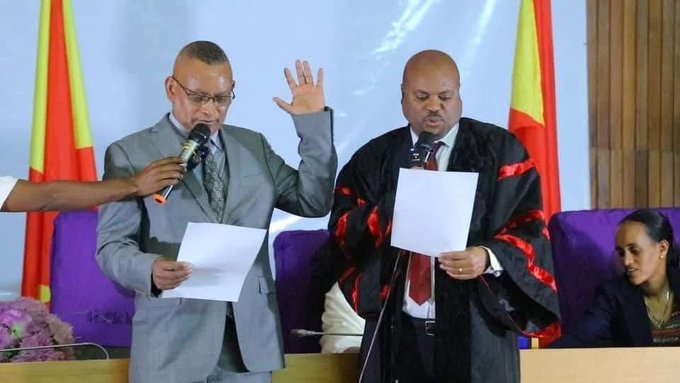
Im Mai erklärte die TPLF schließlich, dass sie die von Abiy eingesetzte Übergangsregierung nicht anerkennen werde und man eine konkurrierende Regionalregierung bilde. Diese wurde dann wiederum von Addis Abeba nicht anerkannt. Das erinnerte bereits an die politische Konstellation vor dem November 2020, als der Bürgerkrieg ausbrach.
»Die Rebellen wissen noch aus dem vergangenen Krieg, dass es nicht so leicht ist, nach Addis Abeba zu marschieren.«
SPIEGEL: Gab es nun einen konkreten Auslöser?
Kurtz: Die Gründung der Rebellenallianz war lange vorbereitet worden. Dass wenige Tage nach ihrer Verkündung der Krieg beginnt, ist sicher kein Zufall. Im Juni haben Parlamentswahlen stattgefunden, Tigray blieb von der Wahl ausgeschlossen. Am 5. Oktober kommt das neue Parlament erstmals zusammen. Möglicherweise hat dieser Termin auch eine Rolle gespielt.
SPIEGEL: In der Allianz haben sich Rebellengruppen zusammengeschlossen, die einst gegeneinander kämpften. Nun ist ihr erklärtes Ziel, die Regierung zu stürzen.
Kurtz: Ja, und bis vor Kurzem haben sie das noch nicht so explizit gesagt. Das Hauptziel ist sicher, die Regierung massiv unter Druck zu setzen. Die Rebellen wissen noch aus dem vergangenen Krieg, dass es nicht so leicht ist, nach Addis Abeba zu marschieren.
SPIEGEL: Die Regierung von Abiy Ahmed wird von den Vereinigten Arabischen Emiraten unterstützt. Hat die Rebellenallianz ebenfalls ausländische Geldgeber im Rücken?
Kurtz: Nicht im gleichen Maße. Sie erhalten Unterstützung aus Eritrea, auch wenn der Nachbarstaat nicht Teil des neuen Bündnisses ist. Aber die Regierung in Asmara schickt anscheinend Munition und Waffen an die TPLF. Eine größere eritreische Truppenpräsenz in Tigray haben wir bislang nicht gesehen, das scheint auch nicht die Erwartung der Allianz zu sein. Die Rückendeckung ist geografisch wichtig: Im vergangenen Krieg konnten die Regierungstruppen die TPLF komplett isolieren, indem sie die Grenze in Zusammenarbeit mit Eritrea dichtmachten. Damals war Eritrea mit Äthiopien verbündet. Insofern ist die Versorgung aus Eritrea für die Rebellen sehr wichtig, das Land hat – anders als Äthiopien, mehrere Häfen.
SPIEGEL: Die isolierte, langjährige Diktatur Eritrea verfügt jedoch nicht über dieselben finanziellen Mittel wie die Emirate.
Kurtz: Das stimmt. Der wohl potenteste mögliche Partner für die Rebellenallianz wäre Ägypten. Kairo streitet mit Addis Abeba um die Nutzung des Nilwassers, und hat sich im Zuge dessen in den vergangenen Monaten sehr stark an Eritrea angenähert. Bislang gibt es aber keine Beweise für eine direkte ägyptische Unterstützung äthiopischer Rebellen.
»Man hätte die Eskalation in den vergangenen Monaten verhindern können.«
SPIEGEL: Äthiopien grenzt an den Sudan, wo seit über drei Jahren ein verheerender Bürgerkrieg geführt wird. Die sudanesische Armee wirft Äthiopien vor, die Rapid Support Forces (RSF) zu unterstützen. Könnte sich der Konflikt in einen Regionalkrieg wandeln?
Kurtz: Die Gefahr besteht, dass die Konflikte sich stärker verbinden – obwohl ihre Ursachen unterschiedlich sind. Schon jetzt sehen wir grenzüberschreitende Angriffe. Es gab eine ganze Reihe von Berichten über Drohnen, die aus Äthiopien in den Sudan geschickt worden sind, auch Waffen werden über die Grenze an die RSF geliefert. Bislang ist es nicht zu einem zwischenstaatlichen Konflikt zwischen Äthiopien und Sudan gekommen, auch, weil da offenbar gute Geheimdienstkontakte bestehen. Trotzdem stellt sich die Frage, wie weit das noch geht.
SPIEGEL: Lässt sich eine weitere Eskalation noch verhindern, und wenn ja, von wem?
Kurtz: Man hätte die Eskalation in den vergangenen Monaten verhindern können. Es gab genug Warnungen. Dieser Konflikt hat sich seit Monaten aufgebaut und die internationale Reaktion war nicht entschieden genug. Es gab Versuche der Mediation durch die Afrikanische Union, aber diese waren nicht besonders erfolgreich. Die USA haben versucht zu vermitteln, ließen aber gleichzeitig Sanktionen gegen die eritreische Regierung auslaufen, genau wie ein Waffenembargo gegen Äthiopien. Natürlich gab es immer wieder Aufrufe, das Waffenstillstandsabkommen von Pretoria umzusetzen, aber zu wenig konkrete Bemühungen, sowohl auf die äthiopische Regierung als auch auf die TPLF einzuwirken.
Wer jetzt noch eine Rolle spielen könnte, sind die arabischen Länder. Die Emirate haben viel Einfluss in Addis Abeba, Saudi-Arabien hat gewisse Kontakte nach Eritrea. Natürlich braucht es diplomatische Initiativen. Aber wenn man jetzt glaubt, man könne einfach eine neue Initiative anfangen, sollte man nicht vergessen, welche Fehler man schon gemacht hat.
The Tigray Region in the Grey Zone between War and Peace
The Conflict Between the TPLF and the Ethiopian Government Has the Potential to Escalate beyond the Country’s Borders
SWP Comment 2026/C 29, 22.07.2026 (see the German version here)
Tensions between Addis Ababa and the Tigray Region are gradually mounting. Miscalculations could even trigger another large-scale war, although the parties involved may not directly seek one. Since the war in northern Ethiopia ended in November 2022, no new, stable political order has emerged. Tigray remains suspended between war and peace. Responsibility for this lies with both the Ethiopian government and its partner in peace, the Tigray People’s Liberation Front (TPLF). Having lost power in the national government in 2018, the TPLF has yet to find a new role for itself; instead, it has been marked by internal power struggles and characterised by authoritarian tendencies. Conversely, the Ethiopian government has not done enough to facilitate the return of internally displaced persons and restore Tigray’s territorial integrity. A renewed outbreak of hostilities could draw in Eritrea, Sudan and other regional actors. Germany and the European Union (EU) should firmly commit to crisis prevention in order to avoid further escalation in the already tense Red Sea region.
Relations between the TPLF and the Ethiopian government resemble a strategic game: Every move by one side prompts a response from the other. Accompanied by threatening rhetoric, both sides are testing how far they can go. Violence is part of their established repertoire.
On 8 April 2026, the Ethiopian government extended the mandate of the Tigray Interim Regional Administration (TIRA) by one year. General Tadesse Worede was to remain president in Mekelle. The TPLF, which was not consulted on the extension (though it had been involved in Tadesse’s appointment a year earlier), did not recognise the decision. Instead, it reinstated the regional parliament, which had emerged from elections organised unilaterally in 2020. On 5 May 2026, that parliament elected TPLF chairman Debretsion Gebremichael president of the regional government. This administration, in turn, is not recognised by the Ethiopian government. Debretsion’s regional government stripped Tadesse of his powers. At the same time, the Tigray Defense Forces (TDF) – the regional government’s armed forces – are recruiting new fighters. Since last year, armed actors from Tigray have repeatedly engaged in brief violent clashes, with the Ethiopian National Defense Forces (ENDF) intervening on several occasions with drone strikes.
This is not some obscure political power struggle confined to the local level. The war from 2020 to 2022 was one of the deadliest armed conflicts worldwide in recent decades. The Pretoria Agreement, which ended the war, hangs by a thread. Ethiopia is the most populous country in the strategically important Horn of Africa region.
The Pretoria Agreement’s fault lines
The cessation-of-hostilities agreement signed by the TPLF and the Ethiopian government in November 2022 in Pretoria, South Africa – after mediation by the African Union (AU), the Intergovernmental Authority on Development (IGAD) and the United States – remains an important framework for relations between Tigray and Addis Ababa, in the absence of alternatives.
The Pretoria Agreement brought about a noticeable improvement in living conditions in Tigray in the first few months following its signing. Hostilities ceased and the government lifted the economic blockade of the region and restored essential services (electricity, banking, telecommunications) that had been suspended during the war. The TPLF handed over its heavy weaponry under AU supervision.
The TPLF agreed to dissolve the regional government it had formed unilaterally in 2020 and, in consultation with Addis Ababa, establish an interim regional administration in March 2023. From the outset, however, the interim administration found itself in a difficult position, as it was also held accountable by the people of Tigray for the Ethiopian government’s failings.
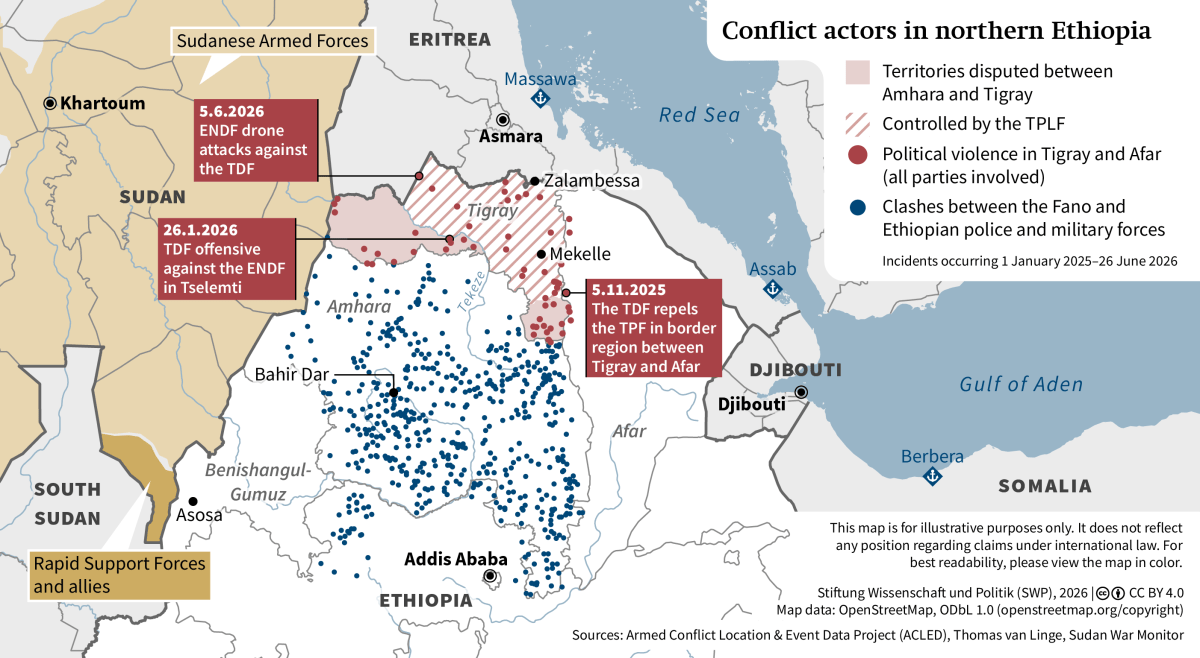
These failures are particularly evident in three key areas concerning the implementation of the Pretoria Agreement. The first concerns the status of areas that belonged to the Tigray Region before the war and were occupied by Amhara militias and the ENDF at the start of the conflict. These include the Western and Southern Zones of the local administration, as well as Tselemti south of the Tekeze River (see map). The neighbouring Amhara Region claims these areas, which had in fact not formed part of Tigray prior to 1991. The Pretoria Agreement merely states that their status should be resolved in accordance with the Constitution. However, the steps necessary for a constitutional settlement have not yet been taken.
The Western Zone of Tigray is of strategic importance. Sesame and cotton are grown there on large agricultural estates for export. The Ethiopian government fears that the TPLF could link up with armed groups across the border with Sudan and organise its own supply lines.
Second, closely linked to this territorial issue, is the plight of internally displaced persons. During the civil war, around 1.9 million people were displaced within and from Tigray. More than three years after the Pretoria Agreement, around 750,000 people remain displaced in the region, according to the UN High Commissioner for Refugees mainly from areas controlled by Amhara forces. With a total population of around six million, this represents a considerable burden. Displaced people who have been able to return to the disputed areas often find their homes destroyed or occupied. They also lack access to essential services. Without a mutually agreed resolution regarding political control of these areas, returns will remain difficult.
The third area of concern is the demobilisation, disarmament and reintegration (DDR) of TDF soldiers. In Tigray alone, around 274,000 people have been registered for the DDR programme. Some 63,000 people have gone through the DDR process in Tigray to date. However, the process has stalled since 2025. Many of the soldiers live in poorly supplied camps. In some cases, the TIRA has allocated more than half of its budget solely to the fighters still awaiting demobilisation. These funds were consequently unavailable for the region’s development.
These unresolved issues also stood in the way of the region’s reintegration into Ethiopia’s political system. No elections were held either for a new regional parliament or to elect Tigrayan representatives to the parliament in Addis Ababa, although the Pretoria Agreement had stipulated this. The entire Tigray Region was excluded from the general elections that took place on 1 June 2026.
The TPLF’s search for a role
Following the devastating war in northern Ethiopia, an intense debate began within the TPLF and among the Tigrayan elite more broadly. How had violence on such a scale come about? How much responsibility lay with the TPLF, which had dominated Tigray’s politics for five decades, and how much compromise could still be reached with Addis Ababa?
| Key actors in the conflict ENDF: Ethiopian National Defense Forces (regular armed forces) TDF: Tigray Defense Forces (Tigray’s regular security forces) TIRA: Tigray Interim Regional Administration (stripped of power since May 2026) TPLF: Tigray People’s Liberation Front (political party) TPF: Tigray Peace Force (a splinter group of the TDF, pro-Addis Ababa) |
The discussions also touched on the fundamental question of Tigray’s place within Ethiopia’s state structure. Since the end of the 19th century, political elites from Tigray and Amhara had been competing for supremacy in Ethiopia. The rivalry escalated into several violent conflicts, such as the civil war against the Derg military regime from 1974 to 1991. The TPLF subsequently controlled the state and the economy for 27 years as part of a coalition of parties, until Abiy Ahmed, who is from Oromia, came to power in 2018. Under Abiy’s more centralised rule, the TPLF is unlikely to be able to play a national role any longer. However, according to an academic from the region, many Tigrayan elites, including those in the TPLF, simply cannot accept their peripheral status.
In the post-war discussions, the interim administration was a bone of contention within the TPLF. Abiy prevented TPLF Chairman Debretsion from becoming its head, whereupon the TPLF Central Committee elected Getachew Reda – its chief negotiator in Pretoria and former Minister of Communications – whom Abiy eventually appointed in March 2023. Getachew’s government was caught between the uncompromising stance of the TPLF leadership led by Debretsion and the delaying tactics of the federal government in Addis Ababa.
In August 2024, the power struggle within the TPLF erupted into the open. The TPLF convened a party congress at short notice, which Getachew and other members of the TIRA boycotted. Shortly afterwards, Getachew and 15 others were expelled from the party. Getachew’s position soon became untenable. After the TPLF had already taken over parts of the administration with the help of security forces, Abiy dismissed Getachew in March 2025 and, following negotiations with Debretsion, replaced him with Tadesse Worede. Tadesse had previously headed the TIRA’s Peace and Security Bureau and, in that capacity, had controlled the TDF.
However, replacing the regional president did not resolve the underlying problems. Tadesse soon encountered difficulties and resistance similar to those faced by his predecessor.
At the same time, relations between the TPLF and the Ethiopian state deteriorated. The National Election Board of Ethiopia (NEBE), which also oversees the political party system, had only re-registered the TPLF in 2024 (following its ban during the war) subject to certain conditions. The TPLF was required to hold a party congress to elect a leadership and adopt a constitution. The TPLF refused to comply with the legal framework, as this would have required it to register as a new political party, thereby renouncing its historical continuity. Furthermore, the TPLF argued that, as a signatory to the Pretoria Agreement, it was already recognised as a political party. In May 2025, the NEBE ultimately revoked the TPLF’s registration. From the Ethiopian government’s perspective, the TPLF therefore no longer exists as a legal entity. This complicates the initiation of direct talks.
The TPLF also faces a legitimacy problem within Tigray itself. On two occasions – March 2025 and May 2026 – it replaced previously legitimised interim administrations in Mekelle, partly through the use of force. Opposition politicians from Tigray report that they and their supporters are occasionally harassed and arrested. The TPLF has declared a “zero tolerance” policy towards media outlets that promote the agenda of its opponents. Tens of thousands of people, mainly young people from Tigray, have left Ethiopia in search of work, usually heading for the Arabian Peninsula. In this situation, the TPLF benefits from the grey zone between war and peace in which Tigray finds itself. Its constant warnings about the Ethiopian government’s machinations help it to justify its own extra-legal measures.
Abiy the juggler
The Ethiopian government under Prime Minister Abiy faces its own challenges. It aims to drive forward the country’s ongoing political and economic transformation, moving away from the ethnic federalism and developmental-state model established under TPLF rule, and towards a unitary state and a controlled opening of the market economy.
Abiy must balance the interests of various groups without becoming dependent on them. He appears to be pursuing a strategy of dividing the opposition and thereby weakening it. A controversial national dialogue, which could pave the way for constitutional amendments, is also part of his toolkit. However, no consultations for the national dialogue have taken place yet in Tigray itself.
Addressing and resolving the outstanding issues in the implementation of the Pretoria Agreement would have meant jeopardising fragile relations with key groups. Clarifying the territorial status of Western Tigray by means of a referendum, which the government had proposed, would have required determining who was eligible to vote, particularly among people displaced from Tigray and new arrivals from Amhara.
The same applied to the government’s commitment to ensure the withdrawal of all “non-ENDF” troops, meaning primarily Amhara militias and Eritrean forces. Although Eritrean troops withdrew from central Tigray, they remained present in the north-east of the region, particularly in Zalambessa and Irob.
The government in Addis Ababa also capitalised on tensions within Tigray, which it actively fuelled, at least in certain instances. TDF fighters dissatisfied with the TPLF’s course split off in 2025 and began to form their own militia under the name Tigray Peace Force (TPF, Hara Meret in Tigrinya). The ENDF appear to be supporting the TPF with ammunition, rations and pay. In November 2025, the ENDF deployed drones against the TDF as it pursued the TPF across the border into Afar.
In May 2026, Getachew, together with his new party, Simret, and other parties, founded the “Peace and Change Council”, which also includes TPF members. The coalition is led by General Tsdadkan Gebretensae, who commanded the TDF during the war and served as vice-president of the TIRA under Getachew. The Peace and Change Council aims to remove the TPLF from power in Tigray “by any means necessary”, as stated at its founding. Getachew has officially served as Abiy’s adviser on East Africa, with the rank of minister, since April 2025.
“Tsimdo” and Eritrea’s interests
For its part, the TPLF is cooperating with its former arch-enemy, Eritrea. Initial contacts reportedly took place as early as the beginning of 2024 in Dubai, when Getachew met with Eritrean representatives on behalf of the TPLF and – according to Debretsion – with Abiy’s encouragement. A strategic objective of the TPLF is to ensure that it can no longer be cut off from the world by the government in Addis Ababa, as happened during the previous war.
As part of this rapprochement, Eritrea launched the “Tsimdo Selam” initiative in 2025. Representatives of Tsimdo describe it as a “grassroots peace movement” between related peoples in the border region of Ethiopia, Eritrea and Sudan. However, given the actors involved in this alliance, Addis Ababa views the initiative as an anti-Ethiopian alliance comprising the TPLF, Eritrea, the Fano (from Amhara) and other opposition movements, which it claims is preparing a joint military offensive.
Eritrea has come a remarkable way – from fighting alongside the ENDF against the TPLF to becoming an ally of the TPLF against the Ethiopian government. For President Isaias Afwerki, the threat environment has since shifted. Since 2023, Abiy has regularly spoken of Ethiopia’s right to access the sea and described the Red Sea as Ethiopia’s “natural boundary”. In November 2025, Ethiopian Foreign Minister Gedion Timothewos stated that Ethiopia had long had sufficient grounds to wage war against Eritrea, but was refraining from doing so out of a sense of responsibility.
Against this backdrop, Eritrea has an interest in overcoming its regional isolation without abandoning its existing totalitarian model of rule. That model also relies on constantly emphasising the threat of external interference, particularly by Ethiopia, in order to justify the continued militarisation of society.
There is a widespread willingness in the region to cooperate with a former enemy when that enemy is regarded as the “lesser evil” compared with the principal adversary, as discussions with various political actors in Ethiopia have shown. This calculation shapes the TPLF’s relations with Eritrea, those of the Fano with the TPLF, and also relations between the Peace and Change Council and the government in Addis Ababa. The actors assume that they can exploit each other’s interests for their own ends. It is a tactical collaboration, not a strategic alliance.
Regional entanglements
Tensions in northern Ethiopia involve not only Eritrea but also other regional actors that could contribute to an escalation and link it to ongoing armed conflicts.
For instance, Ethiopia’s relations with the Sudanese Armed Forces (SAF), which control most of the border with the neighbouring country, have deteriorated significantly in recent months. Since late 2025, Ethiopia has become one of the principal transit countries for supplies to the Rapid Support Forces (RSF) from the United Arab Emirates (UAE), as evidenced by dozens of suspicious cargo flights per month and satellite imagery from Benishangul-Gumuz. The SAF also accuses Ethiopia of facilitating Emirati drone strikes against Sudanese targets, citing, among other evidence, the flight data of a Turkish-made Akıncı drone shot down in May 2026.
Addis Ababa, for its part, views the presence in Sudan of Army 70 – an armed group from Tigray with links to the TPLF – with concern. Army 70 has intervened in the war there on the side of the SAF. The group reportedly comprises several thousand fighters who could operate from the Sudanese border in the event of a potential conflict over Western Tigray.
Furthermore, Eritrea is strengthening its ties with Egypt, which is in dispute with Ethiopia over control of Nile waters. In June 2026, Asmara and Cairo agreed to cooperate in various sectors, including the maritime economy. Egypt also intends to participate in developing the ports of Assab and Massawa – precisely those ports in which Abiy has expressed an interest through his rhetoric on access to the sea.
Another factor influencing the region is the rivalry between the UAE and Saudi Arabia. The UAE is one of Abiy’s closest financial and military partners, whereas Saudi Arabia views further militarisation of the Red Sea with scepticism. In 2020, Riyadh established the Red Sea Council, a regional initiative of the littoral states, of which Eritrea is a member. The blockade of the Strait of Hormuz reinforces the economic importance of the Red Sea for Saudi oil exports. Transnational smuggling routes for Iranian weapons and military materiel in the Red Sea also affect Riyadh’s security interests. Saudi Arabia has in the past attempted to mediate between Ethiopia and Eritrea. However, these efforts failed because the negotiations did not address the military use of Assab, a key interest for Ethiopia.
Sporadic violence and risks of war
Tensions between the TPLF and Addis Ababa are gradually escalating, without, so far, reaching a full-blown crisis. Both sides presumably do not wish to risk a repeat of the devastation of the last war, but have already shown that they remain prepared to use military force to advance their interests. Since the TPLF took power in March 2025, there have been several clashes between the TDF and the ENDF. At the end of January 2026, TDF units advanced across the Tekeze River into Tselemti, and a few days later also into areas of Southern Tigray. Heavy fighting ensued, during which the ENDF also deployed drones. The clashes ended, however, when the TDF withdrew to their original positions. Tadesse, then head of the TIRA, said on regional television: “The force we sent was not sent to ignite a war. It was sent to carry out a manoeuvre-type operation, to create pressure so that the issue of displaced persons’ return and our sovereign territorial rights would move forward as a renewed agenda and elicit a response.” The Ethiopian government responded to the incident by massing troops along the borders with Tigray for several months.
The pressure on the TPLF to act is real, despite all its self-justification. There are shortages of cash, fuel and medicines. Since October 2025, Addis Ababa has fallen behind on its transfers to the regional administration in Tigray. Public-sector employees, such as teachers, are not being paid. The population is caught in the crossfire between the TPLF and Addis Ababa.
The politicisation of the TDF is further exacerbating the conflict. The TDF emerged as a cross-party resistance movement with many volunteers following the ENDF’s first offensive in 2020/21. However, in January 2025, TDF commanders openly sided with Debretsion and supported the TPLF’s takeover of the regional administration. There are now reports of forced conscription. In June, the regional assembly passed legislation to mobilise troops and established a command post under Debretsion’s leadership. Resorting to forced recruitment confirms reports that the TDF cannot rely on a substantial proportion of its troops being willing to fight. War fatigue is widespread, particularly given the prospect of a possible civil war within Tigray.
For both the TPLF and Abiy, the legitimacy of any potential military action is of great importance. Each side seeks to portray the other as the aggressor. The TPLF repeatedly warns of the risk of war in open letters to international actors such as the AU, the United Nations and Western embassies. Conversely, the Ethiopian government warns international partners of alleged war preparations by the TPLF and Eritrea.
Neither the TPLF nor the Ethiopian government can fully control the escalation. There is a risk that smaller militias, such as the Tekeze Guards in Amhara-controlled Western Tigray, the TPF in Afar or the TPLF’s Army 70 in Sudan, might undertake military actions driven by local motives. The ENDF or TDF might then feel compelled either to follow their respective local partners or to respond to the limited actions of the militias. In this tense atmosphere, it is essential that reliable channels of communication are in place to ensure that miscalculations or misunderstandings do not escalate into a major conflict.
International entry points for prevention
International actors should press strongly to break the current spiral of escalation. A renewed outbreak of hostilities in northern Ethiopia could easily spill over into neighbouring countries. It is not yet too late to prevent the next war in the Horn of Africa. The TPLF and the governments in Addis Ababa and Asmara should cease their threats; the TPLF should register as a political party, and Addis Ababa should end Tigray’s economic isolation. These actors are likely to take such steps only if the other sides also cooperate. This requires international mediation.
The AU is taking the lead as mediator through its reinstated Special Envoy, Olusegun Obasanjo, who visited Mekelle in mid-June 2026. Other potential actors include the governments directly involved in the Pretoria Agreement: the United States, Kenya (with former President Uhuru Kenyatta) and South Africa. Saudi Arabia and Turkey could also play a constructive role, particularly at the intergovernmental level, if they so wish.
Mediation will only succeed if it is genuinely impartial and if the various levels of negotiation are properly coordinated. Unilateral pressure on one side of the conflict is likely to prove counterproductive. The United States runs the risk of having breached precisely this fundamental prerequisite with its recent measures. For instance, it lifted its ban on arms exports to Ethiopia and imposed visa restrictions on TPLF leaders. The European Commission, too, must ask how conflict-sensitive its decision was to resume budget support for Ethiopia, even though its call – made three years earlier – for an investigation into war crimes had not been heeded. In a statement, the EU delegation to Ethiopia criticised the TPLF for its unilateral actions, but not the Ethiopian government for the economic isolation of Tigray. It is also clear, however, that public pressure is unlikely to deter the parties involved from further escalation; one-sided rhetoric could instead encourage them to take risks.
The German government should ensure that EU institutions adopt a balanced position towards the parties to the conflict. The German and European role should not be limited to supporting the ongoing AU mediation, particularly as the AU has traditionally been reluctant to criticise its host country, Ethiopia.
The most important lever for influencing the Ethiopian government lies in the multibillion-dollar programmes run by the World Bank and the International Monetary Fund (IMF), within whose governing bodies EU member states wield considerable influence. Germany should advocate for a joint message to the Ethiopian government that another large-scale war would jeopardise the successful continuation of these programmes. The IMF itself has already highlighted precisely this risk. The IMF and the World Bank should also take a more critical view of Ethiopia’s high gold exports, a substantial share of which originates from informal mines in Tigray.
Germany and the EU should also raise the crisis in Ethiopia in discussions with extra-regional partners such as Egypt, Saudi Arabia, the UAE, Israel and Turkey. A key shortcoming following the Pretoria Agreement was that its implementation was not accompanied by a regional dialogue mechanism for security in the Horn of Africa. The current geopolitical rivalry in this region could at least be mitigated through greater communication, transparency and regular dialogue formats involving the states in the region and the external actors mentioned. Establishing a joint format will be difficult due to these rivalries; therefore, international special envoys will need to continue to work intensively to maintain these channels of communication and coordinate their efforts. As a matter of preventive diplomacy, this engagement is more necessary than ever.
Äthiopien und das Meer
Seit Jahren fordert Addis Abeba einen eigenen Meereszugang. Dabei richtet sich der Fokus auf Eritrea, doch die bilateralen Beziehungen sind schwer belastet. Für einen Kompromiss am Horn von Afrika fehlt derzeit das notwendige Vertrauen.
in: Internationale Politik Juli/August 2026, 29.06.2026
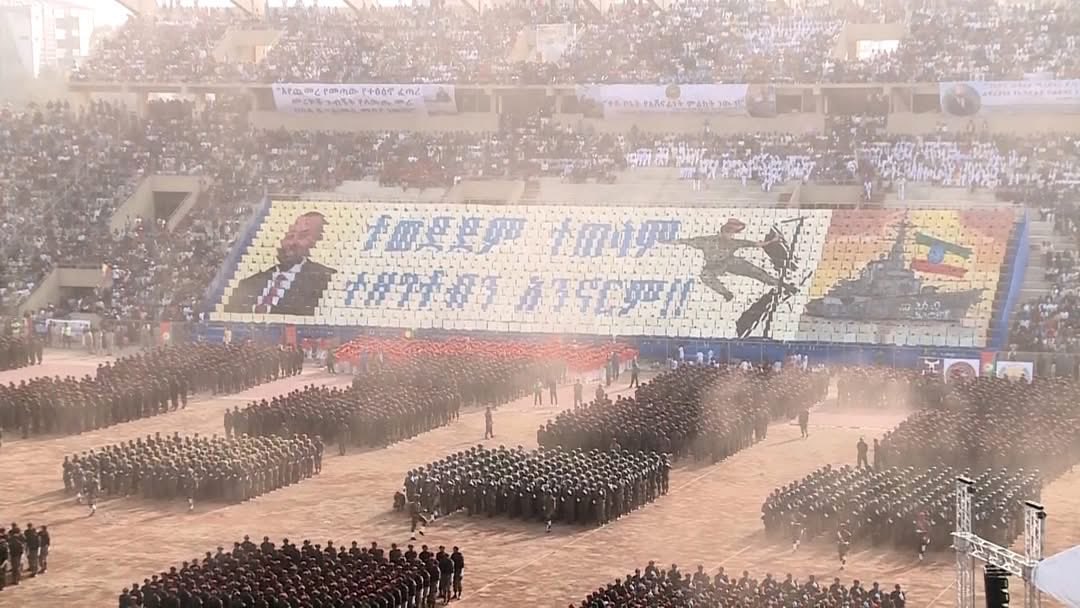
Die Botschaft war nicht sehr subtil. Bei einer Militärparade im Februar 2026 in Awassa zeigten die äthiopischen Streitkräfte ein riesiges Banner. Auf diesem war ein Soldat zu sehen, der eine Tür eintritt, und daneben die Worte: „Ob sie es mögen oder nicht, wir werden kein Binnenstaat sein.“
Die äthiopische Regierung spricht immer wieder von ihrem Recht auf einen souveränen Zugang zum Meer. Denn seit der Unabhängigkeit Eritreas im Jahr 1993 ist Äthiopien ein Binnenstaat – mit rund 135 Millionen Menschen der bevölkerungsreichste weltweit. Bei einer Rede vor Parlamentsabgeordneten sprach Ministerpräsident Abiy Ahmed Ali 2023 davon, dass sein Land nicht in einem „geografischen Gefängnis“ leben dürfe. Und fast so, als wäre der Premier ein außenstehender Beobachter, führte Abiy aus, dass es sonst zu einem Konflikt kommen könne: Das Rote Meer sei „die natürliche Grenze Äthiopiens“.
Aus historischer Perspektive ist das eine eher selektive Darstellung. Denn trotz vorherigen abessinischen Einflusses kontrollierten vom Osmanischen Reich abhängige Herrscher über Jahrhunderte die heutige eritreische Küste am Roten Meer, bevor diese erst unter ägyptisch-britischen Einfluss und anschließend unter italienische Kolonialherrschaft kam; im Jahr 1869 kaufte Italien den Hafen von Assab.
Erst in der zweiten Hälfte des 20. Jahrhunderts erlangte Äthiopien direkten Zugang zum Roten Meer und baute eine imperiale Marine auf. Nach der Unabhängigkeit Eritreas konnte Äthiopien dessen wichtigste Häfen in Massawa und Assab zu vorteilhaften Konditionen nutzen – bis zu dem verheerenden Grenzkrieg von 1998 bis 2000.
Außenhandel über Dschibuti
Wirtschaftliche Gründe sprechen für eine Diversifizierung der äthiopischen Handelswege. Derzeit muss sich Äthiopien für seinen Außenhandel primär auf
die Stabilität Dschibutis verlassen: 95 Prozent der äthiopischen Im- und Exporte laufen über das kleine Land. Sollte es dort zu Spannungen kommen – beispielsweise angesichts der Basen der USA und Chinas –, hätte das
fatale Folgen für die Versorgung des äthiopischen Marktes. Zudem
kostet die Abwicklung des Außenhandels über Dschibuti Äthiopien jedes Jahr rund 1,5 Milliarden US-Dollar an Hafen- und Liegegebühren, die in knappen
ausländischen Devisen bezahlt werden müssen. Hinzu kommen erhebliche Ineffizienzen der logistischen Infrastruktur.
Abiy spricht davon, dass Äthiopien eine „Supermacht in Afrika“ werden solle, was ohne eigenen Meereszugang nicht möglich sei. Es geht um die nationale Sicherheit und die „Existenz“ eines Landes in einer spannungsgeladenen Region. Ein Militärhafen mit Landverbindung würde es Äthiopien ermöglichen,
Rüstungslieferungen über den Seeweg zu empfangen, ohne dass Drittstaaten davon Kenntnis erlangen.
Äthiopien baut eine eigene Marine auf, um in der Lage zu sein, Macht im Roten Meer und im Golf von Aden zu demonstrieren.
Denn nicht nur die sich ausweitende ägyptische Kooperation mit Eritrea und Somalia sorgt in Addis Abeba für Unruhe, auch zahlreiche weitere Mittelmächte
wie die Türkei, die Vereinigten Arabischen Emirate, Saudi-Arabien und Israel verfolgen in dieser Region maritime Interessen.
Konflikte mit Eritrea
Wie weit Ministerpräsident Abiy für das Ziel eines souveränen Meereszugangs gehen würde, ist unklar. Er selbst schließt militärische Gewalt und einen Krieg
rhetorisch aus. Den Status quo herauszufordern, gehört aber durchaus zur Methode. Am Neujahrstag 2024 schloss Äthiopien eine Vereinbarung mit
Somaliland. Nach dieser sollte Äthiopien einen Marinehafen an dessen Küste errichten dürfen, wofür die abtrünnige Region Somalias Anteile an Ethiopian
Airlines erhalten sollte – und die Aussicht auf völkerrechtliche Anerkennung. Mogadischu organisierte jedoch einen breiten diplomatischen Protest, näherte
sich Ägypten und Eritrea an und drohte damit, die zur Bekämpfung Al-Shabaabs in Somalia stationierten äthiopischen Truppen des Landes zu verweisen. Nach türkischer Vermittlung einigten sich Abiy und der somalische
Präsident Hassan Sheikh Mohamud Ende 2024 darauf, einen verlässlichen Meereszugang für Äthiopien nur unter somalischer Souveränität zu verfolgen.
Danach schwenkte Äthiopiens Blick hinsichtlich eines Meereszugangs wieder auf Eritrea um.
Die Rhetorik verschärfte sich zusehends. Im Oktober 2025 schickte Äthiopien einen Brief an UN-Generalsekretär António Guterres, in dem Eritrea vorgeworfen wurde, mit der Volksbefreiungsfront von Tigray (TPLF)
einen Krieg gegen Addis Abeba vorzubereiten. Einen Monat später legte Äthiopiens Außenminister Gedion Timothewos in einer Rede vor ausländischen
Diplomaten ausführlich die Beschwerden gegenüber Eritrea dar. Gedion ging sogar so weit zu sagen, dass ein „Casus Belli“ bereits vorliege, aber Äthiopien
sich bewusst zurückhalte.
In Eritrea treffen solche Aussagen auf eine Regierung, die seit Jahrzehnten vor ausländischer Einflussnahme warnt. Das Vertrauen in internationale Akteure
ist sehr gering. Man fühlt sich immer wieder ungerecht behandelt – zum Beispiel als Äthiopien die Entscheidung der unabhängigen Grenzkommission
nach dem Krieg nicht umsetzte, ohne dafür sanktioniert zu werden. Hingegen erließ der UN-Sicherheitsrat 2009 ein Waffenembargo und Sanktionen gegen
Eritrea wegen dessen Unterstützung für Al-Shabaab; diese wurden erst 2018 aufgehoben.
Nach Abiys Amtsantritt 2018 hatten sich die beiden Länder angenähert, einschließlich persönlicher Treffen von Abiy und dem eritreischen Präsidenten
Isaias Afewerki. Die äthiopischeritreische Zusammenarbeit, das wurde bald deutlich, diente vor allem dazu, gemeinsam gegen die TPLF zu kämpfen. Isaias
machte die TPLF, die zu der Zeit die äthiopische Regierung dominiert hatte, für den Krieg Ende der 1990er Jahre und die darauffolgende internationale
Isolierung verantwortlich. Eritreische Truppen nahmen in großer
Zahl an dem Krieg in Tigray teil und verübten Berichten zufolge massive Kriegsverbrechen an der Zivilbevölkerung.
An dem Pretoria-Abkommen, das den Krieg im Norden Äthiopiens
im November 2022 beendete, war Eritrea nicht beteiligt. Wie
Abiy später selbst sagte, wollte Eritrea die TPLF gänzlich vernichten,
statt ihr zu einem neuen politischen Leben zu verhelfen. So kühlte sich das Verhältnis zwischen Asmara und Addis Abeba wieder ab. Eritrea unterstützte
die Fano, amharisch-nationalistische Rebellen, die sich 2023 gegen den äthiopischen Staat wandten.
Doch die Umsetzung des Pretoria-Abkommens stockte, und in der TPLF setzten sich Hardliner durch, welche die Addis Abeba gegenüber treue Übergangsregierung von Tigray entmachteten. Sowohl Asmara als auch die
TPLF stellten ihre gegenseitige Feindschaft zurück und gingen eine taktische Zusammenarbeit ein im Glauben, so die Regierung in Addis Abeba schwächen zu können.
Drohungen, Disruption, Krieg?
Die jahrelange öffentliche Inszenierung des Themas zeigt, dass
es Äthiopien nicht um kurzfristige Interessen geht. Internationale
Legitimität ist ein wichtiger Faktor. Die USA und auch andere Regierungen haben Addis Abeba in klaren Worten gesagt, dass ein offener Einmarsch in Eritrea inakzeptabel wäre. Er würde wahrscheinlich auch das milliardenschwere Programm des Internationalen Währungsfonds
mit Äthiopien gefährden. Gleichzeitig setzen sowohl Washington
als auch die EU derzeit auf Annäherung an Äthiopien.
Die äthiopische Regierung ist sich bewusst, dass ein direkter, konventioneller Krieg mit Eritrea ein hohes Risiko für die eigene Sicherheit darstellen würde. Äthiopien verfügt zwar über moderne Drohnen und ein großes Heer,
aber Eritrea ist seit Jahrzehnten eine stark militarisierte Gesellschaft.
Selbst eritreische Oppositionelle würden eher auf Seiten des autoritären Regimes von Isaias kämpfen, als eine äthiopische
Besatzung zu akzeptieren. Eritrea könnte seinerseits Druck über
die Zusammenarbeit mit einer ganzen Reihe von äthiopischen
Oppositionsbewegungen ausüben, auch wenn diese inhaltlich
nicht viel verbindet. Eine weitere Regionalisierung von Konflikten
im Sudan und in Somalia wäre wahrscheinlich.
Vermittlungsbemühungen der USA, Saudi-Arabiens und europäischer
Akteure waren bislang nicht erfolgreich. Ein Kompromiss ist denkbar, der regionale Integration und grenzübergreifende Transportinfrastruktur
mit vertrauensbildenden Sicherheitsmaßnahmen und schließlich einer äthiopischen Marinebasis in Somaliland oder Dschibuti verbindet, aber ohne
extraterritorialen Korridor zum äthiopischen Kernland. Für eine solche Lösung braucht es jedoch das Vertrauen aller beteiligten Seiten. Am Horn von Afrika ist
davon derzeit wenig zu spüren.
Razzien gegen Brigade N’Hamedu in Deutschland
Zitate in: Eritreas Konflikte werden in Deutschland ausgetragen, Deutsche Welle, 31.3.2025
….
Hier kommen die Eritrea-Festivals in westlichen Ländern ins Spiel. Offiziell sind sie Kulturveranstaltungen. Organisiert werden sie von der eritreischen Regierung und ihr nahestehende Exilgruppen in Deutschland. In Gießen etwa steht der regierungsnahe Zentralrat der Eritreer in Deutschland e.V. dahinter.
Ihr Charakter hat sich im Laufe der Zeit sehr gewandelt, schreibt der Eritrea-Experte Gerrit Kurtz von der Berliner Stiftung Wissenschaft und Politik der DW: “Früher waren sie eine Gelegenheit, an den Freiheitskampf zu erinnern. Die kulturell angelegten Festivals wurden zunehmend von Vertretern des Regimes übernommen, so dass dort jetzt häufig Offizielle der eritreischen Regierung oder ihnen nahestehenden Personen auftreten und Propaganda für das autoritäre Regime in Asmara verbreiten.”
…
Die deutschen Behörden sind hier in einem Dilemma, meint Gerrit Kurtz von der Stiftung Wissenschaft und Politik: “Deutschland sollte sich nicht auf die Seite der eritreischen Regierung stellen, die oft versucht, auf Mitglieder der Diaspora Druck auszuüben oder sie zu überwachen. Gleichzeitig kann Deutschland natürlich gewalttätige Aktionen, in die Brigade N’Hamedu und andere Diasporaorganisationen verwickelt sind, auf seinem Boden nicht tolerieren.”
…
Der Eritrea-Experte Gerrit Kurtz rät: “Deutschland sollte grundsätzlich die Seite der gewaltfreien Opposition in der Diaspora einnehmen und demokratisch orientierte Akteure fördern, auch wenn die Bundesregierung weiterhin bilaterale Beziehungen zu Asmara unterhalten sollte.” Da Deutschland derzeit keinen Botschafter in Eritrea habe, seien seine Einflussmöglichkeiten dort begrenzt. “Allerdings hat Eritrea durchaus Interesse, die Beziehungen mit Deutschland zu verbessern, was gewisse Einflussmöglichkeiten eröffnet. Das Vorgehen gegen die Brigade N’Hamedu in Deutschland wird die Stellung Deutschlands beim Regime in Asmara positiv beeinflussen, auch wenn das nicht das Ziel der – rechtsstaatlich mutmaßlich gebotenen – Razzien war.”
Kommen Kriegsverbrechen in Tigray vor ein deutsches Gericht?
Zitate in einem Artikel der Deutschen Welle, 28.März 2025
…
Gerrit Kurtz, Äthiopien-Experte bei der Stiftung Wissenschaft und Politik (SWP) in Berlin, dämpft die Erwartungen: “Es soll eine Aufarbeitung geben, aber es kommen ständig neue Verletzungen hinzu, weil es ja gerade insbesondere in Amhara und Oromia weitere aktive Konflikte gibt, wo weiterhin massive Menschenrechtsverletzungen passieren. Und die äthiopische Justiz ist da nicht ausreichend hinterher.”
Schon die Strafverfolgung einfacher Täter ist damit nicht gewährleistet. Doch bei Entscheidungsträgern – wie in der LAW-Strafanzeige – ist sie noch unwahrscheinlicher, räumt Kurtz im DW-Interview ein: “Am einfachsten ist es natürlich immer, wenn es einen klaren Cut gibt nach einem Krieg, und andere Menschen, andere Parteien an der Regierung sind, die nicht für den Krieg verantwortlich waren. Nur dann kann es im eigenen Land zu einer glaubwürdigen Aufarbeitung kommen – und selbst dann gibt es immer noch größere Probleme. Aber das ist ja überhaupt nicht der Fall in Äthiopien.” Weil das effektivste Rechtsmittel, nämlich inländische Strafverfolgung, demnach nicht zur Verfügung stehe, zeigt Kurtz Verständnis für die Entscheidung, das sogenannte Weltrechtsprinzip zu bemühen.
…
Dass Äthiopien oder Eritrea hingegen ihre eigenen Staatsbürger nach Deutschland ausliefern würden, gilt als ausgeschlossen. Aus Sicht von SWP-Wissenschaftler Kurtz ist aber hierbei wichtig, dass die Namen aus der Strafanzeige nicht veröffentlicht wurden. “Das heißt: Bestimmte Menschen, die in dieses Raster reinfallen könnten in Äthiopien und Eritrea, die hochrangige Funktionen in Militär oder Staatsapparat haben, können sich nicht ganz sicher sein, ob sie betroffen sind oder nicht”, sagt Kurtz. Wenn es zu Ermittlungen kommt, müssten diese Menschen also beim Reisen vorsichtiger sein
Horn of Africa: Time for preventive diplomacy
In both Ethiopia and South Sudan, conflicts are escalating again. To prevent further regionalisation of the conflict landscape, Europe should support high-level diplomacy, says Gerrit Kurtz.
SWP Point of View, 21 March 2025. Also available in German.
In the Horn of Africa, two peace processes are in acute danger: Local power struggles in South Sudan and Ethiopia’s Tigray region are at risk of escalating into regional crises. In South Sudan – as in 2013 at the beginning of the last civil war – a power struggle is raging over the possible successor to 73-year-old President Salva Kiir. He is already positioning his son-in-law as a potential replacement. At the same time, clashes between the White Army – a Nuer militia – and the South Sudanese army in the Upper Nile region are causing a stir after a United Nations helicopter was shot down and a high-ranking army general was killed.
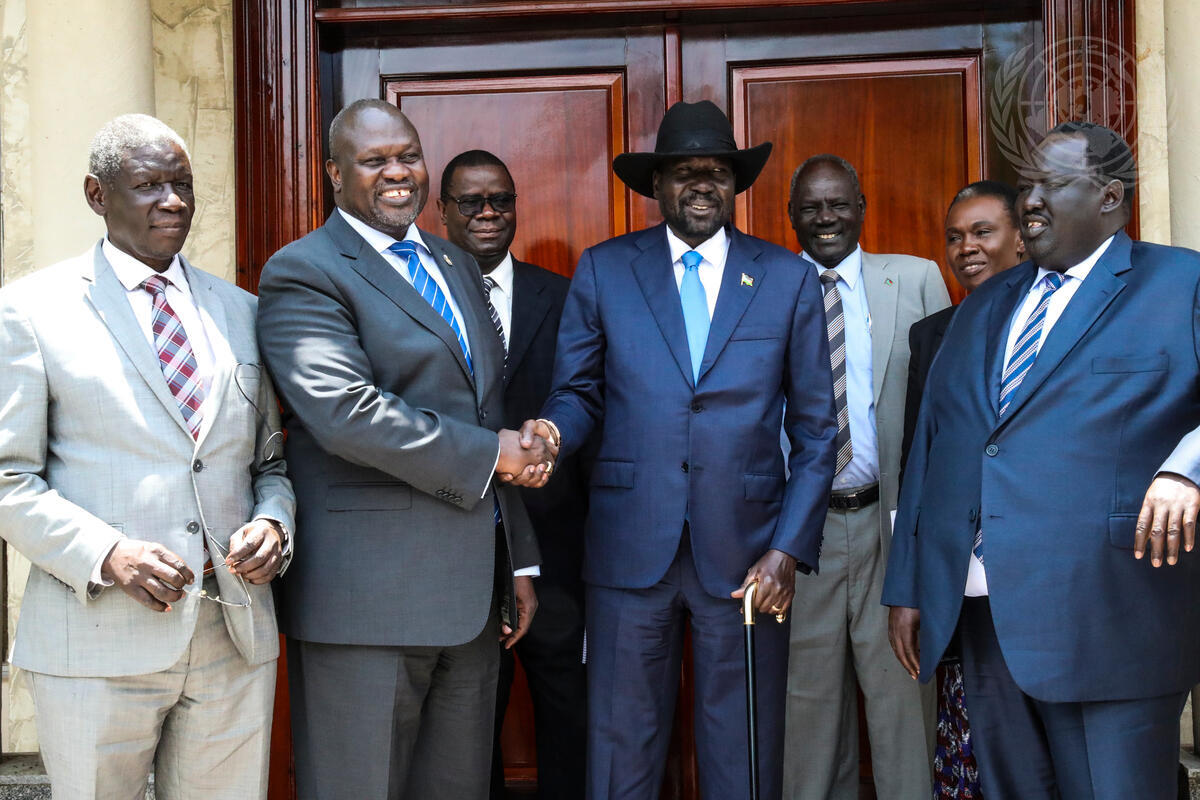
During the civil war from 2013 to 2018, the White Army fought on the side of the main rebel group, the Sudan People’s Liberation Army/Movement-in Opposition (SPLA/M-IO) under today’s First Vice President Riek Machar. Tensions between Kiir and Machar are intensifying once again – a dangerous déjà vu for the country, which has barely had time to recover after decades of conflict.
Ethiopia: Split within the TPLF and growing tensions with Eritrea
In Ethiopia, a local power struggle in the Tigray region threatens to escalate into a regional crisis between the federal government in Addis Ababa and Eritrea. The Tigray People’s Liberation Front (TPLF) – once Ethiopia’s ruling party and the Ethiopian government’s opponent in the war between 2020 and 2022 – is divided: A faction led by chairman Debretsion Gebremichael is opposed by a reformist faction under the president of the Tigray Interim Regional Administration, Getachew Reda.
The Debretsion faction has large parts of the Tigrayan military on its side and has been taking over local administrative structures for months, sometimes violently. In the meantime, it has also brought media and parts of the administration in the provincial capital, Mekelle, under its control. The TPLF’s Debretsion faction is said to have good relations with Eritrea, whereas Getachew is counting on Ethiopian Prime Minister Abiy Ahmed. Bilateral relations between Ethiopia and Eritrea have cooled markedly since the Pretoria Agreement, which ended the war between the TPLF and the government in 2022. Both countries are accused of supporting opponents of the other’s regime.
Due to the increasing tensions, there is a risk that there will be a regionalisation of the conflict landscape. Uganda has already sent troops to support the South Sudanese government, as it did in 2013. Similar to previous clashes, Sudanese actors are also intervening. Over the weekend, militias of the Rapid Support Forces in South Sudan were already fighting against units of the SPLA/M-IO, which were apparently on their way to receive weapons from the Sudanese Armed Forces.
Failure of the peace agreements – fragmented international engagement
The current escalations are no coincidence. The respective agreements to end the civil wars in South Sudan and Ethiopia have only been implemented to a limited degree. Unilateral deviations by both governments from their obligations have de facto prevailed. Kiir rapidly replaced cabinet members and had high-ranking generals of the SPLA/M-IO arrested. In Ethiopia, important measures of the Pretoria Agreement, such as the demobilisation of militias and the withdrawal of Eritrean and Amharic troops from Tigray, have largely failed to materialise.
International engagement with the region is increasingly fragmented – as are the states of the region themselves. In Ethiopia, for example, there is a lack of credible guarantors for the peace process. At the recent extraordinary summit of the Intergovernmental Authority on Development (IGAD) on South Sudan, only two countries took part at the level of their president. Whereas the United States used to be the most important international partner for peace in the region, countries such as the United Arab Emirates, Saudi Arabia, and Turkey are now influential, but they tend to support certain sides rather than mediate in internal conflicts.
In view of the deteriorating situation, it is now time for high-level preventive diplomacy. A coordinated international approach could contain the escalation. An informal division of tasks would be conceivable: Influential countries such as Turkey and Saudi Arabia could defuse tensions at the intergovernmental level, while European actors could support IGAD and the African Union in local mediation processes.
Picture: In better times in 2019, President Salva Kiir met the head of the SPLA/M-IO, Riek Machar, in Juba, to prepare the government of national unity. Source: UN Photo/Isaac Billy
Escalations Risks in the Horn of Africa
Threats from Egypt, Ethiopia, and Somalia Exacerbate Local Conflicts
SWP Comment 2024/C 50, 28.10.2024, together with Stephan Roll and Tobias von Lossow
In recent months, relations between Ethiopia, Egypt, and Somalia have deteriorated significantly. Previously separate disputes have become intertwined: namely the conflict between Egypt and Ethiopia over the use of Nile waters and the disagreement between Ethiopia and Somalia regarding the recognition of Somaliland. The three countries use threats to improve their respective positions in these conflicts. While an inter-state military escalation does not seem imminent at present, regional tensions are likely to rise, which could further empower the jihadist Al-Shabaab militia in Somalia. Germany and the European Union (EU) should recognise the highly complex interdependence of these lines of conflict, remind the countries concerned of their common interest in stabilising Somalia, and continue to advocate for dialogue in the Nile dispute. At the same time, it is also important to hold other influential actors more accountable to contribute to regional stability.
The immediate trigger for the current tensions is the supply of weapons from Egypt to Somalia as a result of a security agreement signed by the two countries in August 2024. In addition, there were reports that Egypt, with agreement from Somalia, is planning to send several thousand soldiers to the Horn of Africa to fight Al-Shabaab and replace the Ethiopian troops that have been stationed there thus far as part of the African Union (AU) mission, which expires at the end of this year. In response, Ethiopian Prime Minister Abiy Ahmed warned that his country would “humiliate anyone who dares to threaten us”. Apparently as a deterrent, the Ethiopian military deployed heavy weapons at the border with Somalia.
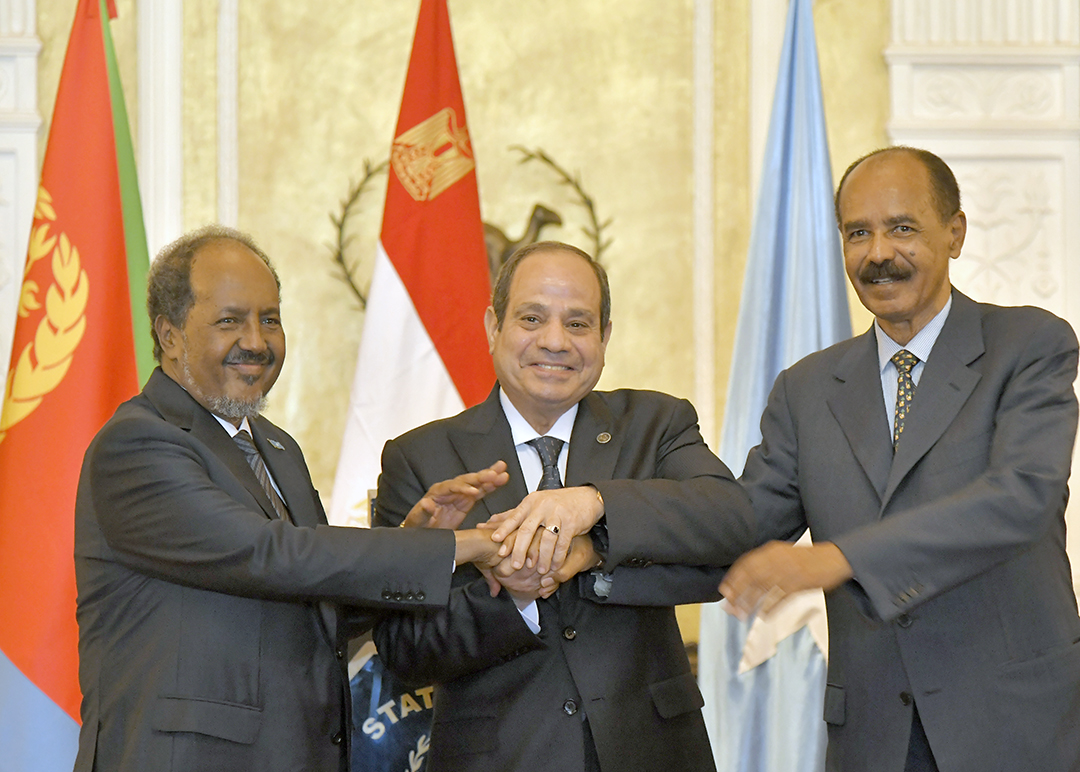
In Somalia, the foreign minister threatened to support armed groups in Ethiopia if Addis Ababa did not stop its steps towards diplomatic recognition of Somaliland. Somalia has received support not only from Egypt, but also from Eritrea: At a tripartite summit in October in Asmara, the presidents of the three countries agreed to intensify their security cooperation. At almost the same time, Egypt lodged a complaint with the United Nations Security Council (UNSC), accusing Addis Ababa of jeopardising its water security by commissioning the Grand Ethiopian Renaissance Dam (GERD). Ethiopia, in turn, claimed that Egypt had repeatedly threatened it with violence. It is apparent that two central conflicts in the Horn of Africa are becoming increasingly interlinked and are therefore intensifying.
Egypt’s water worries
Egypt’s conduct in the Horn of Africa can also be explained by its long-standing dispute with Ethiopia over the use of the Nile’s water. This past summer, the conflict has once again intensified with the fifth phase of filling the GERD’s reservoir. For Egypt, which meets over 90 per cent of its water needs from the Nile, the construction of the gigantic dam since 2011 at the upper reaches of the Blue Nile poses a significant threat to its own water supply and therefore to national security. For years, Ethiopia has been vigorously pushing ahead with the completion of the dam project, which is intended to significantly contribute to meeting the country’s immense energy needs. In contrast, Egypt insists on its right to veto construction projects on the upper Nile and on a bilaterally agreed water sharing formula with Sudan. Cairo attributes both rights to treaties from the colonial era, which Ethiopia and the other upstream riparians reject as they were not part of these treaties.
Diplomatic efforts to resolve the water dispute, including the GERD negotiations in which external actors such as the United States of America (USA), the AU, and the United Arab Emirates (UAE) mediate, have largely stalled. The same applies to cooperation within the framework of the Nile Basin Initiative (NBI), which was established in 1999. In recent years, Cairo’s negotiating position has increasingly deteriorated. On the one hand, construction on the dam is significantly advanced, with the project nearing completion and electricity production already underway. The third and fourth turbines were connected to the grid in August 2024, with the rest of the 13 turbines due to follow in the coming months. On the other hand, Egypt has lost its key ally in the water conflict. Sudan, which long supported Egypt and pursued its own water interests, has effectively withdrawn from the negotiations as an independent actor due to its ongoing civil war. Khartoum also benefits from the GERD, particularly from protection against regular flooding.
In addition, with South Sudan’s ratification in July, the Nile Basin Cooperative Framework Agreement (CFA) came into force in October 2024. This agreement establishes the permanent Nile River Basin Commission (NRBC), which initially includes six upstream riparian states, albeit excluding Egypt and Sudan. Concluding a framework agreement between all 11 riparian states, which sets out the principles, structures, and institutions for joint, basin-wide water management, was one of the main objectives of the NBI. However, since upstream and downstream riparian states failed to agree on such an accord for over ten years, Egypt and Sudan were ultimately left out when the CFA was signed in May 2010 by Ethiopia, Tanzania, Uganda, and Rwanda – followed soon after by Kenya and Burundi. After all signatories except Kenya had ratified the agreement, South Sudan became the sixth state that needed to implement the CFA.
Egypt’s attempts to bolster its negotiating position on the Nile through security agreements with various states in the region, such as South Sudan, the Democratic Republic of the Congo, Uganda, and Rwanda, have thus far been proven unsuccessful. Even after President Abdelfattah al-Sisi and Prime Minister Abiy agreed at a face-to-face meeting in Cairo in July 2023 to resolve the outstanding issues within four months, no progress was made. As a result, Egypt has started to intervene in the conflict between Ethiopia and Somalia to also exert pressure on Addis Ababa.
Ethiopia’s port ambitions
While Ethiopia and Somalia had previously maintained close diplomatic relations for several years, bilateral relations have rapidly gone downhill since the beginning of 2024. The reason? The Memorandum of Understanding (MoU) signed by Prime Minister Abiy and President Muse Bihi Abdi of Somaliland in January. The MoU, the text of which has not been published, stipulates that Ethiopia will lease a 20-kilometre coastal strip for 50 years to establish a naval base there. In addition, Ethiopia is to be given economic access to a harbour of the de facto state. In return, Ethiopia promised Somaliland a stake in Ethiopian Airlines and held out the prospect of considering the recognition of Somaliland as an independent state.

To date, no UN member state has recognised Somaliland’s independence, which the autonomous region proclaimed in 1991. Nevertheless, various states maintain primarily economic relations with Somaliland. For example, the UAE has invested several hundreds of million USD in the expansion of the port of Berbera, which is operated by the Emirati company DP World since 2017, as well as in logistical infrastructure with Ethiopia on both sides of the border. At the time, Ethiopia and DP World signed an agreement under which Addis Ababa was to contribute 19 per cent of the port expansion. However, Ethiopia lost this claim in 2022 after the war-torn country failed to provide the promised funds.
With the MoU, Ethiopia is now taking a different approach to achieving its goal of its own access to the sea. Abyi’s government sees this as compensation for a “historical mistake” made by his predecessors when they granted Eritrea independence in 1993 and thus gave up access to the sea. As a result, Ethiopia is now the most populous country without a coastline. Around 95 per cent of all Ethiopian imports and exports currently pass through the port of Djibouti. The annual fees for this are up to around US$1.5 billion, which Ethiopia must pay in scarce foreign currency.
The leadership in Mogadishu firmly rejected the MoU. Somalia views the recognition of Somaliland by Ethiopia, which could be followed by other states, as a violation of its sovereignty. In April 2024, Somalia expelled the Ethiopian ambassador from the country and withdrew its own representative from Addis Ababa. Meanwhile, Ethiopia appointed an ambassador to Somaliland in August 2024.
Somali President Hassan Sheikh Mohamud successfully sought diplomatic support, both in the region and from international players, including the G7 states. In this context, Somalia and Egypt concluded a security agreement in August 2024. It was on this basis that Egypt delivered weapons to Mogadishu two weeks later.
Risk of war between Egypt and Ethiopia
Military threats from Egypt in its water dispute with Ethiopia are not new. However, a direct Egyptian attack on the GERD construction site was long considered unrealistic due to the limited range of Egypt’s Air Force. Furthermore, Egypt, as a downstream state, would not achieve its main objective through military action, as Ethiopia could then deliberately reduce the Nile water flow at the dam to exert pressure on Egypt. Now that the reservoir is filled, such an attack also harbours unpredictable risks for the water flow of the Nile and would trigger a catastrophic flood in Sudan. Nevertheless, the deployment of Egyptian troops in Somalia could increase the risk of a direct military conflict between the two countries.
Should hostilities actually occur, Cairo would undertake considerable risk. Although the country has by far the largest armed forces in Africa and an extensive arsenal of weapons, this does not necessarily translate into actual military power. For example, the armed forces suffered heavy losses in the fight against insurgent groups in the Sinai Peninsula after 2013. It was only in the past two years that the security situation was gradually brought under control. Despite having troops stationed in Somalia, a military operation outside its own borders would be much more challenging, not least due to the distance, while Ethiopia could act from its own territory. Should armed action by Egypt result in massive losses or even failure, this could lead the Egyptian population to openly question the role of the armed forces in the country’s politics and economy. Civil society is already critical of the army’s preoccupation with managing a vast, inefficient economic empire.
There is also no conceivable international and regional backing for military action. Cairo is heavily dependent on the Gulf States and the USA. The UAE, in particular, has become Egypt’s most important state creditor in recent years. Meanwhile, the USA provides around US$1.3 billion annually in military aid, which makes up an integral part of Egypt’s defence budget. As both countries also maintain close relations with Ethiopia, an Egyptian military move could jeopardize this critical financial support.
Cairo’s actions are therefore unlikely to aim at a direct military confrontation with Addis Ababa. Rather, the threat of escalation is intended to persuade external actors to become more involved in the Nile water dispute on Egypt’s behalf. There has been no such internationalisation of the conflict to date, although Cairo has sought this for years. Above all, Cairo would like to see Ethiopia’s regional opponents strengthened militarily.
In addition to local groups in Somalia and Ethiopia, Cairo is likely to focus on Eritrea. Asmara’s relations with Ethiopia have deteriorated significantly since 2022 when Eritrea fought alongside Ethiopian troops against the Tigray People’s Liberation Front (TPLF). Eritrea opposes the Pretoria Agreement between the Ethiopian government and the TPLF, which ended that war, as it thwarted Eritrea’s goal of destroying the TPLF once and for all. Border disputes and Ethiopia’s quest for direct access to the sea, possibly again in Eritrea, are further exacerbating tensions. As a result, Asmara has emphatically intensified its relations with Cairo. The summit between Egypt, Eritrea, and Somalia in October is a visible sign of that rapprochement. Nevertheless, Eritrea is unlikely to simply become Egypt’s stooge. Instead, it would rather pursue its own interests in the medium term, namely the establishment of a buffer zone on Ethiopian territory. The Ethiopian federal government currently appears to tolerate the presence of Eritrean troops in northern Tigray.
Nevertheless, a direct clash between Egyptian and Ethiopian troops cannot be completely ruled out should Cairo actually station a significant number of soldiers in Somalia. This risk increases all the more if Ethiopia refuses to withdraw its troops from Somalia. Egypt could cite the defence of Somali interests and create a naval blockade of Somaliland, or in the worst-case scenario, attempt to expel Ethiopian troops.
A “game of chicken” between Ethiopia and Somalia
Two factors significantly mitigate the risk of an armed conflict between Ethiopia and Somalia: the military balance of power and shared interest in fighting Al-Shabaab.
While Ethiopia’s army is strongly involved in fighting several insurgencies and weakened by the 2020–22 war in the north of the country, it remains one of the largest military powers in the region. It possesses drones, helicopters, fighter planes, and heavy weaponry, among other equipment. In contrast, the Somali security sector remains a work-in-progress. It is not even able to effectively protect Mogadishu from attacks by Al-Shabaab. The Somali security forces are divided between units under different commands of the federal government, the federal member states, and clan militias that operate incoherently. Despite successes in training some units, the Somali security forces remain heavily dependent on international military and financial support, including from the AU, EU, USA, Turkey, Kenya, and Ethiopia.
Ethiopia and Somalia have long been united in the fight against Al-Shabaab. Addis Ababa wants to contain the jihadist group’s capabilities in its neighbouring country, maintain a buffer zone, and thus prevent it from attacking Ethiopia. In July 2022, hundreds of Al-Shabaab fighters crossed the border and advanced around 150 kilometres into the Ethiopian interior until they were repelled. The invaders are said to have included many Ethiopian nationals from the Somali and Oromia regions.
Due to this threat situation, Ethiopia is currently deploying around 10,000 of its own soldiers in Somalia. Only about a third so far have been part of the AU Transition Mission in Somalia (ATMIS). Addis Ababa has deployed the rest on its own initiative. These troops co-operate closely with those of the respective Somali federal member states and local militias. The Somali federal government had tolerated these troops for years (similar to Kenyan units in the south of Somalia) because they serve to provide security in their areas of operation.
The threatening behaviour of Ethiopia and Somalia reflects this unequal balance of power. Ethiopia is calculating that Somalia cannot afford to expel the Ethiopian troops from the country because they are making a decisive contribution to the fight against Al-Shabaab. In this logic, Somali reactions to the MoU with Somaliland would thus fizzle out. Conversely, the Somali government has now announced that if Ethiopia does not withdraw the MoU then Ethiopian troops need to leave the country by the end of December 2024 when ATMIS ends. Somalia is counting on the fact that Ethiopia cannot afford to withdraw. The question is who will give in first.
Escalation of internal conflicts as the real danger
While direct conventional armed conflict between the states involved is currently rather unlikely, both Ethiopia and Somalia are susceptible to both intentional and unintentional escalations due to their internal divisions.
The biggest risk is that the Ethiopian-Somali disagreements could further boost Al-Shabaab. The group has already been able to benefit from the partial withdrawal of ATMIS because Somali security forces thus far have been unable to fill the gap. In addition, the so-called Islamic State is spreading in Puntland.
It is still unclear what exactly the successor mission to ATMIS, whose mandate expires at the end of December 2024, will look like. In August 2024, the AU Peace and Security Council adopted an operational plan for a new mission under the name AU Support and Stabilisation Mission in Somalia (AUSSOM), which is supposed to replace ATMIS in January 2025. However, it has not yet been clarified which countries will provide troops or how the mission will be financed. Egyptian troops could take the lead, along with a presumably smaller contingent offered by Djibouti. However, it remains to be seen who will provide the rest of the planned 12,000 soldiers (ATMIS currently has around 12,600). More troops from the current contributors, namely Kenya and Uganda, are possible. In principle, AUSSOM is planned to continue for five years, gradually handing over increasing responsibility to the Somali security forces.
If the Ethiopian troops do indeed withdraw and are replaced by Egyptian troops, the latter are likely to have difficulties controlling the security situation, at least during the transition period. The Ethiopian armed forces have built up local networks over more than a decade and have equipped and trained local militias. Egypt would first have to painstakingly establish these contacts. Meanwhile, Al-Shabaab could continue to spread both in Somalia and possibly on the border with Ethiopia. Furthermore, it cannot be ruled out that weapons destined by Egypt for the Somali government could find their way to Al-Shabaab.
The AU is hoping for funding through a new mechanism created by the UNSC in December 2023. Under this mechanism, 75 per cent of future AU missions could be paid for from UN compulsory contributions. However, this requires approval by the UNSC. The UN and AU are scheduled to present a plan for the design and financing of AUSSOM by mid-November. The decision could come too late to guarantee a seamless transition from the current to the successor mission. For this reason, bridge financing is already being discussed, for which attention focusses on the most important source of funding to date: the EU. However, currently the EU opposes continued funding of an AU deployment.
Another dimension of the conflict is the relationship between the Somali federal government and Somali member states. There have already been several demonstrations in the Somali South-West State calling for the continued presence of Ethiopian troops. The President of the South-West State, Abdiaziz Laftagareen, also spoke out against the deployment of Egyptian troops and in favour of keeping the Ethiopian contingents deployed in his state.
Relations between Mogadishu and the federal member states are already strained. At the end of March, Puntland announced that it would withdraw from the country’s federal system after the federal government had pushed the first chapters of a constitutional reform through parliament. A few days later, Puntland representatives met with an Ethiopian state secretary. Ethiopia could continue to offer an open door to dissatisfied political stakeholders in Somalia in the future and thus influence the political situation there. There have been armed clashes between Somali federal member states and the government in Mogadishu at various times in the past. Somalia’s foreign ministry has already accused Ethiopia of supplying weapons to Puntland.
Conversely, Ethiopia is exposed to the risk that armed groups in the country could be supported from outside. For example, external support for the Ogaden National Liberation Front (ONLF) in Ethiopia’s Somali State would be conceivable. Although the ONLF declared a ceasefire with the government in 2018, the movement complained in September 2024 about Ethiopian troop deployments, which it saw as a “militarisation” of the state and threat to peace.
Other intervention possibilities exist in Amhara, Oromia, Benishangul-Gumuz (where the GERD is located), and Tigray. In the past, the Ethiopian government has repeatedly accused Egypt of supporting various armed groups in Ethiopia. These include Gumuz militias, which tried to block the main road to the GERD a few years ago, as well as the TPLF during the war in the north.
The currently most active centres of conflict in Ethiopia are the regions of Amhara and parts of Oromia. The Fano militias in Amhara have benefited from past training by Eritrean forces– a support that may still be ongoing. In August 2024, Ethiopian and Kenyan intelligence services reported a cooperation between the Oromo Liberation Army, which is fighting the Ethiopian government, and Al-Shabaab in Somalia.
Policy options for Germany and the EU
Germany and its European partners should take the geopolitical tensions in the Horn of Africa seriously and ensure that they are not exacerbated by one-sided positioning or ill-conceived financial incentives. Although an inter-state war is currently unlikely it cannot be completely ruled out due to misunderstandings, ill-considered missteps, and emotional responses on all sides. In any case, the tensions are making further regional cooperation more difficult at a time when there are already major challenges in the region: the war in Sudan, the Houthis’ attacks on shipping in the Red Sea, and the strengthening of Al-Shabaab and the so-called Islamic State in Somalia.
It is important that Germany and the EU think about the complex conflicts in the region together and not in isolation. Europeans should not allow themselves to be tempted by the power games of Egypt, Ethiopia, and Somalia to support unilateral agendas in the name of dubious promises of stability.
Regarding Somalia, the Europeans should make it clear that transitional financing of AUSSOM from the European Peace Facility must not play to the hands of Egypt’s threat against Ethiopia. A possible compromise could be that if Somalia insists on Egyptian military involvement, such troops could be stationed in Mogadishu to train security forces there, while Ethiopian troops continue to directly support the fight against Al-Shabaab in other states. The EU should continue to reject the unilateral recognition of Somaliland under international law.
In the conflict over the utilisation of the Nile water, Germany and the EU should work to ensure that the NRBC is not exploited by individual riparian states to further weaken Egypt’s position when the CFA will be implemented. The NRBC should only be supported if its activities are truly basin-wide, comply with international legal standards, and thus implicitly protect Egypt’s Nile water interests. The Europeans should also work to maintain the NBI for the exchange of information on Nile water issues between NBRC members and other riparian states or to establish a comparable low-threshold (dialogue) platform that all Nile riparian states can join without obligation.
Finally, Europeans should continue to endeavour to better coordinate their overall engagement in the region. External actors with influence on the concerned governments should also be held accountable to promote conflict resolution approaches. Turkey is already serving as a mediator between Ethiopia and Somalia, albeit so far without success. The UAE has a special role to play: It has strong economic interests in the Horn of Africa, particularly through investments in harbour infrastructure and agriculture, and is one of the most important state creditors. Financial aid and – in the case of Ethiopia – military support have contributed significantly to the consolidation of power of the current political leaderships in Cairo and Addis Ababa and increased their willingness to take foreign policy risks. Nevertheless, the UAE has lacked vision for regional order. Its contribution to constructive conflict resolution remains small – a fact that should be addressed more assertively with Abu Dhabi.
Eskalationsrisiko am Horn von Afrika
Drohgebärden aus Ägypten, Äthiopien und Somalia verschärfen lokale Konflikte
SWP-Aktuell 2024/A 52, 21.10.2024, zusammen mit Stephan Roll und Tobias von Lossow
In den letzten Monaten haben sich die Beziehungen zwischen Äthiopien, Ägypten und Somalia deutlich verschlechtert. Neu ist dabei die Verknüpfung der bisher separat betrachteten Streitfälle zwischen Ägypten und Äthiopien um die Nutzung des Nilwassers und zwischen Äthiopien und Somalia um die Anerkennung Somalilands. Die drei Hauptakteure setzen derzeit vor allem auf Drohgebärden, um ihre jeweilige Position in diesen Konflikten zu verbessern. Zwar ist eine zwischenstaatliche militärische Eskalation derzeit unwahrscheinlich, jedoch dürften sich die regionalen Spannungen verschärfen und der jihadistischen Al-Shabaab-Miliz in Somalia weiteren Auftrieb geben. Deutschland und die EU sollten die sehr komplexe Verflechtung der Konfliktlinien anerkennen, die betroffenen Länder an das gemeinsame Interesse erinnern, Somalia zu stabilisieren, und sich weiterhin für Dialog im Nilstreit einsetzen. Gleichzeitig gilt es, auch andere einflussreiche Akteure stärker in die Verantwortung zu nehmen.
Der unmittelbare Auslöser der aktuellen Spannungen sind Waffenlieferungen Ägyptens an Somalia infolge eines Sicherheitsabkommens, das beide Länder im August 2024 geschlossen haben. Hinzu kamen Berichte, dass Ägypten im Einvernehmen mit Somalia plant, mehrere Tausend Soldaten zur Bekämpfung Al-Shabaabs ans Horn von Afrika zu entsenden und die äthiopischen Truppen abzulösen, die dort bislang unter anderem im Rahmen der Ende des Jahres auslaufenden AU-Mission stationiert sind. Der äthiopische Ministerpräsident Abiy Ahmed warnte daraufhin, sein Land werde „jeden erniedrigen, der es wagt, uns zu bedrohen“. Offenbar zur Abschreckung brachte das äthiopische Militär schwere Waffen an der Grenze zu Somalia in Stellung.
Der somalische Außenminister drohte seinerseits, bewaffnete Gruppen in Äthiopien zu unterstützen, sollte Addis Abeba seine Schritte hin zu einer diplomatischen Anerkennung Somalilands nicht stoppen. Unterstützung bekam das Land hierbei nicht nur von Ägypten, sondern auch von Eritrea: Auf einem Dreiergipfel im Oktober vereinbarten die Präsidenten der drei Länder eine Intensivierung ihrer Sicherheitskooperation. Nahezu zeitgleich warf Ägypten Addis Abeba im UN-Sicherheitsrat vor, seine Wassersicherheit durch die Inbetriebnahme des Grand Ethiopian Renaissance Dam (GERD) zu gefährden. Äthiopien beschuldigte wiederum Ägypten, seinem Land wiederholt Gewalt angedroht zu haben. All dies zeigt: zwei zentrale Konflikte am Horn von Afrika werden zunehmend miteinander verknüpft und verschärfen sich dadurch.
Ägyptens Wassersorgen
Ägyptens Vorgehen am Horn von Afrika erklärt sich auch aus seinem langjährigen Streit mit Äthiopien über die Nilwassernutzung, der sich durch die fünfte Phase der Befüllung des Stausees hinter dem seit 2011 errichteten GERD weiter zugespitzt hat. Aus Ägyptens Sicht, das über 90 Prozent seines Wasserbedarfs aus dem Nil deckt, stellt der Bau des gigantischen Staudamms am Oberlauf des Blauen Nils eine erhebliche Bedrohung für die eigene Wasserversorgung und damit für die nationale Sicherheit dar. Seit Jahren treibt Äthiopien die Fertigstellung der Anlage energisch voran, die einen entscheidenden Beitrag zur Deckung des immensen Energiebedarfs des Landes leisten soll. Demgegenüber beharrt Ägypten auf einem Vetorecht gegen Bauvorhaben am Oberlauf des Nils und auf einem bilateral mit Sudan vereinbarten Wasserverteilungsschlüssel. Beide Rechte führt Kairo auf Verträge aus der Kolonialzeit zurück, die Äthiopien und die anderen Oberlieger als Nichtbeteiligte nicht anerkennen.
Die diplomatischen Bemühungen, einschließlich der Verhandlungen zum GERD, bei denen externe Akteure wie die USA, die Afrikanische Union und die Vereinigten Arabischen Emirate (VAE) vermitteln, sind weitgehend zum Erliegen gekommen. Gleiches gilt für die die Zusammenarbeit im Rahmen der 1999 gegründeten Nile Basin Initiative (NBI). In den vergangenen Jahren hat sich Kairos Verhandlungsposition zunehmend verschlechtert. Zum einen sind die Bauarbeiten am Staudamm weit fortgeschritten, so dass das Projekt größtenteils abgeschlossen ist und die Stromproduktion begonnen hat. Im August 2024 gingen die dritte und vierte Turbine des Damms ans Netz, der Rest der insgesamt 13 Turbinen soll in den nächsten Monaten folgen. Zum anderen hat Ägypten seinen wichtigsten Verbündeten im Wasserkonflikt verloren. Sudan, das aufgrund seiner eigenen Wassernutzungsinteressen lange Ägypten unterstützte, ist infolge des Bürgerkriegs de facto als eigenständiger Akteur aus den Verhandlungen ausgeschieden. Zudem profitiert Khartum durchaus auch vom GERD, insbesondere beim Schutz vor regelmäßigen Überflutungen.
Mit der Ratifizierung durch Südsudan im Juli trat im Oktober 2024 zudem das Nile Basin Cooperative Framework Agreement (CFA) in Kraft. Das Abkommen sieht mit der Nile River Basin Commission (NRBC) eine permanente Flussgebietskommission vor, der zunächst nur sechs Oberliegerstaaten, nicht aber Ägypten und Sudan angehören. Der Abschluss einer Rahmenvereinbarung aller elf Anrainerstaaten, die Prinzipien, Strukturen und Institutionen für ein gemeinsames, beckenweites Wassermanagement fixiert, war ein Hauptziel der NBI. Weil Ober- und Unterliegerstaaten sich über zehn Jahre aber nicht auf ein solches Abkommen einigen konnten, blieben Ägypten und Sudan schließlich außen vor, als im Mai 2010 Äthiopien, Tansania, Uganda und Ruanda – wenig später auch Kenia und Burundi – das CFA unterzeichneten. Nachdem bis auf Kenia alle das Abkommen ratifiziert hatten, folgte mit Südsudan nun der zur Umsetzung erforderliche sechste Staat.
Versuche der ägyptischen Regierung, ihre Verhandlungsposition am Nil durch Sicherheitsabkommen mit verschiedenen Staaten der Region wie Südsudan, der Demokratischen Republik Kongo, Uganda und Ruanda zu stärken, blieben bisher erfolglos. Auch nachdem Präsident Abdelfattah al-Sisi und Ministerpräsident Abiy bei einem persönlichen Treffen in Kairo im Juli 2023 vereinbart hatten, die ausstehenden Streitfragen innerhalb von vier Monaten zu klären, gab es keine Fortschritte. Schließlich schaltete sich Ägypten in den Konflikt zwischen Äthiopien und Somalia ein, um auf diese Weise Druck auf Addis Abeba auszuüben.
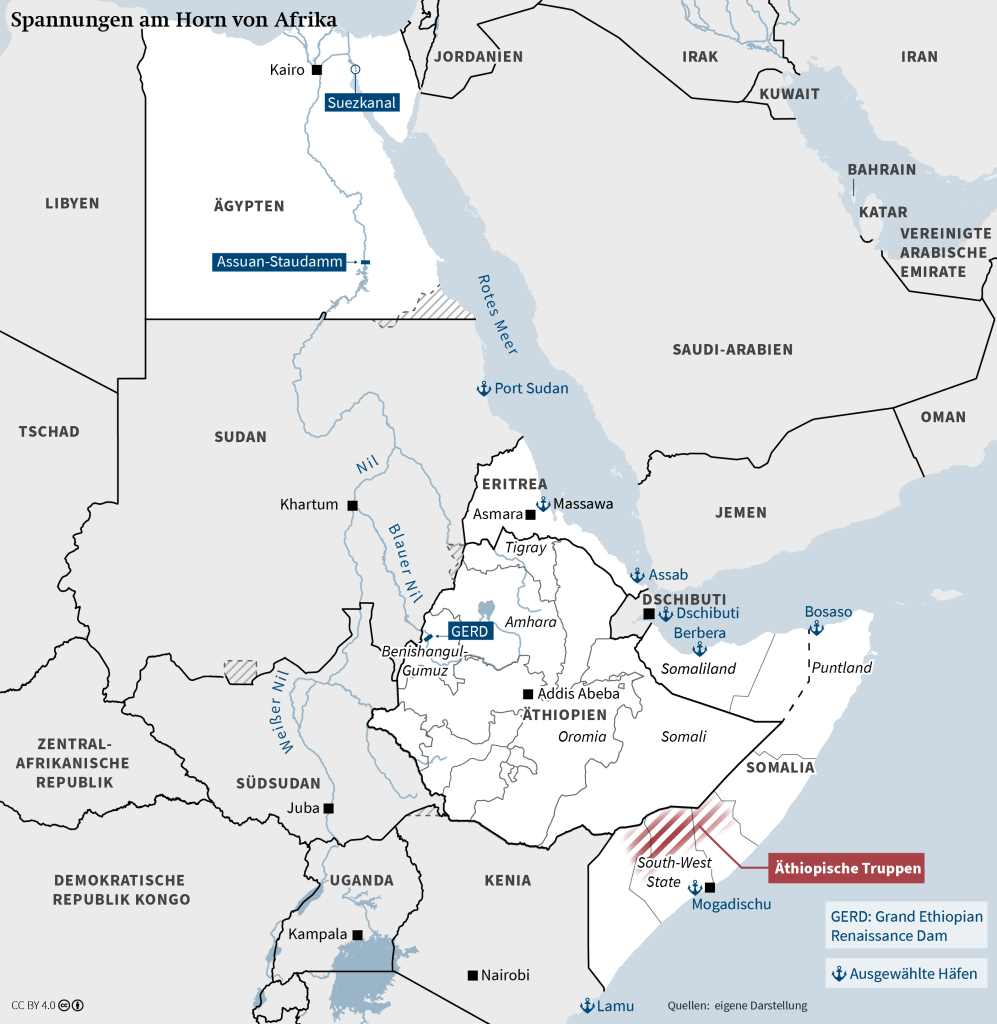
Äthiopiens Hafenambitionen
Während Äthiopien und Somalia zuvor jahrelang enge diplomatische Beziehungen gepflegt haben, ging es im bilateralen Verhältnis seit Anfang 2024 rapide bergab. Der Grund: die Absichtserklärung, die Ministerpräsident Abiy und Präsident Muse Bihi Abdi von Somaliland im Januar unterzeichneten. Das Memorandum of Understanding (MoU), dessen Wortlaut nicht veröffentlicht wurde, sieht vor, dass Äthiopien einen 20 Kilometer langen Küstenstreifen für 50 Jahre pachtet, um dort eine Marinebasis zu errichten. Außerdem soll Äthiopien wirtschaftlichen Zugang zu einem Hafen des De-facto-Staats bekommen. Im Gegenzug versprach Äthiopien Somaliland eine Beteiligung an Ethiopian Airlines und stellte in Aussicht, die völkerrechtliche Anerkennung Somalilands zu prüfen.
Bislang hat kein UN-Mitgliedstaat die Unabhängigkeit Somalilands anerkannt, die die autonome Region 1991 ausrief. Gleichwohl unterhalten verschiedene Staaten eigene, vor allem wirtschaftliche Beziehungen mit Somaliland. So investierten die VAE mehrere Hundert Millionen US-Dollar in den Ausbau des Hafens von Berbera, den das emiratische Unternehmen DP World seit 2017 betreibt, sowie in die logistische Infrastruktur mit Äthiopien zu beiden Seiten der Grenze. Damals schlossen Äthiopien und DP World eine Vereinbarung, der zufolge sich Addis Abeba mit 19 Prozent am Hafenausbau beteiligen sollte. 2022 verlor Äthiopien diesen Anspruch jedoch, nachdem das kriegsgeschüttelte Land die versprochenen Mittel nicht bereitgestellt hatte.
Äthiopien setzt mit dem MoU nun auf einen anderen Weg, sein Ziel eines eigenen Zugangs zum Meer zu erreichen. Abyis Regierung sieht darin den Ausgleich eines „historischen Fehlers“, den seine Vorgänger begangen hätten, als sie Eritrea 1993 in die Unabhängigkeit entließen und damit den Meereszugang aufgaben. Äthiopien sei dadurch heute das bevölkerungsreichste Land ohne Küste. Derzeit erfolgen rund 95 Prozent aller äthiopischen In- und Exporte über den Hafen von Dschibuti. Dafür werden jährlich rund 1,5 Milliarden US-Dollar an Gebühren fällig, die Äthiopien in knappen Devisen bezahlen muss.
Die Führung in Mogadischu reagierte auf das MoU mit entschiedener Ablehnung. Eine Anerkennung Somalilands durch Äthiopien, der weitere Staaten folgen könnten, betrachtet Somalia als Verletzung seiner Souveränität. Im April 2024 verwies Somalia den äthiopischen Botschafter des Landes und zog seinen eigenen Vertreter aus Addis Abeba ab.
Der somalische Präsident Hassan Sheikh Mohamud bemühte sich erfolgreich um diplomatische Unterstützung, sowohl in der Region als auch von internationalen Akteuren, darunter den G7-Staaten. In diesem Zusammenhang schlossen Somalia und Ägypten im August 2024 ein Sicherheitsabkommen, auf dessen Grundlage Ägypten zwei Wochen später Waffen zunächst per Flugzeug und später auch per Schiff nach Mogadischu lieferte.
Kriegsrisiko zwischen Ägypten und Äthiopien
Kriegsdrohungen Ägyptens sind im Wasserkonflikt mit Äthiopien keineswegs neu. Ein direkter ägyptischer Angriff auf die Baustelle des GERD war jedoch lange Zeit wegen der begrenzten militärischen Reichweite der ägyptischen Luftwaffe kein realistisches Szenario. Auch würde Ägypten als Unterliegerstaat sein eigentliches Ziel durch einen Waffengang nicht erreichen, da Äthiopien das Nilwasser dann erst recht als Druckmittel einsetzen und den Durchfluss am Staudamm gezielt drosseln könnte. Nach der Befüllung des Staubeckens birgt ein solcher Angriff nun zudem unkalkulierbare Risiken für den Wasserfluss des Nils und würde eine für Sudan katastrophale Flutwelle auslösen. Durch die Stationierung ägyptischer Truppen in Somalia könnte die Gefahr eines direkten militärischen Konflikts zwischen beiden Ländern allerdings steigen.
Sollte es tatsächlich zu Kampfhandlungen kommen, würde Kairo aber aus mehreren Gründen ein erhebliches Risiko eingehen. Zwar verfügt das Land über die bei weitem größten Streitkräfte Afrikas und ein umfangreiches Waffenarsenal, doch daraus lässt sich nicht zwingend die tatsächliche militärische Schlagkraft ableiten. So mussten die Streitkräfte bei der Bekämpfung aufständischer Gruppen auf der Sinai-Halbinsel nach 2013 schwere Verluste hinnehmen. Erst in den vergangenen zwei Jahren gelang es sukzessive, die Sicherheitslage unter Kontrolle zu bekommen. Ein Militäreinsatz außerhalb der eigenen Landesgrenzen wäre trotz einer Truppenstationierung in Somalia ungleich schwerer durchzuführen, nicht zuletzt aufgrund der Distanz, während Äthiopien aus dem eigenen Territorium heraus agieren könnte. Sollte ein bewaffnetes Vorgehen Ägyptens mit massiven Verlusten verbunden sein oder gar scheitern, könnte dies dazu führen, dass die ägyptische Bevölkerung die Rolle der Streitkräfte in der Politik und der Wirtschaft des Landes stärker in Frage stellt. Schon jetzt wird aus den Reihen der ägyptischen Zivilgesellschaft Kritik laut, dass die Armee vor allem mit der Verwaltung eines riesigen, ineffizienten Wirtschaftsimperiums beschäftigt ist.
Hinzu käme der Mangel an internationalem und regionalem Rückhalt für ein militärisches Vorgehen. Kairo ist stark von den Golfstaaten und den USA abhängig. Besonders die VAE sind in den letzten Jahren zum wichtigsten staatlichen Gläubiger Ägyptens geworden. Die USA leisten jährlich rund 1,3 Milliarden US-Dollar an Militärhilfe, die einen festen Bestandteil des ägyptischen Rüstungsetats ausmacht. Da beide Länder ebenfalls enge Beziehungen zu Äthiopien pflegen, würde ein Waffengang Ägyptens das Risiko bergen, diese Unterstützung zu verlieren.
So dürfte Kairos Handeln weniger auf eine direkte militärische Konfrontation mit Addis Abeba abzielen. Vielmehr soll die Drohung mit einer Eskalation externe Akteure dazu bewegen, sich im Nilwasserkonflikt verstärkt im Sinne Ägyptens zu engagieren. Eine derartige Internationalisierung des Konflikts hat es bisher nicht gegeben, obgleich Kairo dies seit Jahren anstrebt. Vor allem aber sollen regionale Gegner Äthiopiens militärisch gestärkt werden.
Neben lokalen Gruppierungen in Somalia und Äthiopien dürfte sich Kairo hier vor allem auf Eritrea fokussieren, da sich dessen Beziehungen zu Äthiopien seit 2022 deutlich verschlechtert haben. Hintergrund ist das Pretoria-Abkommen, das die äthiopische Regierung mit der Tigray People’s Liberation Front (TPLF) geschlossen hat, um den Bürgerkrieg im Land zu beenden. Eritrea sieht sein Ziel einer Zerschlagung der TPLF hierdurch konterkariert. Grenzstreitigkeiten und Äthiopiens Bestreben, sich einen Zugang zum Meer möglicherweise auch wieder in Eritrea zu sichern, verschärfen die Spannungen zusätzlich. Infolgedessen intensivierte Asmara mit Nachdruck seine Beziehungen zu Kairo, was nicht zuletzt durch das Gipfeltreffen zwischen den Präsidenten Ägyptens, Eritreas und Somalias im Oktober unübersehbar geworden ist. Gleichwohl dürfte sich Eritrea nicht einfach von Ägypten vereinnahmen lassen, sondern mittelfristig eher sein eigenes Interesse, die Errichtung einer Pufferzone auf äthiopischem Territorium, verfolgen. Die äthiopische Bundesregierung scheint die Präsenz eritreischer Truppen im Norden Tigrays derzeit zu tolerieren.
Dennoch kann auch ein direktes Aufeinandertreffen ägyptischer und äthiopischer Truppen nicht ganz ausgeschlossen werden, sollte Kairo tatsächlich Soldaten in nennenswerter Zahl in Somalia stationieren. Dieses Risiko steigt umso mehr, wenn Äthiopien sich weigert, seine Truppen aus Somalia abzuziehen. Ägypten könnte im schlimmsten Fall versuchen, die äthiopischen Truppen zu vertreiben – und zwar im Namen der somalischen Bundesregierung.
Chicken Game zwischen Äthiopien und Somalia
Die Wahrscheinlichkeit eines bewaffneten Konflikts zwischen Äthiopien und Somalia ist durch zwei Faktoren stark gemindert: das militärische Kräfteverhältnis und das geteilte Interesse an der Bekämpfung von Al-Shabaab.
Äthiopiens Armee ist zwar in hohem Maße eingebunden in die Bekämpfung mehrerer Aufstände und geschwächt vom verlustreichen Krieg im Norden des Landes 2020–22; sie bleibt jedoch eine der größten Militärmächte der Region und verfügt unter anderem über Drohnen, Hubschrauber, Kampfflugzeuge und schwere Waffen. Im Gegensatz dazu befindet sich der somalische Sicherheitssektor weiterhin im Aufbau. Ihm gelingt es nicht einmal, Mogadischu effektiv vor Angriffen durch Al-Shabaab zu schützen. Die somalischen Sicherheitskräfte sind auf Einheiten unter unterschiedlichem Kommando der Bundesregierung und der Bundesstaaten sowie auf Klan-Milizen verteilt, die inkohärent agieren. Trotz Erfolgen bei der Ausbildung einiger Einheiten sind die somalischen Sicherheitskräfte weiterhin stark von internationalen militärischen und finanziellen Unterstützern abhängig, darunter neben der AU die EU, die USA, die Türkei, Kenia und auch Äthiopien.
Äthiopien und Somalia verbindet seit langem der Kampf gegen Al-Shabaab. Addis Abeba will die Fähigkeiten der dschihadistischen Gruppe in seinem Nachbarland eindämmen, eine Pufferzone aufrechterhalten und damit deren Angriffe in Äthiopien verhindern. Im Juli 2022 überschritten Hunderte von Al-Shabaab-Kämpfern die Grenze und drangen rund 150 Kilometer ins äthiopische Landesinnere vor, bis sie zurückgeschlagen werden konnten. Unter den Invasoren sollen auch viele äthiopische Staatsangehörige aus den Regionen Somali und Oromia gewesen sein.
Wegen dieser Bedrohungslage setzt Äthiopien derzeit rund 10.000 eigene Soldaten in Somalia ein. Nur etwa ein Drittel davon ist bisher Teil der AU-Missionen AMISOM und ATMIS gewesen. Den Rest hat Addis Abeba aus eigener Initiative entsandt. Diese Truppen kooperieren eng mit denen der jeweiligen somalischen Bundesstaaten und lokalen Milizen. Die somalische Regierung hatte diese Truppen über Jahre toleriert (ähnlich wie kenianische Einheiten im Süden), weil sie der Sicherheit in ihren Einsatzgebieten dienen.
Die Drohgebärden Äthiopiens und Somalias sind Spiegel dieses ungleichen Machtverhältnisses. Äthiopien kalkuliert damit, dass Somalia es sich gar nicht leisten kann, die äthiopischen Truppen des Landes zu verweisen, weil diese einen entscheidenden Beitrag im Kampf gegen Al-Shabaab leisten. Die zu erwartenden somalischen Reaktionen auf das MoU mit Somaliland würden damit verpuffen. Umgekehrt hat die somalische Regierung allerdings mittlerweile angekündigt, dass die äthiopischen Truppen mit dem Ende von ATMIS das Land bis Ende Dezember 2024 verlassen sollen, wenn Äthiopien das MoU nicht zurückzieht. Somalia setzt damit darauf, dass Äthiopien sich eigentlich einen Abzug nicht leisten kann. Die Frage ist, wer zuerst nachgibt.
Eskalation innerstaatlicher Konflikte als eigentliche Gefahr
Während direkte konventionelle Auseinandersetzungen zwischen den beteiligten Staaten derzeit eher unwahrscheinlich sind, sind sowohl Äthiopien als auch Somalia aufgrund ihrer innerstaatlichen Zerrissenheit anfällig für gezielte wie auch unbeabsichtigte Eskalationen.
Das größte Risiko ist, dass die äthiopisch-somalischen Unstimmigkeiten Al-Shabaab weiter Auftrieb geben könnten. Die Gruppe konnte bereits von dem bisherigen Teilabzug von ATMIS profitieren, weil somalische Sicherheitskräfte nicht in der Lage waren, die entstandene Lücke zu füllen. Zudem breitet sich in Puntland der sogenannte Islamische Staat aus.
Noch ist offen, wie genau die Nachfolgemission der derzeitigen AU Transition Mission in Somalia(ATMIS), deren Mandat Ende Dezember 2024 ausläuft, aussehen soll. Der AU-Friedens- und Sicherheitsrat nahm im August 2024 einen Operationsplan für eine neue Mission unter dem Namen AU Support and Stabilization Mission in Somalia (AUSSOM) an, die grundsätzlich ATMIS ab Januar 2025 ablösen soll. Allerdings ist bislang weder geklärt, welche Staaten Truppen stellen, noch wie die Mission finanziert werden soll. Die ägyptischen Truppen könnten die Führung übernehmen, dazu käme ein vermutlich kleineres Kontingent, das Dschibuti angeboten hat. Damit bleibt aber offen, wer die restlichen der geplanten knapp 12.000 Soldaten stellen soll (ATMIS hat derzeit rund 12.600). Möglich wären Beiträge der bisherigen Truppensteller Kenia und Uganda. Grundsätzlich soll AUSSOM fünf Jahre Bestand haben und dabei schrittweise immer mehr Verantwortung an die somalischen Sicherheitskräfte abgeben.
Falls die äthiopischen Truppen tatsächlich abziehen und durch ägyptische ersetzt werden sollten, dürften diese mindestens beim Übergang Schwierigkeiten haben, die Sicherheitslage zu kontrollieren. Die äthiopischen Streitkräfte haben über mehr als ein Jahrzehnt lokale Netzwerke geknüpft und lokale Milizen ausgerüstet und ausgebildet. Ägypten müsste diese Kontakte erst mühsam aufbauen. Währenddessen könnte Al-Shabaab sich sowohl in Somalia als auch möglicherweise an der Grenze zu Äthiopien weiter ausbreiten. Außerdem ist nicht auszuschließen, dass die von Ägypten für die somalische Regierung bestimmten Waffen ihren Weg zu Al-Shabaab finden.
Die AU hofft auf eine Finanzierung durch einen neuen Mechanismus, den der UN-Sicherheitsrat im Dezember 2023 geschaffen hat. Danach könnten AU-Missionen künftig zu 75 Prozent aus UN-Pflichtbeiträgen bezahlt werden. Voraussetzung dafür ist allerdings ein Beschluss des UN-Sicherheitsrats. UN und AU sollen bis Mitte November einen Plan zum Design und zur Finanzierung von AUSSOM vorlegen. Die Entscheidung könnte zu spät kommen, um einen lückenlosen Übergang von der Vorgänger‑ zur Nachfolgemission zu garantieren. Daher wird bereits über eine Brückenfinanzierung diskutiert, für welche sich die Blicke auf die wichtigste bisherige Finanzquelle richten, die Europäische Union.
Eine weitere Konfliktdimension eröffnet sich mit den Beziehungen zwischen der somalischen Bundesregierung und den somalischen Bundesstaaten. So hat es bereits mehrere Demonstrationen im somalischen South-West State gegeben, auf denen die Fortdauer der Präsenz der äthiopischen Truppen gefordert wurden. Auch der Präsident von South-West State Abdiaziz Laftagareen sprach sich gegen die Stationierung von ägyptischen Truppen und für den Verbleib der äthiopischen Kontingente aus, die in seinem Bundesstaat eingesetzt sind.
Die Beziehungen zwischen Mogadischu und den Bundesstaaten sind ohnehin angespannt. Ende März kündigte Puntland an, es werde sich aus dem föderalen System des Landes zurückziehen, nachdem die Bundesregierung die ersten Kapitel einer Verfassungsreform durchs Parlament gebracht hatte. Wenige Tage später trafen sich Vertreter Puntlands mit einem äthiopischen Staatssekretär. Äthiopien könnte auch in Zukunft ein offenes Ohr für unzufriedene politische Stakeholder in Somalia haben und so die dortigen politischen Verhältnisse beeinflussen. In der Vergangenheit hat es bereits zu verschiedenen Zeitpunkten bewaffnete Auseinandersetzungen zwischen somalischen Bundesstaaten und der Regierung in Mogadischu gegeben. Somalias Außenministerium wirft Äthiopien bereits vor, Waffen an Puntland zu liefern.
Umgekehrt sieht sich Äthiopien der Gefahr ausgesetzt, dass bewaffnete Gruppen im Land von außen gezielt gefördert werden könnten. Denkbar wäre zum Beispiel eine externe Unterstützung der Ogaden National Liberation Front (ONLF) im äthiopischen Somali State. Diese erklärte zwar 2018 einen Waffenstillstand mit der Regierung, allerdings beschwerte sich die Bewegung im September 2024 über äthiopische Truppenverlegungen, die sie als friedensgefährdende „Militarisierung“ des Bundesstaats wertete.
Andere Eingriffsmöglichkeiten bestehen in Amhara, Oromia, Benishangul-Gumuz (wo der GERD liegt) und Tigray. Die äthiopische Regierung hat in der Vergangenheit Ägypten mehrfach vorgeworfen, verschiedene bewaffnete Gruppen in Äthiopien zu unterstützen. Dazu zählten Gumuz-Milizen, die vor einigen Jahren unter anderem versuchten, die Hauptstraße zum GERD zu blockieren, aber auch die TPLF während des Kriegs im Norden.
Die derzeit aktivsten Konfliktherde Äthiopiens sind die Regionen Amhara und Teile Oromias. Die Fano-Milizen in Amhara profitierten in der Vergangenheit von der Ausbildung durch eritreische Kräfte – eine Unterstützung, die möglicherweise immer noch anhält. Äthiopische und kenianische Nachrichtendienste berichteten im August 2024 über eine Zusammenarbeit zwischen der Oromo Liberation Army, die gegen die äthiopische Regierung kämpft, und Al-Shabaab in Somalia.
Handlungsoptionen für Deutschland und die EU
Deutschland und seine europäischen Partner sollten die geopolitischen Spannungen am Horn von Afrika ernst nehmen und darauf achten, diese nicht durch einseitige Positionierungen oder falsche finanzielle Anreize zu verschärfen. Ein zwischenstaatlicher Krieg ist derzeit zwar unwahrscheinlich, aber aufgrund von Missverständnissen, unüberlegten Fehltritten und der emotionalen Aufheizung auf allen Seiten nicht komplett auszuschließen. In jedem Fall erschweren die Spannungen die weitere regionale Zusammenarbeit zu einer Zeit, in der es ohnehin große Herausforderungen in der Region gibt: den Krieg in Sudan, die Angriffe der Houthis auf die Schifffahrt im Roten Meer und ein Erstarken der Al-Shabaab und des sogenannten Islamischen Staates in Somalia.
Wichtig ist, dass Deutschland und die EU die komplexen Konflikte in der Region zusammendenken und nicht isoliert voneinander bearbeiten. Die Europäer sollten sich von den Machtspielen Ägyptens, Äthiopiens und Somalias nicht dazu verleiten lassen, einseitige Agenden im Namen zweifelhafter Stabilitätsversprechen zu unterstützen.
In Bezug auf Somalia sollten die Europäer deutlich machen, dass eine übergangsweise Finanzierung von AUSSOM aus dem Europäischen Friedensfonds nicht der Stärkung der ägyptischen Drohkulisse gegenüber Äthiopien dienen darf. Ein möglicher Kompromiss könnte darin bestehen, dass ägyptisches Militär zur weiteren Ausbildung von Sicherheitskräften in Mogadischu stationiert wird, während die äthiopischen Truppen in anderen Bundesstaaten weiter direkt den Kampf gegen Al-Shabaab unterstützen. Die EU sollte weiterhin die einseitige völkerrechtliche Anerkennung Somalilands ablehnen.
Im Konflikt um die Nutzung des Nilwassers sollten Deutschland und die EU darauf hinwirken, dass bei der Umsetzung des CFA die Nile River Basin Commission nicht von einzelnen Anrainerstaaten dazu genutzt wird, Ägyptens Position weiter zu schwächen. Nur wenn das Wirken der NRBC tatsächlich beckenweit ausgerichtet ist, internationale rechtliche Standards einhält und damit in der Folge implizit auch ägyptische Nilwasserinteressen wahrt, ist eine Unterstützung der Kommission angeraten. Die Europäer sollten sich zudem dafür einsetzen, die NBI für den Austausch über Nilwasserfragen zwischen NBRC-Mitgliedern und den anderen Anrainerstaaten zu erhalten oder eine vergleichbare niedrigschwellige (Dialog-)Plattform zu etablieren, der alle Nilanrainerstaaten unverbindlich beitreten können.
Schließlich sollten sich die Europäer weiterhin um eine bessere Abstimmung des gesamten internationalen Engagements in der Region bemühen. Dabei gilt es, auch externe Akteure mit Einfluss auf die betreffenden Regierungen stärker in die Pflicht zu nehmen, damit sie Konfliktlösungsansätze in der Region intensiver fördern. Die Türkei vermittelt bereits zwischen Äthiopien und Somalia, wenn auch bisher ohne Erfolg. Eine besondere Rolle kommt den VAE zu: Sie verfolgen am Horn von Afrika ausgeprägte wirtschaftliche Interessen, insbesondere durch Investitionen in Hafeninfrastruktur und Landwirtschaft, und zählen zu den wichtigsten staatlichen Gläubigern. Ihre Finanzhilfen und, im Fall Äthiopiens, auch militärische Unterstützung haben maßgeblich zur Machtkonsolidierung der aktuellen politischen Führungen in Kairo und Addis Abeba beigetragen und deren außenpolitische Risikobereitschaft erhöht. Dennoch fehlt den VAE bisher eine ordnungspolitische Vision für die Region und ihr Beitrag zur konstruktiven Konfliktbearbeitung bleibt gering – ein Umstand, der in Abu Dhabi intensiver zur Sprache gebracht werden sollte
Dr. Gerrit Kurtz ist Wissenschaftler, Dr. Stephan Roll Senior Fellow in der Forschungsgruppe Afrika und Mittlerer Osten.
Tobias von Lossow ist Research Fellow bei Clingendael – Netherlands Institute of International Relations.

