Pod und die Welt, Podcast der Zeitschrift Internationale Politik, 15.10.2026
Tag: Tigray
Kämpfe in Tigray: “Es gab genug Warnungen”
Interview mit dem Spiegel, 26.9.2026
SPIEGEL: Herr Kurtz, erst vor vier Jahren endete der brutale Bürgerkrieg zwischen Äthiopiens Armee und der sogenannten Volksbefreiungsfront von Tigray (TPLF). Seit einigen Monaten scheinen die Spannungen wieder zuzunehmen. Nun haben Kämpfer der TPLF mehrere Flughäfen eingenommen, es gibt Berichte über heftige Kämpfe. Geht der Krieg jetzt wieder los?
Kurtz: In den vergangenen Monaten gab es immer wieder Kämpfe in Tigray – die waren allerdings in der Regel nach ein paar Stunden vorbei. Am vergangenen Sonntag haben die wichtigsten bewaffneten Gruppen Äthiopiens verkündet, dass sie eine »Allianz des Überlebens« bilden, die den Sturz der Regierung von Abiy Ahmed als Ziel hat. Mittlerweile spricht die TPLF selbst von Krieg. Das bedeutet nicht, dass es sich nicht wieder einfangen lässt – aber wir sehen hier schon eine ziemliche Eskalation.
SPIEGEL: Der vergangene Bürgerkrieg begann als Machtkampf zwischen der TPLF und der äthiopischen Regierung von Abiy Ahmed. Nach Schätzungen der Afrikanischen Union kostete der Krieg mehr als 600.000 Menschen das Leben, letztlich einigte man sich im Pretoria-Abkommen von 2022 auf einen Waffenstillstand. Warum scheint dieser nun zu zerbrechen?
Kurtz: Wichtige Punkte des Abkommens wurden nie umgesetzt, wie etwa die Rückkehr der Vertriebenen in ihre Heimat. Noch immer sind Hunderttausende Menschen vertrieben und leben unter extrem prekären humanitären Bedingungen. Das ist ein wichtiger Punkt, die große Frage ist jedoch eine politische: Was ist die künftige Rolle der TPLF?
Vor Abiys Amtsantritt 2018 dominierte die von Tigrayern geführte TPLF über Jahrzehnte die äthiopische Staats- und Sicherheitsordnung. Während des Krieges wurde die TPLF verboten, nach dem Kriegsende hätten sie sich laut Vorgaben aus Addis Abeba neu als Partei registrieren müssen – das wollte man aber in Mekelle auf keinen Fall.
Im Mai erklärte die TPLF schließlich, dass sie die von Abiy eingesetzte Übergangsregierung nicht anerkennen werde und man eine konkurrierende Regionalregierung bilde. Diese wurde dann wiederum von Addis Abeba nicht anerkannt. Das erinnerte bereits an die politische Konstellation vor dem November 2020, als der Bürgerkrieg ausbrach.
»Die Rebellen wissen noch aus dem vergangenen Krieg, dass es nicht so leicht ist, nach Addis Abeba zu marschieren.«
SPIEGEL: Gab es nun einen konkreten Auslöser?
Kurtz: Die Gründung der Rebellenallianz war lange vorbereitet worden. Dass wenige Tage nach ihrer Verkündung der Krieg beginnt, ist sicher kein Zufall. Im Juni haben Parlamentswahlen stattgefunden, Tigray blieb von der Wahl ausgeschlossen. Am 5. Oktober kommt das neue Parlament erstmals zusammen. Möglicherweise hat dieser Termin auch eine Rolle gespielt.
SPIEGEL: In der Allianz haben sich Rebellengruppen zusammengeschlossen, die einst gegeneinander kämpften. Nun ist ihr erklärtes Ziel, die Regierung zu stürzen.
Kurtz: Ja, und bis vor Kurzem haben sie das noch nicht so explizit gesagt. Das Hauptziel ist sicher, die Regierung massiv unter Druck zu setzen. Die Rebellen wissen noch aus dem vergangenen Krieg, dass es nicht so leicht ist, nach Addis Abeba zu marschieren.
SPIEGEL: Die Regierung von Abiy Ahmed wird von den Vereinigten Arabischen Emiraten unterstützt. Hat die Rebellenallianz ebenfalls ausländische Geldgeber im Rücken?
Kurtz: Nicht im gleichen Maße. Sie erhalten Unterstützung aus Eritrea, auch wenn der Nachbarstaat nicht Teil des neuen Bündnisses ist. Aber die Regierung in Asmara schickt anscheinend Munition und Waffen an die TPLF. Eine größere eritreische Truppenpräsenz in Tigray haben wir bislang nicht gesehen, das scheint auch nicht die Erwartung der Allianz zu sein. Die Rückendeckung ist geografisch wichtig: Im vergangenen Krieg konnten die Regierungstruppen die TPLF komplett isolieren, indem sie die Grenze in Zusammenarbeit mit Eritrea dichtmachten. Damals war Eritrea mit Äthiopien verbündet. Insofern ist die Versorgung aus Eritrea für die Rebellen sehr wichtig, das Land hat – anders als Äthiopien, mehrere Häfen.
SPIEGEL: Die isolierte, langjährige Diktatur Eritrea verfügt jedoch nicht über dieselben finanziellen Mittel wie die Emirate.
Kurtz: Das stimmt. Der wohl potenteste mögliche Partner für die Rebellenallianz wäre Ägypten. Kairo streitet mit Addis Abeba um die Nutzung des Nilwassers, und hat sich im Zuge dessen in den vergangenen Monaten sehr stark an Eritrea angenähert. Bislang gibt es aber keine Beweise für eine direkte ägyptische Unterstützung äthiopischer Rebellen.
»Man hätte die Eskalation in den vergangenen Monaten verhindern können.«
SPIEGEL: Äthiopien grenzt an den Sudan, wo seit über drei Jahren ein verheerender Bürgerkrieg geführt wird. Die sudanesische Armee wirft Äthiopien vor, die Rapid Support Forces (RSF) zu unterstützen. Könnte sich der Konflikt in einen Regionalkrieg wandeln?
Kurtz: Die Gefahr besteht, dass die Konflikte sich stärker verbinden – obwohl ihre Ursachen unterschiedlich sind. Schon jetzt sehen wir grenzüberschreitende Angriffe. Es gab eine ganze Reihe von Berichten über Drohnen, die aus Äthiopien in den Sudan geschickt worden sind, auch Waffen werden über die Grenze an die RSF geliefert. Bislang ist es nicht zu einem zwischenstaatlichen Konflikt zwischen Äthiopien und Sudan gekommen, auch, weil da offenbar gute Geheimdienstkontakte bestehen. Trotzdem stellt sich die Frage, wie weit das noch geht.
SPIEGEL: Lässt sich eine weitere Eskalation noch verhindern, und wenn ja, von wem?
Kurtz: Man hätte die Eskalation in den vergangenen Monaten verhindern können. Es gab genug Warnungen. Dieser Konflikt hat sich seit Monaten aufgebaut und die internationale Reaktion war nicht entschieden genug. Es gab Versuche der Mediation durch die Afrikanische Union, aber diese waren nicht besonders erfolgreich. Die USA haben versucht zu vermitteln, ließen aber gleichzeitig Sanktionen gegen die eritreische Regierung auslaufen, genau wie ein Waffenembargo gegen Äthiopien. Natürlich gab es immer wieder Aufrufe, das Waffenstillstandsabkommen von Pretoria umzusetzen, aber zu wenig konkrete Bemühungen, sowohl auf die äthiopische Regierung als auch auf die TPLF einzuwirken.
Wer jetzt noch eine Rolle spielen könnte, sind die arabischen Länder. Die Emirate haben viel Einfluss in Addis Abeba, Saudi-Arabien hat gewisse Kontakte nach Eritrea. Natürlich braucht es diplomatische Initiativen. Aber wenn man jetzt glaubt, man könne einfach eine neue Initiative anfangen, sollte man nicht vergessen, welche Fehler man schon gemacht hat.
The Tigray Region in the Grey Zone between War and Peace
The Conflict Between the TPLF and the Ethiopian Government Has the Potential to Escalate beyond the Country’s Borders
SWP Comment 2026/C 29, 22.07.2026 (see the German version here)
Tensions between Addis Ababa and the Tigray Region are gradually mounting. Miscalculations could even trigger another large-scale war, although the parties involved may not directly seek one. Since the war in northern Ethiopia ended in November 2022, no new, stable political order has emerged. Tigray remains suspended between war and peace. Responsibility for this lies with both the Ethiopian government and its partner in peace, the Tigray People’s Liberation Front (TPLF). Having lost power in the national government in 2018, the TPLF has yet to find a new role for itself; instead, it has been marked by internal power struggles and characterised by authoritarian tendencies. Conversely, the Ethiopian government has not done enough to facilitate the return of internally displaced persons and restore Tigray’s territorial integrity. A renewed outbreak of hostilities could draw in Eritrea, Sudan and other regional actors. Germany and the European Union (EU) should firmly commit to crisis prevention in order to avoid further escalation in the already tense Red Sea region.
Relations between the TPLF and the Ethiopian government resemble a strategic game: Every move by one side prompts a response from the other. Accompanied by threatening rhetoric, both sides are testing how far they can go. Violence is part of their established repertoire.
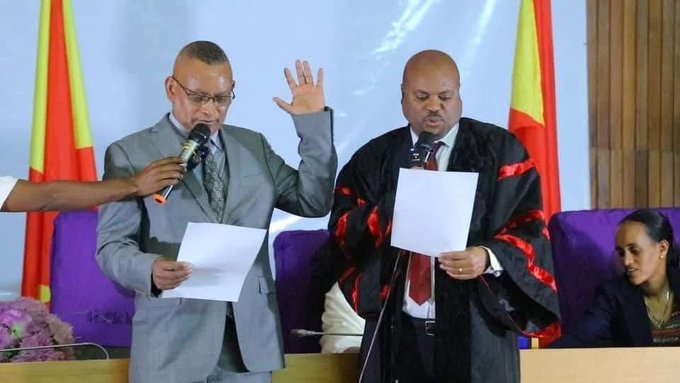
On 8 April 2026, the Ethiopian government extended the mandate of the Tigray Interim Regional Administration (TIRA) by one year. General Tadesse Worede was to remain president in Mekelle. The TPLF, which was not consulted on the extension (though it had been involved in Tadesse’s appointment a year earlier), did not recognise the decision. Instead, it reinstated the regional parliament, which had emerged from elections organised unilaterally in 2020. On 5 May 2026, that parliament elected TPLF chairman Debretsion Gebremichael president of the regional government. This administration, in turn, is not recognised by the Ethiopian government. Debretsion’s regional government stripped Tadesse of his powers. At the same time, the Tigray Defense Forces (TDF) – the regional government’s armed forces – are recruiting new fighters. Since last year, armed actors from Tigray have repeatedly engaged in brief violent clashes, with the Ethiopian National Defense Forces (ENDF) intervening on several occasions with drone strikes.
This is not some obscure political power struggle confined to the local level. The war from 2020 to 2022 was one of the deadliest armed conflicts worldwide in recent decades. The Pretoria Agreement, which ended the war, hangs by a thread. Ethiopia is the most populous country in the strategically important Horn of Africa region.
The Pretoria Agreement’s fault lines
The cessation-of-hostilities agreement signed by the TPLF and the Ethiopian government in November 2022 in Pretoria, South Africa – after mediation by the African Union (AU), the Intergovernmental Authority on Development (IGAD) and the United States – remains an important framework for relations between Tigray and Addis Ababa, in the absence of alternatives.
The Pretoria Agreement brought about a noticeable improvement in living conditions in Tigray in the first few months following its signing. Hostilities ceased and the government lifted the economic blockade of the region and restored essential services (electricity, banking, telecommunications) that had been suspended during the war. The TPLF handed over its heavy weaponry under AU supervision.
The TPLF agreed to dissolve the regional government it had formed unilaterally in 2020 and, in consultation with Addis Ababa, establish an interim regional administration in March 2023. From the outset, however, the interim administration found itself in a difficult position, as it was also held accountable by the people of Tigray for the Ethiopian government’s failings.
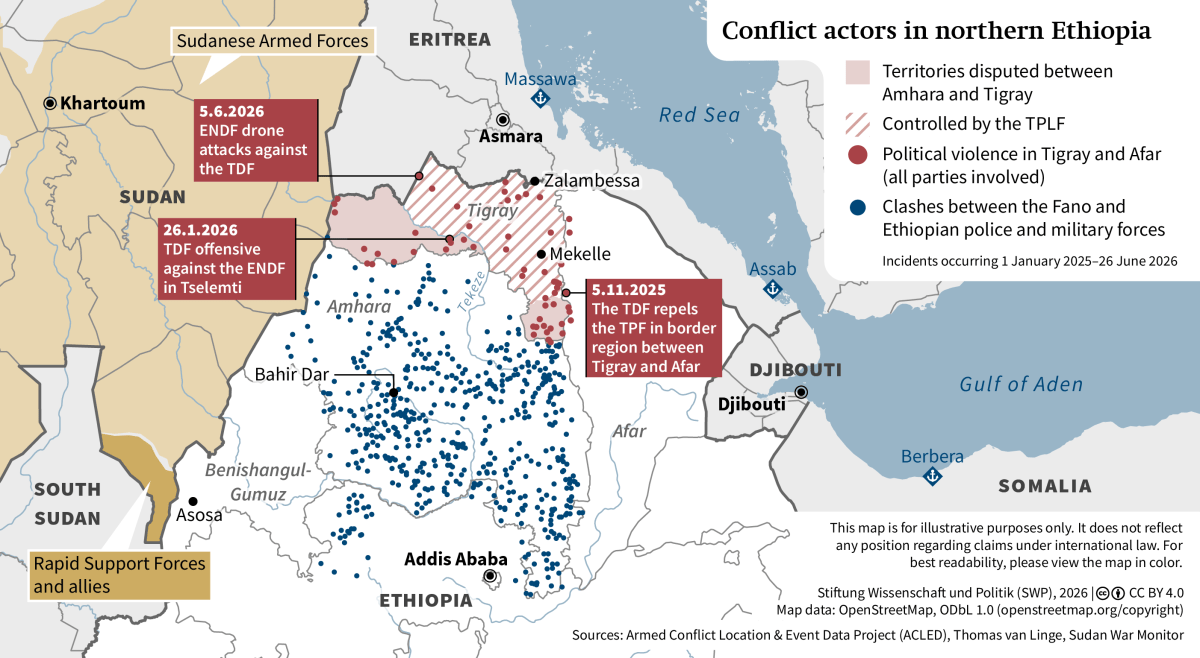
These failures are particularly evident in three key areas concerning the implementation of the Pretoria Agreement. The first concerns the status of areas that belonged to the Tigray Region before the war and were occupied by Amhara militias and the ENDF at the start of the conflict. These include the Western and Southern Zones of the local administration, as well as Tselemti south of the Tekeze River (see map). The neighbouring Amhara Region claims these areas, which had in fact not formed part of Tigray prior to 1991. The Pretoria Agreement merely states that their status should be resolved in accordance with the Constitution. However, the steps necessary for a constitutional settlement have not yet been taken.
The Western Zone of Tigray is of strategic importance. Sesame and cotton are grown there on large agricultural estates for export. The Ethiopian government fears that the TPLF could link up with armed groups across the border with Sudan and organise its own supply lines.
Second, closely linked to this territorial issue, is the plight of internally displaced persons. During the civil war, around 1.9 million people were displaced within and from Tigray. More than three years after the Pretoria Agreement, around 750,000 people remain displaced in the region, according to the UN High Commissioner for Refugees mainly from areas controlled by Amhara forces. With a total population of around six million, this represents a considerable burden. Displaced people who have been able to return to the disputed areas often find their homes destroyed or occupied. They also lack access to essential services. Without a mutually agreed resolution regarding political control of these areas, returns will remain difficult.
The third area of concern is the demobilisation, disarmament and reintegration (DDR) of TDF soldiers. In Tigray alone, around 274,000 people have been registered for the DDR programme. Some 63,000 people have gone through the DDR process in Tigray to date. However, the process has stalled since 2025. Many of the soldiers live in poorly supplied camps. In some cases, the TIRA has allocated more than half of its budget solely to the fighters still awaiting demobilisation. These funds were consequently unavailable for the region’s development.
These unresolved issues also stood in the way of the region’s reintegration into Ethiopia’s political system. No elections were held either for a new regional parliament or to elect Tigrayan representatives to the parliament in Addis Ababa, although the Pretoria Agreement had stipulated this. The entire Tigray Region was excluded from the general elections that took place on 1 June 2026.
The TPLF’s search for a role
Following the devastating war in northern Ethiopia, an intense debate began within the TPLF and among the Tigrayan elite more broadly. How had violence on such a scale come about? How much responsibility lay with the TPLF, which had dominated Tigray’s politics for five decades, and how much compromise could still be reached with Addis Ababa?
| Key actors in the conflict ENDF: Ethiopian National Defense Forces (regular armed forces) TDF: Tigray Defense Forces (Tigray’s regular security forces) TIRA: Tigray Interim Regional Administration (stripped of power since May 2026) TPLF: Tigray People’s Liberation Front (political party) TPF: Tigray Peace Force (a splinter group of the TDF, pro-Addis Ababa) |
The discussions also touched on the fundamental question of Tigray’s place within Ethiopia’s state structure. Since the end of the 19th century, political elites from Tigray and Amhara had been competing for supremacy in Ethiopia. The rivalry escalated into several violent conflicts, such as the civil war against the Derg military regime from 1974 to 1991. The TPLF subsequently controlled the state and the economy for 27 years as part of a coalition of parties, until Abiy Ahmed, who is from Oromia, came to power in 2018. Under Abiy’s more centralised rule, the TPLF is unlikely to be able to play a national role any longer. However, according to an academic from the region, many Tigrayan elites, including those in the TPLF, simply cannot accept their peripheral status.
In the post-war discussions, the interim administration was a bone of contention within the TPLF. Abiy prevented TPLF Chairman Debretsion from becoming its head, whereupon the TPLF Central Committee elected Getachew Reda – its chief negotiator in Pretoria and former Minister of Communications – whom Abiy eventually appointed in March 2023. Getachew’s government was caught between the uncompromising stance of the TPLF leadership led by Debretsion and the delaying tactics of the federal government in Addis Ababa.
In August 2024, the power struggle within the TPLF erupted into the open. The TPLF convened a party congress at short notice, which Getachew and other members of the TIRA boycotted. Shortly afterwards, Getachew and 15 others were expelled from the party. Getachew’s position soon became untenable. After the TPLF had already taken over parts of the administration with the help of security forces, Abiy dismissed Getachew in March 2025 and, following negotiations with Debretsion, replaced him with Tadesse Worede. Tadesse had previously headed the TIRA’s Peace and Security Bureau and, in that capacity, had controlled the TDF.
However, replacing the regional president did not resolve the underlying problems. Tadesse soon encountered difficulties and resistance similar to those faced by his predecessor.
At the same time, relations between the TPLF and the Ethiopian state deteriorated. The National Election Board of Ethiopia (NEBE), which also oversees the political party system, had only re-registered the TPLF in 2024 (following its ban during the war) subject to certain conditions. The TPLF was required to hold a party congress to elect a leadership and adopt a constitution. The TPLF refused to comply with the legal framework, as this would have required it to register as a new political party, thereby renouncing its historical continuity. Furthermore, the TPLF argued that, as a signatory to the Pretoria Agreement, it was already recognised as a political party. In May 2025, the NEBE ultimately revoked the TPLF’s registration. From the Ethiopian government’s perspective, the TPLF therefore no longer exists as a legal entity. This complicates the initiation of direct talks.
The TPLF also faces a legitimacy problem within Tigray itself. On two occasions – March 2025 and May 2026 – it replaced previously legitimised interim administrations in Mekelle, partly through the use of force. Opposition politicians from Tigray report that they and their supporters are occasionally harassed and arrested. The TPLF has declared a “zero tolerance” policy towards media outlets that promote the agenda of its opponents. Tens of thousands of people, mainly young people from Tigray, have left Ethiopia in search of work, usually heading for the Arabian Peninsula. In this situation, the TPLF benefits from the grey zone between war and peace in which Tigray finds itself. Its constant warnings about the Ethiopian government’s machinations help it to justify its own extra-legal measures.
Abiy the juggler
The Ethiopian government under Prime Minister Abiy faces its own challenges. It aims to drive forward the country’s ongoing political and economic transformation, moving away from the ethnic federalism and developmental-state model established under TPLF rule, and towards a unitary state and a controlled opening of the market economy.
Abiy must balance the interests of various groups without becoming dependent on them. He appears to be pursuing a strategy of dividing the opposition and thereby weakening it. A controversial national dialogue, which could pave the way for constitutional amendments, is also part of his toolkit. However, no consultations for the national dialogue have taken place yet in Tigray itself.
Addressing and resolving the outstanding issues in the implementation of the Pretoria Agreement would have meant jeopardising fragile relations with key groups. Clarifying the territorial status of Western Tigray by means of a referendum, which the government had proposed, would have required determining who was eligible to vote, particularly among people displaced from Tigray and new arrivals from Amhara.
The same applied to the government’s commitment to ensure the withdrawal of all “non-ENDF” troops, meaning primarily Amhara militias and Eritrean forces. Although Eritrean troops withdrew from central Tigray, they remained present in the north-east of the region, particularly in Zalambessa and Irob.
The government in Addis Ababa also capitalised on tensions within Tigray, which it actively fuelled, at least in certain instances. TDF fighters dissatisfied with the TPLF’s course split off in 2025 and began to form their own militia under the name Tigray Peace Force (TPF, Hara Meret in Tigrinya). The ENDF appear to be supporting the TPF with ammunition, rations and pay. In November 2025, the ENDF deployed drones against the TDF as it pursued the TPF across the border into Afar.
In May 2026, Getachew, together with his new party, Simret, and other parties, founded the “Peace and Change Council”, which also includes TPF members. The coalition is led by General Tsdadkan Gebretensae, who commanded the TDF during the war and served as vice-president of the TIRA under Getachew. The Peace and Change Council aims to remove the TPLF from power in Tigray “by any means necessary”, as stated at its founding. Getachew has officially served as Abiy’s adviser on East Africa, with the rank of minister, since April 2025.
“Tsimdo” and Eritrea’s interests
For its part, the TPLF is cooperating with its former arch-enemy, Eritrea. Initial contacts reportedly took place as early as the beginning of 2024 in Dubai, when Getachew met with Eritrean representatives on behalf of the TPLF and – according to Debretsion – with Abiy’s encouragement. A strategic objective of the TPLF is to ensure that it can no longer be cut off from the world by the government in Addis Ababa, as happened during the previous war.
As part of this rapprochement, Eritrea launched the “Tsimdo Selam” initiative in 2025. Representatives of Tsimdo describe it as a “grassroots peace movement” between related peoples in the border region of Ethiopia, Eritrea and Sudan. However, given the actors involved in this alliance, Addis Ababa views the initiative as an anti-Ethiopian alliance comprising the TPLF, Eritrea, the Fano (from Amhara) and other opposition movements, which it claims is preparing a joint military offensive.
Eritrea has come a remarkable way – from fighting alongside the ENDF against the TPLF to becoming an ally of the TPLF against the Ethiopian government. For President Isaias Afwerki, the threat environment has since shifted. Since 2023, Abiy has regularly spoken of Ethiopia’s right to access the sea and described the Red Sea as Ethiopia’s “natural boundary”. In November 2025, Ethiopian Foreign Minister Gedion Timothewos stated that Ethiopia had long had sufficient grounds to wage war against Eritrea, but was refraining from doing so out of a sense of responsibility.
Against this backdrop, Eritrea has an interest in overcoming its regional isolation without abandoning its existing totalitarian model of rule. That model also relies on constantly emphasising the threat of external interference, particularly by Ethiopia, in order to justify the continued militarisation of society.
There is a widespread willingness in the region to cooperate with a former enemy when that enemy is regarded as the “lesser evil” compared with the principal adversary, as discussions with various political actors in Ethiopia have shown. This calculation shapes the TPLF’s relations with Eritrea, those of the Fano with the TPLF, and also relations between the Peace and Change Council and the government in Addis Ababa. The actors assume that they can exploit each other’s interests for their own ends. It is a tactical collaboration, not a strategic alliance.
Regional entanglements
Tensions in northern Ethiopia involve not only Eritrea but also other regional actors that could contribute to an escalation and link it to ongoing armed conflicts.
For instance, Ethiopia’s relations with the Sudanese Armed Forces (SAF), which control most of the border with the neighbouring country, have deteriorated significantly in recent months. Since late 2025, Ethiopia has become one of the principal transit countries for supplies to the Rapid Support Forces (RSF) from the United Arab Emirates (UAE), as evidenced by dozens of suspicious cargo flights per month and satellite imagery from Benishangul-Gumuz. The SAF also accuses Ethiopia of facilitating Emirati drone strikes against Sudanese targets, citing, among other evidence, the flight data of a Turkish-made Akıncı drone shot down in May 2026.
Addis Ababa, for its part, views the presence in Sudan of Army 70 – an armed group from Tigray with links to the TPLF – with concern. Army 70 has intervened in the war there on the side of the SAF. The group reportedly comprises several thousand fighters who could operate from the Sudanese border in the event of a potential conflict over Western Tigray.
Furthermore, Eritrea is strengthening its ties with Egypt, which is in dispute with Ethiopia over control of Nile waters. In June 2026, Asmara and Cairo agreed to cooperate in various sectors, including the maritime economy. Egypt also intends to participate in developing the ports of Assab and Massawa – precisely those ports in which Abiy has expressed an interest through his rhetoric on access to the sea.
Another factor influencing the region is the rivalry between the UAE and Saudi Arabia. The UAE is one of Abiy’s closest financial and military partners, whereas Saudi Arabia views further militarisation of the Red Sea with scepticism. In 2020, Riyadh established the Red Sea Council, a regional initiative of the littoral states, of which Eritrea is a member. The blockade of the Strait of Hormuz reinforces the economic importance of the Red Sea for Saudi oil exports. Transnational smuggling routes for Iranian weapons and military materiel in the Red Sea also affect Riyadh’s security interests. Saudi Arabia has in the past attempted to mediate between Ethiopia and Eritrea. However, these efforts failed because the negotiations did not address the military use of Assab, a key interest for Ethiopia.
Sporadic violence and risks of war
Tensions between the TPLF and Addis Ababa are gradually escalating, without, so far, reaching a full-blown crisis. Both sides presumably do not wish to risk a repeat of the devastation of the last war, but have already shown that they remain prepared to use military force to advance their interests. Since the TPLF took power in March 2025, there have been several clashes between the TDF and the ENDF. At the end of January 2026, TDF units advanced across the Tekeze River into Tselemti, and a few days later also into areas of Southern Tigray. Heavy fighting ensued, during which the ENDF also deployed drones. The clashes ended, however, when the TDF withdrew to their original positions. Tadesse, then head of the TIRA, said on regional television: “The force we sent was not sent to ignite a war. It was sent to carry out a manoeuvre-type operation, to create pressure so that the issue of displaced persons’ return and our sovereign territorial rights would move forward as a renewed agenda and elicit a response.” The Ethiopian government responded to the incident by massing troops along the borders with Tigray for several months.
The pressure on the TPLF to act is real, despite all its self-justification. There are shortages of cash, fuel and medicines. Since October 2025, Addis Ababa has fallen behind on its transfers to the regional administration in Tigray. Public-sector employees, such as teachers, are not being paid. The population is caught in the crossfire between the TPLF and Addis Ababa.
The politicisation of the TDF is further exacerbating the conflict. The TDF emerged as a cross-party resistance movement with many volunteers following the ENDF’s first offensive in 2020/21. However, in January 2025, TDF commanders openly sided with Debretsion and supported the TPLF’s takeover of the regional administration. There are now reports of forced conscription. In June, the regional assembly passed legislation to mobilise troops and established a command post under Debretsion’s leadership. Resorting to forced recruitment confirms reports that the TDF cannot rely on a substantial proportion of its troops being willing to fight. War fatigue is widespread, particularly given the prospect of a possible civil war within Tigray.
For both the TPLF and Abiy, the legitimacy of any potential military action is of great importance. Each side seeks to portray the other as the aggressor. The TPLF repeatedly warns of the risk of war in open letters to international actors such as the AU, the United Nations and Western embassies. Conversely, the Ethiopian government warns international partners of alleged war preparations by the TPLF and Eritrea.
Neither the TPLF nor the Ethiopian government can fully control the escalation. There is a risk that smaller militias, such as the Tekeze Guards in Amhara-controlled Western Tigray, the TPF in Afar or the TPLF’s Army 70 in Sudan, might undertake military actions driven by local motives. The ENDF or TDF might then feel compelled either to follow their respective local partners or to respond to the limited actions of the militias. In this tense atmosphere, it is essential that reliable channels of communication are in place to ensure that miscalculations or misunderstandings do not escalate into a major conflict.
International entry points for prevention
International actors should press strongly to break the current spiral of escalation. A renewed outbreak of hostilities in northern Ethiopia could easily spill over into neighbouring countries. It is not yet too late to prevent the next war in the Horn of Africa. The TPLF and the governments in Addis Ababa and Asmara should cease their threats; the TPLF should register as a political party, and Addis Ababa should end Tigray’s economic isolation. These actors are likely to take such steps only if the other sides also cooperate. This requires international mediation.
The AU is taking the lead as mediator through its reinstated Special Envoy, Olusegun Obasanjo, who visited Mekelle in mid-June 2026. Other potential actors include the governments directly involved in the Pretoria Agreement: the United States, Kenya (with former President Uhuru Kenyatta) and South Africa. Saudi Arabia and Turkey could also play a constructive role, particularly at the intergovernmental level, if they so wish.
Mediation will only succeed if it is genuinely impartial and if the various levels of negotiation are properly coordinated. Unilateral pressure on one side of the conflict is likely to prove counterproductive. The United States runs the risk of having breached precisely this fundamental prerequisite with its recent measures. For instance, it lifted its ban on arms exports to Ethiopia and imposed visa restrictions on TPLF leaders. The European Commission, too, must ask how conflict-sensitive its decision was to resume budget support for Ethiopia, even though its call – made three years earlier – for an investigation into war crimes had not been heeded. In a statement, the EU delegation to Ethiopia criticised the TPLF for its unilateral actions, but not the Ethiopian government for the economic isolation of Tigray. It is also clear, however, that public pressure is unlikely to deter the parties involved from further escalation; one-sided rhetoric could instead encourage them to take risks.
The German government should ensure that EU institutions adopt a balanced position towards the parties to the conflict. The German and European role should not be limited to supporting the ongoing AU mediation, particularly as the AU has traditionally been reluctant to criticise its host country, Ethiopia.
The most important lever for influencing the Ethiopian government lies in the multibillion-dollar programmes run by the World Bank and the International Monetary Fund (IMF), within whose governing bodies EU member states wield considerable influence. Germany should advocate for a joint message to the Ethiopian government that another large-scale war would jeopardise the successful continuation of these programmes. The IMF itself has already highlighted precisely this risk. The IMF and the World Bank should also take a more critical view of Ethiopia’s high gold exports, a substantial share of which originates from informal mines in Tigray.
Germany and the EU should also raise the crisis in Ethiopia in discussions with extra-regional partners such as Egypt, Saudi Arabia, the UAE, Israel and Turkey. A key shortcoming following the Pretoria Agreement was that its implementation was not accompanied by a regional dialogue mechanism for security in the Horn of Africa. The current geopolitical rivalry in this region could at least be mitigated through greater communication, transparency and regular dialogue formats involving the states in the region and the external actors mentioned. Establishing a joint format will be difficult due to these rivalries; therefore, international special envoys will need to continue to work intensively to maintain these channels of communication and coordinate their efforts. As a matter of preventive diplomacy, this engagement is more necessary than ever.
Äthiopien und das Meer
Seit Jahren fordert Addis Abeba einen eigenen Meereszugang. Dabei richtet sich der Fokus auf Eritrea, doch die bilateralen Beziehungen sind schwer belastet. Für einen Kompromiss am Horn von Afrika fehlt derzeit das notwendige Vertrauen.
in: Internationale Politik Juli/August 2026, 29.06.2026
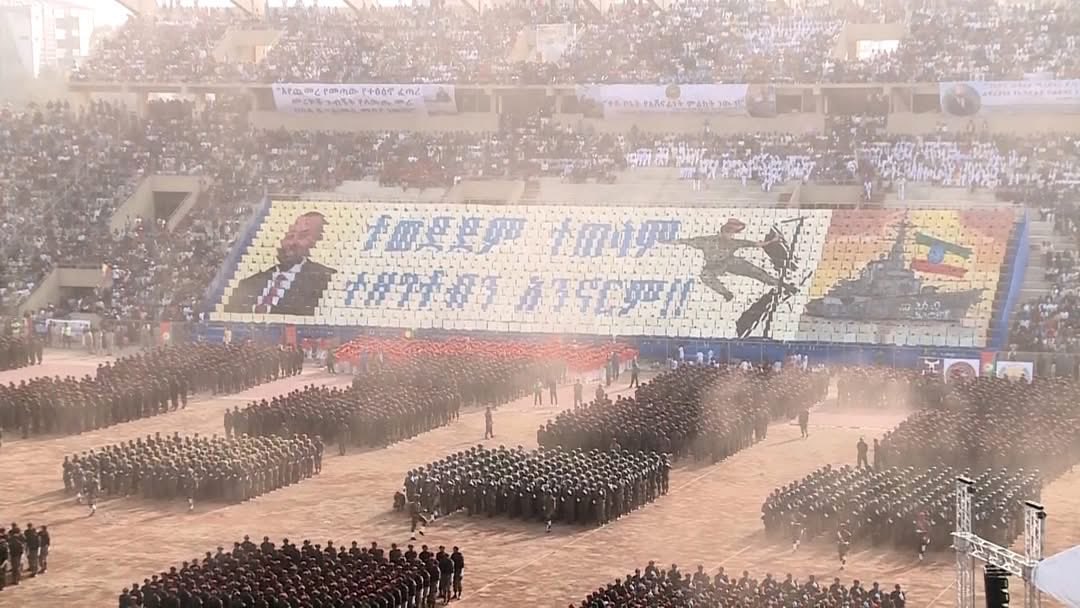
Die Botschaft war nicht sehr subtil. Bei einer Militärparade im Februar 2026 in Awassa zeigten die äthiopischen Streitkräfte ein riesiges Banner. Auf diesem war ein Soldat zu sehen, der eine Tür eintritt, und daneben die Worte: „Ob sie es mögen oder nicht, wir werden kein Binnenstaat sein.“
Die äthiopische Regierung spricht immer wieder von ihrem Recht auf einen souveränen Zugang zum Meer. Denn seit der Unabhängigkeit Eritreas im Jahr 1993 ist Äthiopien ein Binnenstaat – mit rund 135 Millionen Menschen der bevölkerungsreichste weltweit. Bei einer Rede vor Parlamentsabgeordneten sprach Ministerpräsident Abiy Ahmed Ali 2023 davon, dass sein Land nicht in einem „geografischen Gefängnis“ leben dürfe. Und fast so, als wäre der Premier ein außenstehender Beobachter, führte Abiy aus, dass es sonst zu einem Konflikt kommen könne: Das Rote Meer sei „die natürliche Grenze Äthiopiens“.
Aus historischer Perspektive ist das eine eher selektive Darstellung. Denn trotz vorherigen abessinischen Einflusses kontrollierten vom Osmanischen Reich abhängige Herrscher über Jahrhunderte die heutige eritreische Küste am Roten Meer, bevor diese erst unter ägyptisch-britischen Einfluss und anschließend unter italienische Kolonialherrschaft kam; im Jahr 1869 kaufte Italien den Hafen von Assab.
Erst in der zweiten Hälfte des 20. Jahrhunderts erlangte Äthiopien direkten Zugang zum Roten Meer und baute eine imperiale Marine auf. Nach der Unabhängigkeit Eritreas konnte Äthiopien dessen wichtigste Häfen in Massawa und Assab zu vorteilhaften Konditionen nutzen – bis zu dem verheerenden Grenzkrieg von 1998 bis 2000.
Außenhandel über Dschibuti
Wirtschaftliche Gründe sprechen für eine Diversifizierung der äthiopischen Handelswege. Derzeit muss sich Äthiopien für seinen Außenhandel primär auf
die Stabilität Dschibutis verlassen: 95 Prozent der äthiopischen Im- und Exporte laufen über das kleine Land. Sollte es dort zu Spannungen kommen – beispielsweise angesichts der Basen der USA und Chinas –, hätte das
fatale Folgen für die Versorgung des äthiopischen Marktes. Zudem
kostet die Abwicklung des Außenhandels über Dschibuti Äthiopien jedes Jahr rund 1,5 Milliarden US-Dollar an Hafen- und Liegegebühren, die in knappen
ausländischen Devisen bezahlt werden müssen. Hinzu kommen erhebliche Ineffizienzen der logistischen Infrastruktur.
Abiy spricht davon, dass Äthiopien eine „Supermacht in Afrika“ werden solle, was ohne eigenen Meereszugang nicht möglich sei. Es geht um die nationale Sicherheit und die „Existenz“ eines Landes in einer spannungsgeladenen Region. Ein Militärhafen mit Landverbindung würde es Äthiopien ermöglichen,
Rüstungslieferungen über den Seeweg zu empfangen, ohne dass Drittstaaten davon Kenntnis erlangen.
Äthiopien baut eine eigene Marine auf, um in der Lage zu sein, Macht im Roten Meer und im Golf von Aden zu demonstrieren.
Denn nicht nur die sich ausweitende ägyptische Kooperation mit Eritrea und Somalia sorgt in Addis Abeba für Unruhe, auch zahlreiche weitere Mittelmächte
wie die Türkei, die Vereinigten Arabischen Emirate, Saudi-Arabien und Israel verfolgen in dieser Region maritime Interessen.
Konflikte mit Eritrea
Wie weit Ministerpräsident Abiy für das Ziel eines souveränen Meereszugangs gehen würde, ist unklar. Er selbst schließt militärische Gewalt und einen Krieg
rhetorisch aus. Den Status quo herauszufordern, gehört aber durchaus zur Methode. Am Neujahrstag 2024 schloss Äthiopien eine Vereinbarung mit
Somaliland. Nach dieser sollte Äthiopien einen Marinehafen an dessen Küste errichten dürfen, wofür die abtrünnige Region Somalias Anteile an Ethiopian
Airlines erhalten sollte – und die Aussicht auf völkerrechtliche Anerkennung. Mogadischu organisierte jedoch einen breiten diplomatischen Protest, näherte
sich Ägypten und Eritrea an und drohte damit, die zur Bekämpfung Al-Shabaabs in Somalia stationierten äthiopischen Truppen des Landes zu verweisen. Nach türkischer Vermittlung einigten sich Abiy und der somalische
Präsident Hassan Sheikh Mohamud Ende 2024 darauf, einen verlässlichen Meereszugang für Äthiopien nur unter somalischer Souveränität zu verfolgen.
Danach schwenkte Äthiopiens Blick hinsichtlich eines Meereszugangs wieder auf Eritrea um.
Die Rhetorik verschärfte sich zusehends. Im Oktober 2025 schickte Äthiopien einen Brief an UN-Generalsekretär António Guterres, in dem Eritrea vorgeworfen wurde, mit der Volksbefreiungsfront von Tigray (TPLF)
einen Krieg gegen Addis Abeba vorzubereiten. Einen Monat später legte Äthiopiens Außenminister Gedion Timothewos in einer Rede vor ausländischen
Diplomaten ausführlich die Beschwerden gegenüber Eritrea dar. Gedion ging sogar so weit zu sagen, dass ein „Casus Belli“ bereits vorliege, aber Äthiopien
sich bewusst zurückhalte.
In Eritrea treffen solche Aussagen auf eine Regierung, die seit Jahrzehnten vor ausländischer Einflussnahme warnt. Das Vertrauen in internationale Akteure
ist sehr gering. Man fühlt sich immer wieder ungerecht behandelt – zum Beispiel als Äthiopien die Entscheidung der unabhängigen Grenzkommission
nach dem Krieg nicht umsetzte, ohne dafür sanktioniert zu werden. Hingegen erließ der UN-Sicherheitsrat 2009 ein Waffenembargo und Sanktionen gegen
Eritrea wegen dessen Unterstützung für Al-Shabaab; diese wurden erst 2018 aufgehoben.
Nach Abiys Amtsantritt 2018 hatten sich die beiden Länder angenähert, einschließlich persönlicher Treffen von Abiy und dem eritreischen Präsidenten
Isaias Afewerki. Die äthiopischeritreische Zusammenarbeit, das wurde bald deutlich, diente vor allem dazu, gemeinsam gegen die TPLF zu kämpfen. Isaias
machte die TPLF, die zu der Zeit die äthiopische Regierung dominiert hatte, für den Krieg Ende der 1990er Jahre und die darauffolgende internationale
Isolierung verantwortlich. Eritreische Truppen nahmen in großer
Zahl an dem Krieg in Tigray teil und verübten Berichten zufolge massive Kriegsverbrechen an der Zivilbevölkerung.
An dem Pretoria-Abkommen, das den Krieg im Norden Äthiopiens
im November 2022 beendete, war Eritrea nicht beteiligt. Wie
Abiy später selbst sagte, wollte Eritrea die TPLF gänzlich vernichten,
statt ihr zu einem neuen politischen Leben zu verhelfen. So kühlte sich das Verhältnis zwischen Asmara und Addis Abeba wieder ab. Eritrea unterstützte
die Fano, amharisch-nationalistische Rebellen, die sich 2023 gegen den äthiopischen Staat wandten.
Doch die Umsetzung des Pretoria-Abkommens stockte, und in der TPLF setzten sich Hardliner durch, welche die Addis Abeba gegenüber treue Übergangsregierung von Tigray entmachteten. Sowohl Asmara als auch die
TPLF stellten ihre gegenseitige Feindschaft zurück und gingen eine taktische Zusammenarbeit ein im Glauben, so die Regierung in Addis Abeba schwächen zu können.
Drohungen, Disruption, Krieg?
Die jahrelange öffentliche Inszenierung des Themas zeigt, dass
es Äthiopien nicht um kurzfristige Interessen geht. Internationale
Legitimität ist ein wichtiger Faktor. Die USA und auch andere Regierungen haben Addis Abeba in klaren Worten gesagt, dass ein offener Einmarsch in Eritrea inakzeptabel wäre. Er würde wahrscheinlich auch das milliardenschwere Programm des Internationalen Währungsfonds
mit Äthiopien gefährden. Gleichzeitig setzen sowohl Washington
als auch die EU derzeit auf Annäherung an Äthiopien.
Die äthiopische Regierung ist sich bewusst, dass ein direkter, konventioneller Krieg mit Eritrea ein hohes Risiko für die eigene Sicherheit darstellen würde. Äthiopien verfügt zwar über moderne Drohnen und ein großes Heer,
aber Eritrea ist seit Jahrzehnten eine stark militarisierte Gesellschaft.
Selbst eritreische Oppositionelle würden eher auf Seiten des autoritären Regimes von Isaias kämpfen, als eine äthiopische
Besatzung zu akzeptieren. Eritrea könnte seinerseits Druck über
die Zusammenarbeit mit einer ganzen Reihe von äthiopischen
Oppositionsbewegungen ausüben, auch wenn diese inhaltlich
nicht viel verbindet. Eine weitere Regionalisierung von Konflikten
im Sudan und in Somalia wäre wahrscheinlich.
Vermittlungsbemühungen der USA, Saudi-Arabiens und europäischer
Akteure waren bislang nicht erfolgreich. Ein Kompromiss ist denkbar, der regionale Integration und grenzübergreifende Transportinfrastruktur
mit vertrauensbildenden Sicherheitsmaßnahmen und schließlich einer äthiopischen Marinebasis in Somaliland oder Dschibuti verbindet, aber ohne
extraterritorialen Korridor zum äthiopischen Kernland. Für eine solche Lösung braucht es jedoch das Vertrauen aller beteiligten Seiten. Am Horn von Afrika ist
davon derzeit wenig zu spüren.
Horn of Africa: Time for preventive diplomacy
In both Ethiopia and South Sudan, conflicts are escalating again. To prevent further regionalisation of the conflict landscape, Europe should support high-level diplomacy, says Gerrit Kurtz.
SWP Point of View, 21 March 2025. Also available in German.
In the Horn of Africa, two peace processes are in acute danger: Local power struggles in South Sudan and Ethiopia’s Tigray region are at risk of escalating into regional crises. In South Sudan – as in 2013 at the beginning of the last civil war – a power struggle is raging over the possible successor to 73-year-old President Salva Kiir. He is already positioning his son-in-law as a potential replacement. At the same time, clashes between the White Army – a Nuer militia – and the South Sudanese army in the Upper Nile region are causing a stir after a United Nations helicopter was shot down and a high-ranking army general was killed.
During the civil war from 2013 to 2018, the White Army fought on the side of the main rebel group, the Sudan People’s Liberation Army/Movement-in Opposition (SPLA/M-IO) under today’s First Vice President Riek Machar. Tensions between Kiir and Machar are intensifying once again – a dangerous déjà vu for the country, which has barely had time to recover after decades of conflict.
Ethiopia: Split within the TPLF and growing tensions with Eritrea
In Ethiopia, a local power struggle in the Tigray region threatens to escalate into a regional crisis between the federal government in Addis Ababa and Eritrea. The Tigray People’s Liberation Front (TPLF) – once Ethiopia’s ruling party and the Ethiopian government’s opponent in the war between 2020 and 2022 – is divided: A faction led by chairman Debretsion Gebremichael is opposed by a reformist faction under the president of the Tigray Interim Regional Administration, Getachew Reda.
The Debretsion faction has large parts of the Tigrayan military on its side and has been taking over local administrative structures for months, sometimes violently. In the meantime, it has also brought media and parts of the administration in the provincial capital, Mekelle, under its control. The TPLF’s Debretsion faction is said to have good relations with Eritrea, whereas Getachew is counting on Ethiopian Prime Minister Abiy Ahmed. Bilateral relations between Ethiopia and Eritrea have cooled markedly since the Pretoria Agreement, which ended the war between the TPLF and the government in 2022. Both countries are accused of supporting opponents of the other’s regime.
Due to the increasing tensions, there is a risk that there will be a regionalisation of the conflict landscape. Uganda has already sent troops to support the South Sudanese government, as it did in 2013. Similar to previous clashes, Sudanese actors are also intervening. Over the weekend, militias of the Rapid Support Forces in South Sudan were already fighting against units of the SPLA/M-IO, which were apparently on their way to receive weapons from the Sudanese Armed Forces.
Failure of the peace agreements – fragmented international engagement
The current escalations are no coincidence. The respective agreements to end the civil wars in South Sudan and Ethiopia have only been implemented to a limited degree. Unilateral deviations by both governments from their obligations have de facto prevailed. Kiir rapidly replaced cabinet members and had high-ranking generals of the SPLA/M-IO arrested. In Ethiopia, important measures of the Pretoria Agreement, such as the demobilisation of militias and the withdrawal of Eritrean and Amharic troops from Tigray, have largely failed to materialise.
International engagement with the region is increasingly fragmented – as are the states of the region themselves. In Ethiopia, for example, there is a lack of credible guarantors for the peace process. At the recent extraordinary summit of the Intergovernmental Authority on Development (IGAD) on South Sudan, only two countries took part at the level of their president. Whereas the United States used to be the most important international partner for peace in the region, countries such as the United Arab Emirates, Saudi Arabia, and Turkey are now influential, but they tend to support certain sides rather than mediate in internal conflicts.
In view of the deteriorating situation, it is now time for high-level preventive diplomacy. A coordinated international approach could contain the escalation. An informal division of tasks would be conceivable: Influential countries such as Turkey and Saudi Arabia could defuse tensions at the intergovernmental level, while European actors could support IGAD and the African Union in local mediation processes.
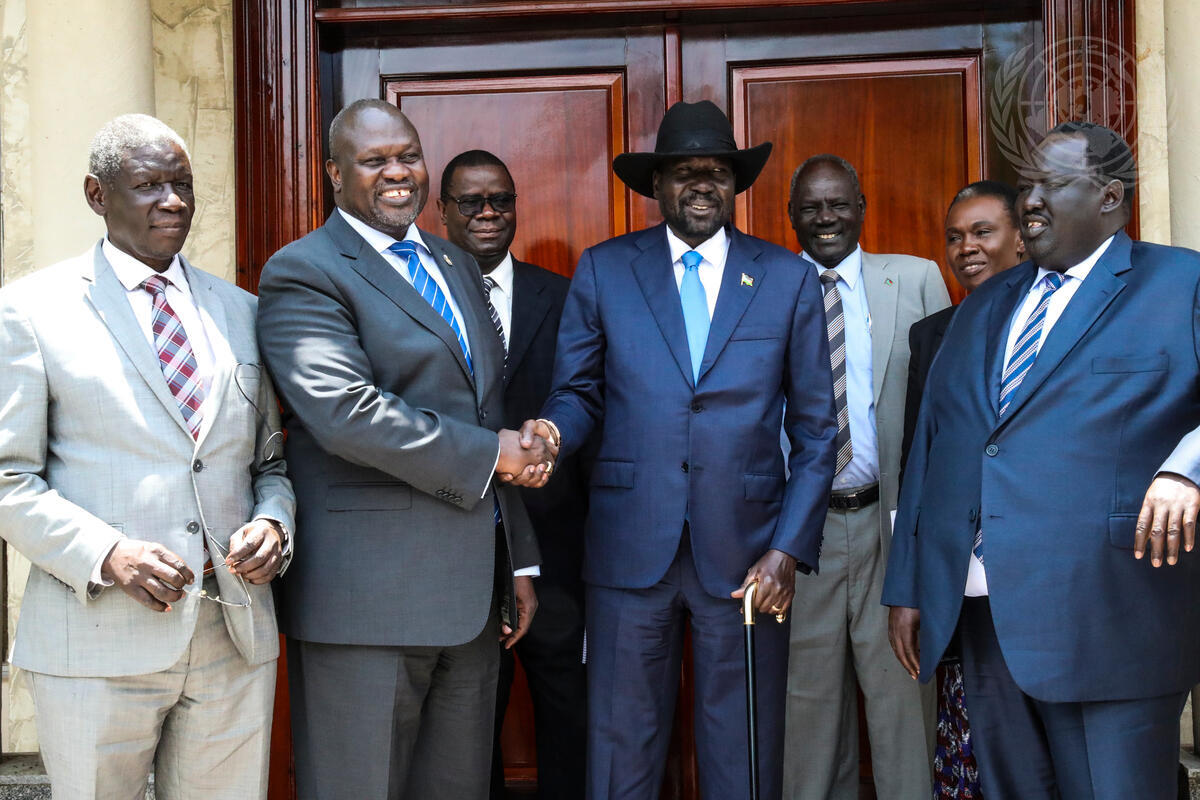
Picture: In better times in 2019, President Salva Kiir met the head of the SPLA/M-IO, Riek Machar, in Juba, to prepare the government of national unity. Source: UN Photo/Isaac Billy
Power Struggle in Tigray
As Ethiopian PM Abiy Ahmed continues to renege on the Pretoria Agreement that ended hostilities two years ago, infighting within the TPLF further threatens the tenuous stability in war-shattered Tigray.

Published in African Arguments, 29 October 2024.
Long-simmering tensions within the Tigray People‘s Liberation Front (TPLF) broke out into the open in August 2024. The party leadership around President Debretsion Gebremichael now stands apart from key TPLF officials in the Tigray Interim Regional Administration (TIRA) around its President Getachew Reda. Each side considers the other an illegal entity. The division has stirred up fears of renewed violence in northern Ethiopia. The split occurs in a context in which the economic and social situation in the northern highlands remains dire, the legacy of the devastating war four years ago that was only stopped by the Cessation of Hostilities Agreement signed in Pretoria, South Africa, in November 2022.
I was recently in Addis Ababa and Mekelle and spoke to political stakeholders and civil society representatives from both TPLF factions, TIRA representatives and opposition parties. They were eager to talk about the origins of the differences, the risks involved and a potential way out.
Dissonance in the aftermath of the war
Interlocutors went back to different points in time to explain the conflict. Internal differences are not new to the TPLF in its near-fifty-year long evolution from guerrilla movement to political party. A notable division took place in 2001, after the war with Eritrea and in the light of an internal evaluation of the party’s first ten years in power. In that case, Meles Zenawi, confirmed his dominance of the party until his premature death in 2012.
The party has long championed the Leninist concept of democratic centralism, which ensured a high degree of subservience of the lower ranks to the leadership. The principle eroded significantly under Meles‘ successors who lacked his charisma and vision.
Similarly, the most recent war in Tigray also stirred internal debates. Political stakeholders with direct knowledge of the Pretoria negotiations with the federal government pointed to simmering disagreements at the time. According to them, the provision that the existing regional government in Tigray be dismantled and an interim administration formed appeared relatively late during the negotiations. This created some opposition in Mekelle. It was visible in the initial difficulties of the TPLF in agreeing on the head of the new interim administration. Prime Minister Abiy rejected Debretsion, who laid claim to the position given his leadership of the TPLF. Debretsion then met Abiy and brought Abiy‘s informal ‘recommendation’, according to a TPLF cadre, that the former should prepare a short list of candidates. The Central Committee of the TPLF rejected this list as being too close to the party president though. It finally elected then TPLF deputy chairperson, Getachew Reda, who had led the TPLF delegation in Pretoria, via a secret ballot. Getachew had been an outsider in the TPLF Executive Bureau before the war, according to several accounts. A member of the TPLF negotiation team protested that they had not been properly consulted on the formation of the TIRA and that it was unclear how long the TIRA would remain in place and when elections would be held.
Every interlocutor agrees that the division within the party is not ideological. Rather, it is an inter-generational power struggle: “Power-mongering is the main problem in the TPLF as an organization,” observed a cadre member. The party leadership and people connected to them are perceived as seeking to evade accountability – for illicit gains, for corruption, and for political mistakes and alleged crimes committed before and during the war. The members of this “old guard” still control substantial business holdings amassed during the TPLF’s time in government, in particular as part of the Endowment Fund for the Rehabilitation of Tigray (EFFORT). Most of the conglomerate’s companies were released from state control in July 2023. In addition, some military commanders apparently took over gold mining in Tigray during the war and remain in control of illegal gold mining and smuggling, amounting to two metric tons of gold annually.
The TPLF started a process of internal evaluation about three sets of issues: the conditions that led to the war; how the war has been conducted; and about the Pretoria Agreement and its implementation. The party leadership wanted to avoid the evaluation of the conduct of the war, claiming that this would touch on sensitive military matters and military leaders not formally part of the TPLF. One of the alleged abuses came to light last year: TPLF and federal government officials diverted substantial amounts of food aid for years, which is why USAID and WFP paused their assistance for several months in 2023.
Escalation of division
In the past two years, there have been several issues that further inflamed those tensions. Some interlocutors see the hand of the Federal Government in this, manipulating Tigrayan politics to foster divergence in the TPLF and thus making it easier to control. Even those highly critical of their internal opponents see Prime Minister Abiy as the main culprit. They point to the lack of implementation of the Pretoria Agreement. Indeed, the Federal Government has failed to ensure that Amhara militias and Eritrean troops leave Tigray, thus allowing the full return of the nearly one million displaced people, in particular to Western Tigray, most of whom remain in squalid camps. Still, they also blame Getachew as Regional President of being too accommodative of Abiy.
The interim cabinet decided to create an inclusive advisory council for the interim administration. Though without legal mandate in the Pretoria Agreement, the aim was to put the necessary post-war reforms on a more participatory basis with the involvement of the small but vocal opposition parties in Tigray. The TPLF leadership opposed this proposal, however, and the council has not been established despite continued calls from the opposition.
Furthermore, there were divisions about the re-registration of the TPLF as a political party and about the replacement of zonal and woreda (district) officials as planned by the TIRA. It all led to the organization of the 14th Party Congress by the TPLF in August 2024, even though there was no legal basis for it. Predictably, it was opposed by the National Election Board of Ethiopia (NEBE). The leadership felt that they could wait no longer as the re-registration of the TPLF kept being delayed despite Abiy’s promises to the contrary.
14 high-level members wrote a letter to the TPLF President denouncing the Congress and stating their intention not to attend, among them Getachew Reda. The Congress consequently excluded them from the Executive Bureau and the Central Committee, which were elected there.
Public dispute and the role of the security forces
Both factions are trying to assert themselves. Getachew has been holding large public meetings in different parts of the Region, trying to mobilise public support. The TPLF formally expelled Getachew and 15 other members of the party on 15 September, stating that they could no longer hold public office in the name of the party. As a reaction, Getachew accused them of plotting a “coup”. Both sides use leaks and allegations to accuse each other of betrayal and siding with the enemy – Eritrea, the Fano militia of Amhara, or the federal government.
The Tigray Security Forces (TSF) have become a key factor in this power game. Fears of renewed violence and even civil war could only materialise if the TSF became involved, which still numbers around 200,000 fighters under arms, even if it has handed over its heavy weapons as part of the Pretoria Agreement. So far, the TSF have remained neutral, despite their leaders being part of the TIRA. Interlocutors credited Lieutenant General Tadesse Werede, deputy president of Tigray’s interim administration and head of the cabinet secretariat for peace and security, with cooling down the temperatures. He spoke out against attempts to change the TIRA or appoint local officials and reinforced restrictions on public gatherings. Since then, Getachew Reda claimed that the TIRA cabinet has command over the TSF, which the TPLF’s Debretsion immediately disputed.
Mediation efforts
What does a way out look like? US officials have recently tried to mediate, first with Ambassador Massinga and just two weeks later, Mike Hammer, Special Envoy for the Horn of Africa, visiting Mekelle and speaking to the leaders involved. This was seen as helpful, though no concrete results emerged. The TSF are trying to mediate between the factions, together with representatives of civil society, business and religious leaders. According to a mediator, they are exploring a compromise that may involve creating a short-term technocratic or caretaker government and regional elections within six to eight months. So far, an agreement remains elusive. Both sides, at least, have pledged to pursue dialogue.
In any case, the status quo is untenable. The interim administration cannot function without the backing of the TPLF and their vast networks throughout the Region. The TPLF cannot just take over the administration either, however, as that would risk losing the legality and legitimacy of the TIRA in the eyes of the federal government. There is also the question of who will represent the TPLF as signatory to the Pretoria Agreement in future meetings with the federal government and the African Union.
At the same time, it is unclear how much support the TPLF still commands among the population at large in Tigray. Last year, the TIRA clamped down violently on an opposition rally in Mekelle. As a legacy of the war, many people are traumatised and focus on their own survival, especially the almost 900,000 internally displaced persons (out of a pre-war population of around six million). Tens of thousands of young people are leaving Tigray each year in search of better livelihoods, according to the TIRA. Others become criminals. There are many survivors of gender-based violence, including those that have born the children of their tormentors. The prevalence of HIV/AIDS has increased rapidly in the region. Nonetheless, one expert noted: “the TPLF is the best organisation we have” in Tigray. It remains by far the largest party in Tigray, and perhaps the only one with the organisational capacity at the moment that could address those urgent humanitarian and development issues. That requires a unity of purpose though and could benefit from a more inclusive approach.
Full and speedy implementation of the Pretoria Agreement remains essential, including the return of displaced persons, the withdrawal of the non-federal troops from Tigray, elections for the regional and council and Tigray’s representatives in the federal parliament, and a comprehensive political dialogue. As long as political leaders in Tigray keep bickering among themselves, however, they will not unite to achieve these tasks.

